
100 Golden Bead UnitsIndividual Beads Glass
The first photo is the maker's own. The other shots are illustrative.
Inv. no. NIE-0077G0
- Maker
- Nienhuis Montessori, since 1929
- Approval
- AMI
- Beads
- Glass with golden finish
- Storage Container
- Clear acrylic plastic
- EAN
- 8719924004453
Final price incl. VAT. Delivery €5.90, €119.10 to go for free delivery.
Advice, warranty and returns are handled by us.
Why it costs €29.90
Behind the price of the original are things you can check yourself.
AMI approval
The material is approved by the Association Montessori Internationale (AMI). Nienhuis has made Montessori materials since 1929.
A verifiable original
The EAN 8719924004453 is on the box. It is the maker's number, not ours.
100 Golden Bead Units in a child's hands
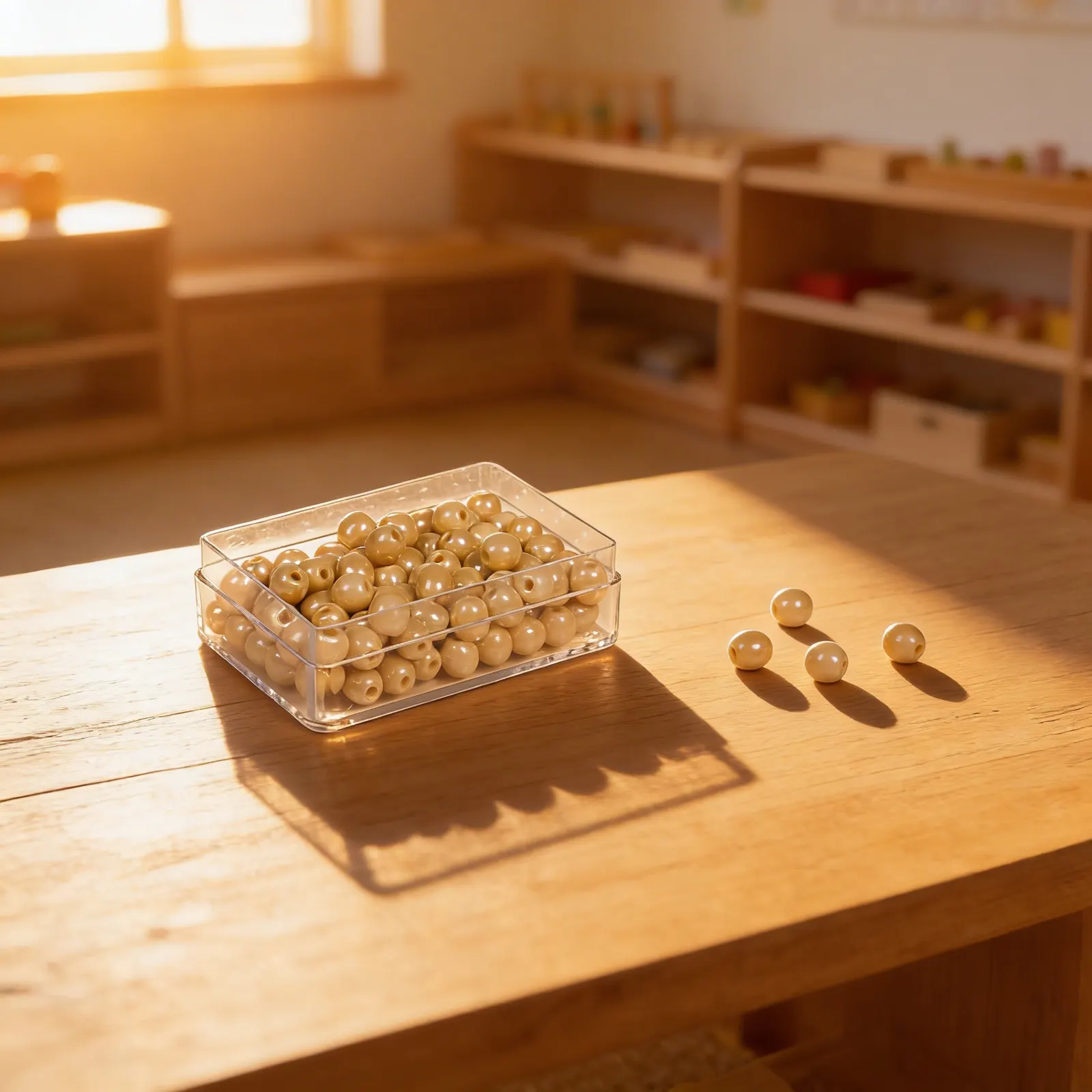
A plastic box of a hundred golden unit beads in glass, the units of the golden bead material sold on their own. Units are what a decimal set loses first: they are single beads, they roll off a table, and a set that started complete quietly stops being able to show nine of anything. Buying a hundred at a time is cheaper than buying the set again, and glass units have the weight that makes one bead feel like one thing. Glass beads in a plastic box, for ages 3 to 12.
Concrete Number Sense
Physical manipulation of individual units builds deep understanding of quantity and the base-ten system through hands-on exploration.
Fine Motor Precision
Handling small glass beads develops pincer grasp and controlled movement essential for later writing skills.
Mathematical Foundation
Forms the basis for understanding place value, addition, and the decimal system through concrete materials.
How to present it
Place a small tray with 20-30 golden bead units on the work mat. Have number cards 1-9 available nearby.
- 1Invite the child to count out specific quantities of beads, starting with small numbers like 3 or 5
- 2Match the counted beads to corresponding number cards
- 3Introduce simple addition by combining two small groups of beads
- 4Practice exchanging ten individual units for one golden ten-bar
3 tips for parents
- Practice counting objects at home to reinforce the bead work, count toys, snacks, or steps
- When your child mentions bead work, ask 'How many units did you count today?'
- Support mathematical language by using terms like 'units' and 'quantity' in daily conversation

If you are not sure it suits your child, we answer in person.
Norbert Kovalčín, founder of Faborino · write to him
There is no review here yet. We will ask you for one after you buy. Write the first review
What's in the Box
- Glass Golden Beads: Approx. 100 individual units
- Clear Storage Box: Acrylic container with secure lid
Size and material
| Packaging | 6 × 4 × 2 cm |
| Beads | Glass with golden finish |
| Storage Container | Clear acrylic plastic |
| Recommended Age | 3-6 years |
Care
Wipe beads with soft cloth; handle with care to prevent chipping
Frequently Asked Questions
What is the diameter of each glass golden bead unit?
Each glass golden bead unit is typically 8mm in diameter, matching the standard Montessori specification for golden bead materials to ensure consistency across all decimal system work.
Why are glass beads preferred over plastic for Montessori mathematics?
Glass beads provide superior tactile feedback with their weight and smooth texture, helping children develop a concrete sense of quantity. The material's quality also reflects the respect we show for the child's work and maintains the aesthetic beauty central to Montessori environments.
How do these individual units integrate with other golden bead materials?
These units form the foundation of the decimal system, combining to create tens (10-bars), hundreds (100-squares), and thousands (1000-cubes). Children use them for counting, place value work, and all four mathematical operations throughout their Casa experience.
What activities can children do with 100 golden bead units?
Children use these beads for initial counting exercises, building teen and ten numbers, exchanging activities, introduction to addition and subtraction, and eventually for dynamic operations including multiplication and division with larger quantities.
Are these beads safe for 3-year-old children?
Yes, these glass beads are specifically designed for Montessori use with proper supervision. However, they should always be presented as part of a lesson and used on work mats. Children should be shown proper handling and reminded these are precious materials for mathematical work, not play.
Product safety
Manufacturer: Nienhuis Montessori, Anders Celsiusstraat 15, 7442 PB Nijverdal, Netherlands
100 Golden Bead Units