
101 Things Everyone Should Know About Science
The first photo is the maker's own. The other shots are illustrative.
Inv. no. NIE-536900
- Maker
- Nienhuis Montessori, since 1929
- Cover
- Glossy paperback
- Pages
- Paper
- EAN
- 8719924027926
Final price incl. VAT. Delivery €5.90, €134.10 to go for free delivery.
Advice, warranty and returns are handled by us.
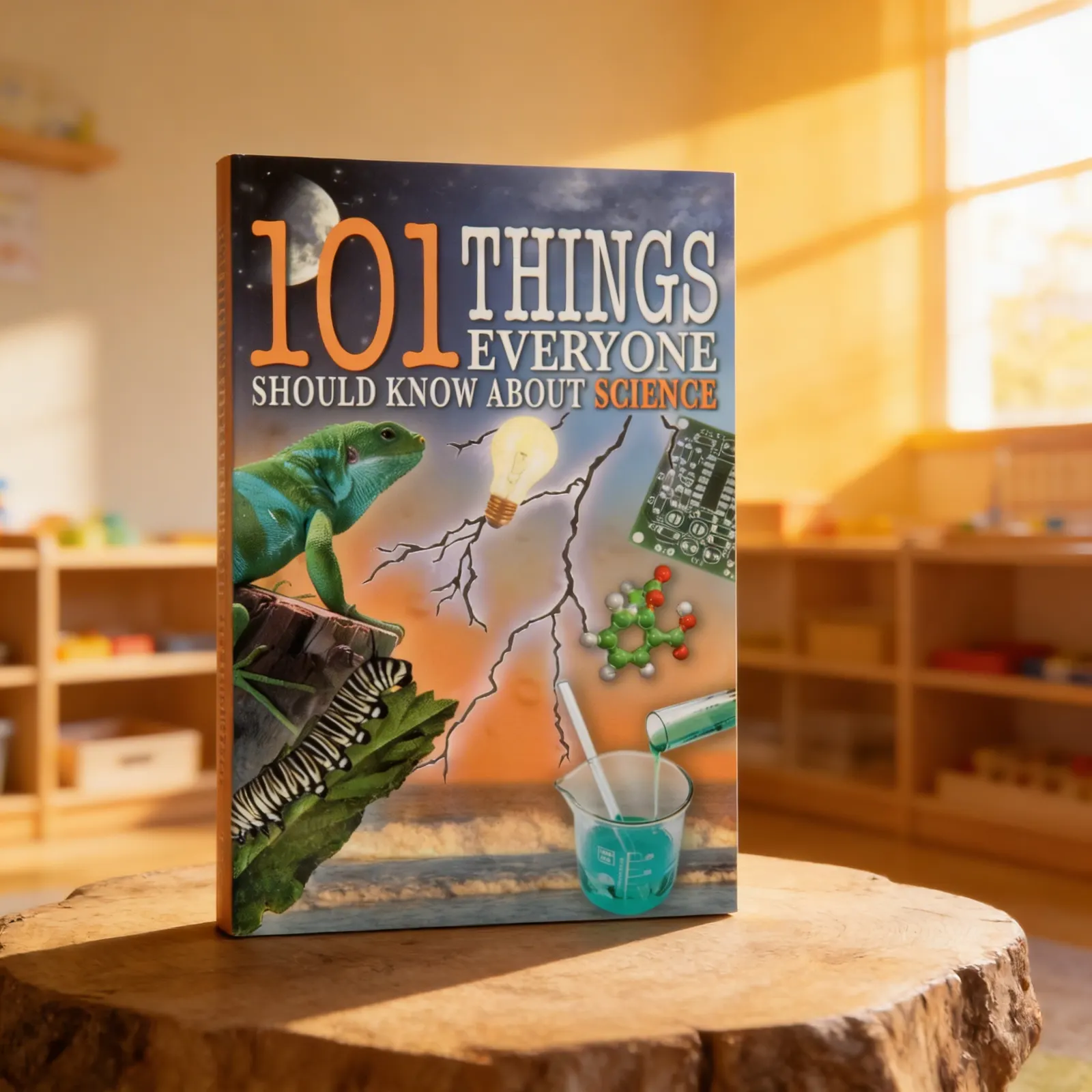
101 Things Everyone Should Know About Science in a child's hands
101 Things Everyone Should Know About Science is a book by Dia L. Michels and Nathan Levy. It is written in a question-and-answer format, with each question followed by a short explanation and facts about science. According to the manufacturer it is meant for all ages, with 3 years given as the minimum. The book has 160 pages and a soft cover, and it is the 2006 edition. The text is in English, and the book is made of paper.
Scientific Literacy
Introduces fundamental scientific concepts and vocabulary appropriate for early elementary learners.
Visual Learning
Colorful illustrations help children connect abstract concepts to concrete visual representations.
Cosmic Education
Supports Montessori's integrated approach to understanding the interconnectedness of sciences.
Independent Discovery
Encourages self-directed exploration of scientific topics at the child's own pace.
How to present it
Place the book in the science reference area of the classroom library, easily accessible at child height. Create a simple bookmark system or sticky notes for children to mark pages of interest.
- 1Introduce the book during a group lesson, demonstrating how to use the table of contents and any index features
- 2Show children how to cross-reference topics by finding related concepts throughout the book
- 3Demonstrate taking simple notes or making sketches from the book's information
- 4Establish a routine where children can share interesting discoveries from the book during circle time
3 tips for parents
- Browse the book together at home, letting your child teach you about concepts they've learned at school
- Use the book to answer 'why' questions that arise during daily activities or observations
- Support home experiments or investigations inspired by topics your child discovers in the book

If you are not sure it suits your child, we answer in person.
Norbert Kovalčín, founder of Faborino · write to him
There is no review here yet. We will ask you for one after you buy. Write the first review
What's in the Box
- Science Reference Book: 101 science facts with illustrations
Size and material
| Packaging | 22 × 14 × 1 cm |
| Cover | Glossy paperback |
| Pages | Paper |
| Recommended Age | 3-6 years |
Care
Wipe cover with dry cloth
Frequently Asked Questions
Is this book appropriate for 3-year-olds given the complex science topics?
Yes, the book presents scientific concepts through simple language and colorful illustrations designed specifically for ages 3-6. Each topic is explained at an age-appropriate level that introduces fundamental ideas without overwhelming young learners.
How does this book support the Montessori approach to learning?
This book aligns with Montessori cosmic education by presenting interconnected scientific concepts that help children understand their place in the universe. It encourages self-directed exploration and supports the Montessori principle of learning through discovery and wonder.
Can this book be used for group lessons or is it better for individual reading?
The book works excellently for both settings. Teachers can use it for circle time discussions and demonstrations, while the accessible format also allows children to explore topics independently during work periods, supporting different learning styles and preferences.
What specific science topics are covered in the 101 concepts?
The book covers a comprehensive range including living things, human body, plants, animals, weather, space, simple machines, materials, energy, and basic chemistry concepts. Each topic is presented with real-world connections that children can relate to.
How are the illustrations designed to support early learners?
The vibrant illustrations use clear, realistic images that help children connect abstract concepts to concrete examples. Visual elements are carefully chosen to be engaging without being distracting, supporting comprehension and maintaining focus on the scientific content.
Product safety
Manufacturer: Nienhuis Montessori, Anders Celsiusstraat 15, 7442 PB Nijverdal, Netherlands
101 Things Everyone Should Know About Science