
12 Identical Blue Triangles Activity Set
The first photo is the maker's own. The other shots are illustrative.
Inv. no. NIE-061101
- Maker
- Nienhuis Montessori, since 1929
- Approval
- AMI
- Storage Box
- Solid wood
- Activity Cards
- Durable cardstock
- EAN
- 8719924013301
Final price incl. VAT. Delivery €5.90, €81.10 to go for free delivery.
Advice, warranty and returns are handled by us.
Why it costs €67.90
Behind the price of the original are things you can check yourself.
AMI approval
The material is approved by the Association Montessori Internationale (AMI). Nienhuis has made Montessori materials since 1929.
A verifiable original
The EAN 8719924013301 is on the box. It is the maker's number, not ours.
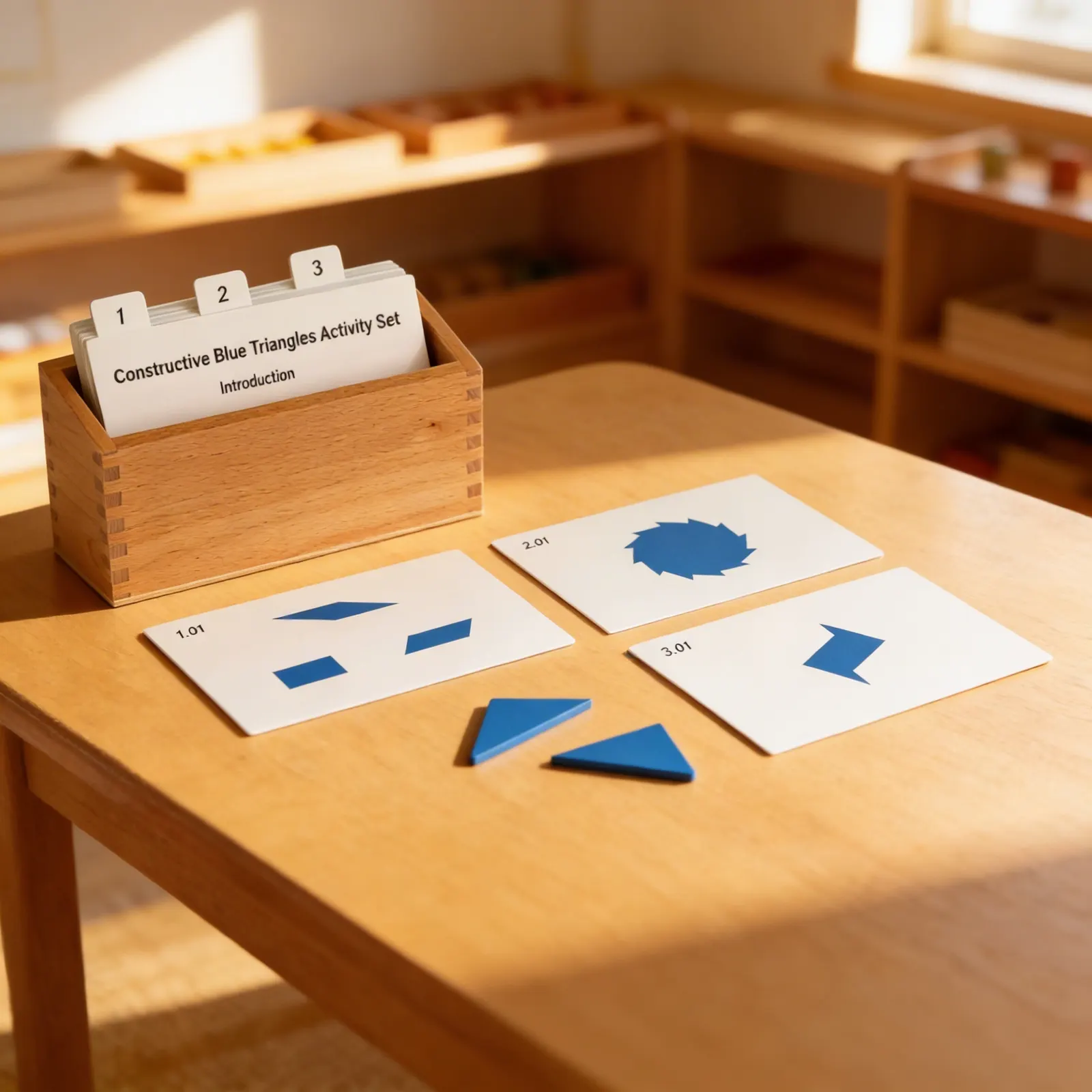
12 Identical Blue Triangles Activity Set in a child's hands
Exercise cards with divider tabs in a wooden box, extending the twelve identical blue triangles. Twelve identical pieces sound like a small material, and a child left alone with them will find four or five arrangements and consider the question closed. The cards are what shows there are far more, and being shown a shape you did not find yourself is the thing that makes a child look properly at the next one. Twelve identical blue triangles sold separately. Wood and cardstock, for ages 3 to 6.
Spatial Intelligence
Manipulating identical triangles to create various configurations develops spatial visualization and geometric intuition.
Pattern Recognition
Progressive activities guide children in discovering symmetry, tessellation, and geometric relationships through hands-on exploration.
Mathematical Reasoning
Working with congruent shapes introduces concepts of equality, transformation, and spatial relationships fundamental to geometry.
Concentration Development
The systematic nature of the activities promotes sustained focus and methodical thinking patterns.
How to present it
Place the wooden box on a work mat. Remove numbered divider cards and arrange them sequentially. Set out triangles in a tray beside the work area.
- 1Begin with two triangles, demonstrating how they fit together to form a parallelogram
- 2Introduce the first divider card pattern, placing triangles to match the design
- 3Progress through numbered cards, each showing increasingly complex arrangements
- 4Encourage free exploration after completing card sequences
3 tips for parents
- Cut paper triangles at home to extend pattern work beyond the classroom
- Notice triangular shapes in architecture and nature during walks
- Support pattern work by providing time and space without rushing completion

If you are not sure it suits your child, we answer in person.
Norbert Kovalčín, founder of Faborino · write to him
There is no review here yet. We will ask you for one after you buy. Write the first review
What's in the Box
- Wooden Storage Box: With solid construction
- 12 Blue Triangles: Identical geometric shapes
- Numbered Divider Cards: Cards 1, 2, and 3 for activity progression
- Introduction Card: Constructive Blue Triangles Activity Set label
Size and material
| Packaging | 20 × 14 × 8 cm |
| Storage Box | Solid wood |
| Activity Cards | Durable cardstock |
| Recommended Age | 3-6 years |
Care
Wipe wooden box with dry cloth; handle cards with clean, dry hands
Frequently Asked Questions
What educational skills do the 12 Identical Blue Triangles develop?
This material develops spatial reasoning, pattern recognition, geometric understanding, visual discrimination, and early mathematical thinking. Children learn about congruent shapes, symmetry, and how triangles can be combined to form other geometric figures like squares, hexagons, and complex tessellations.
How are the triangles organized and presented to the child?
The 12 blue triangles are stored in a handcrafted wooden box with numbered divider cards that guide the child through sequential activities. Each card presents progressively complex pattern formations, allowing children to work independently and systematically through geometric explorations at their own pace.
What age group is this material most appropriate for?
The 12 Identical Blue Triangles are designed for children ages 3-6 years. Younger children begin with simple pattern matching and shape exploration, while older children can create complex geometric designs and discover mathematical relationships between shapes.
What are the dimensions and quality specifications of the triangles?
Each triangle is precisely cut from high-quality, durable material in a distinctive blue color. All 12 triangles are identical (congruent) in size and shape, typically equilateral triangles measuring approximately 10cm per side. The wooden storage box is handcrafted for durability and features smooth, child-safe finishes.
How does this material prepare children for advanced mathematical concepts?
By manipulating identical triangles, children develop foundational understanding of congruence, symmetry, angles, and spatial relationships. This hands-on experience prepares them for later work with fractions, area calculations, and geometric proofs, making abstract mathematical concepts concrete and accessible through sensorial exploration.
Product safety
Manufacturer: Nienhuis Montessori, Anders Celsiusstraat 15, 7442 PB Nijverdal, Netherlands
12 Identical Blue Triangles Activity Set