
2 Bells MountedF
The first photo is the maker's own. The other shots are illustrative.
Inv. no. NIE-0063A006
- Maker
- Nienhuis Montessori, since 1929
- Approval
- AMI
- Bell Dome
- Polished metal
- Handle & Base
- Turned wood
- EAN
- 8719924004040
Final price incl. VAT. Free delivery.
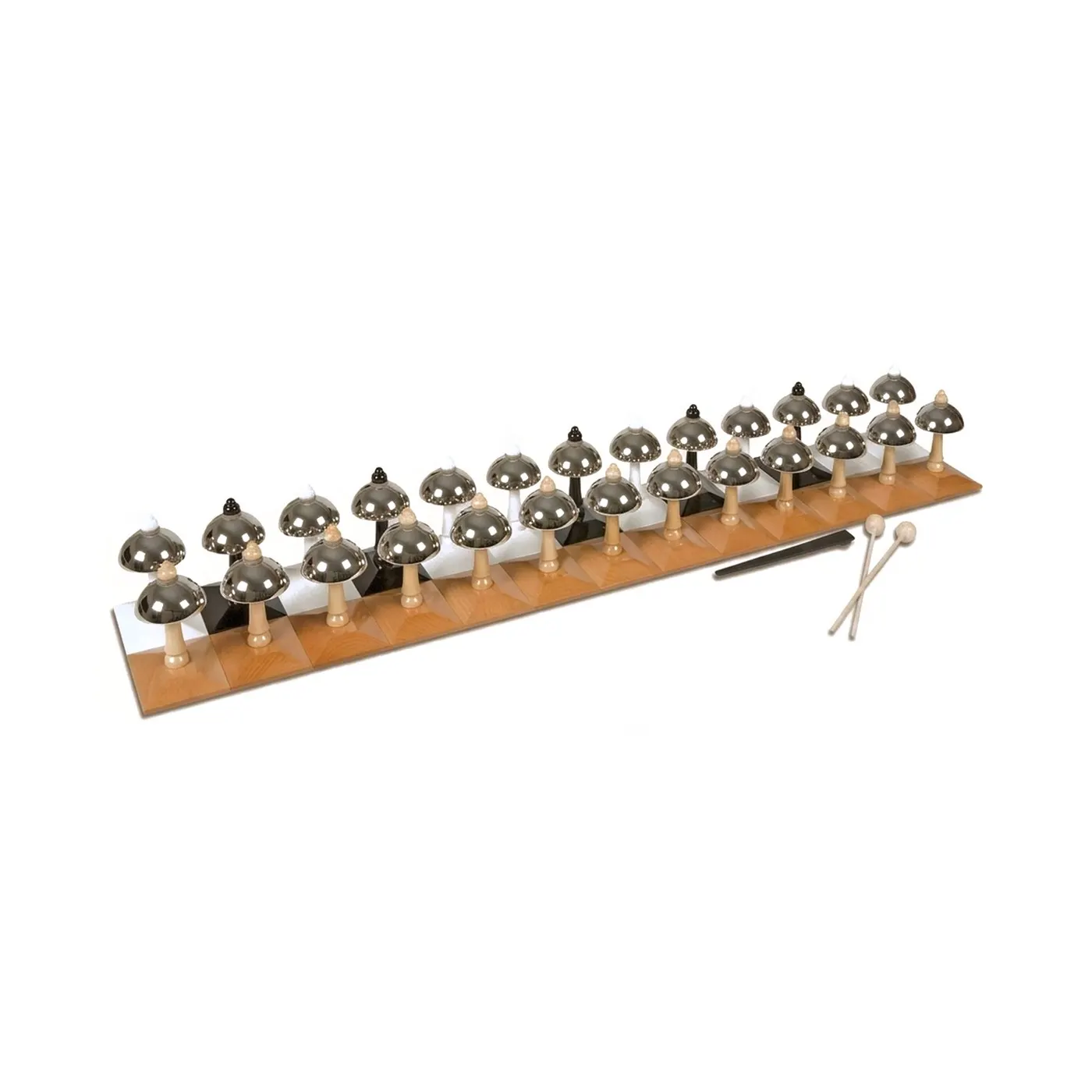 Montessori Bells Complete Set €1,421.90
Advice, warranty and returns are handled by us.
Why it costs €151.90
Behind the price of the original are things you can check yourself.
AMI approval
The material is approved by the Association Montessori Internationale (AMI). Nienhuis has made Montessori materials since 1929.
A verifiable original
The EAN 8719924004040 is on the box. It is the maker's number, not ours.
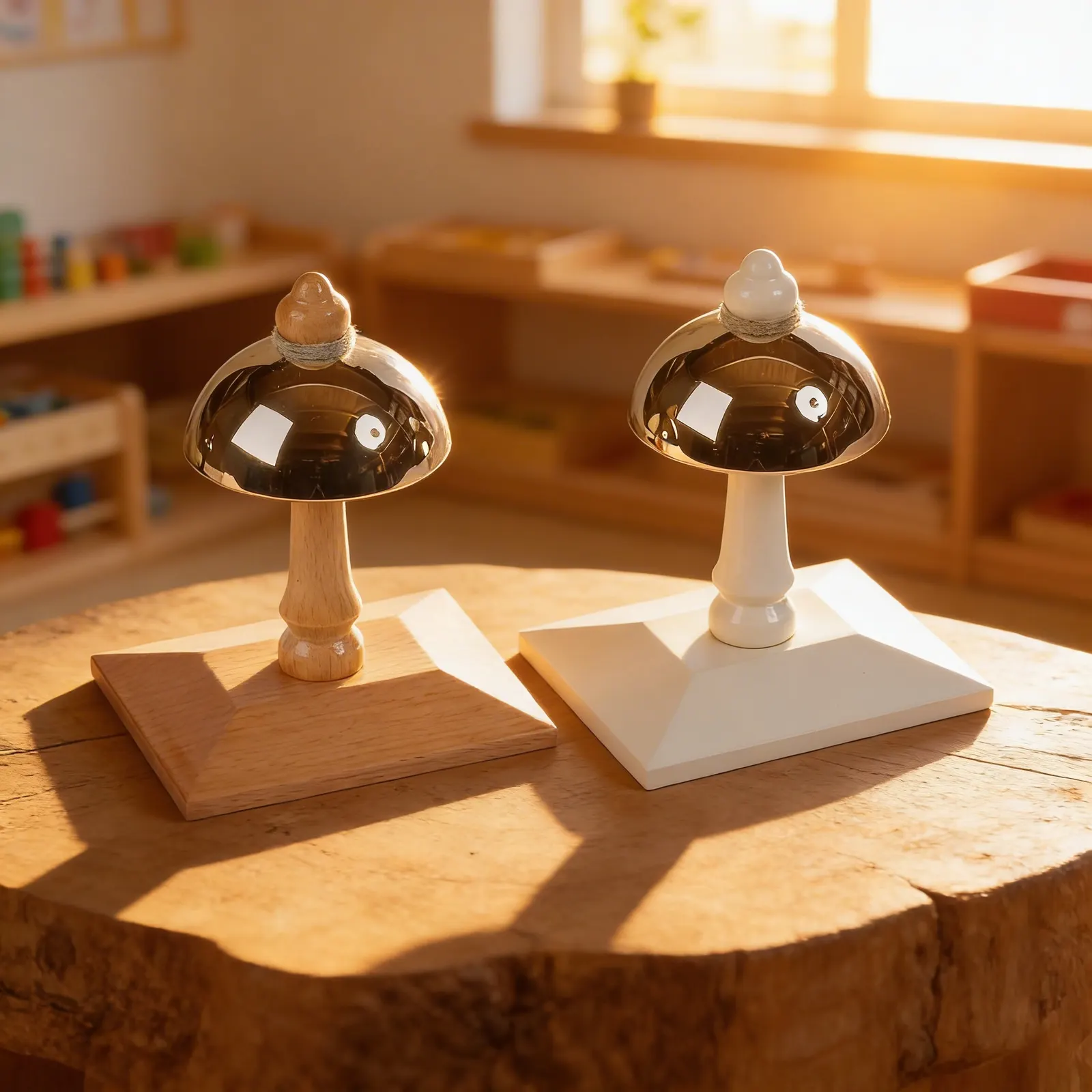
2 Bells Mounted in a child's hands
F, one of the seven naturals that make up the diatomic set a child works with first. The naturals are learned as a run before any sharp or flat is introduced, so this bell belongs to the stage where the ear is still building the plain scale. A mounted pair means one bell stays on the board as the reference while its twin travels, which is how grading a whole scale stays possible for a child working alone. Metal on a wooden base, for ages 3 to 6.
Auditory Discrimination
Matching identical tones refines the child's ability to perceive subtle differences in pitch and timbre.
Musical Foundation
Introduces fundamental concepts of pitch, tone, and resonance through hands-on exploration.
Concentration
Listening activities with bells develop focused attention and mindful awareness of sound.
Sensorial Refinement
Isolates the auditory sense, supporting the development of musical intelligence and appreciation.
How to present it
Place both F bells on a mat, handles pointing toward the child. Set the striker beside the bells. Ensure a quiet environment for optimal sound perception.
- 1Strike the first bell gently near the rim of the metal dome
- 2Listen until the sound completely fades
- 3Strike the second bell with identical force and placement
- 4Compare the two sounds, noting their similarity
- 5Alternate between bells, matching volume and tone quality
3 tips for parents
- Practice deep listening at home by identifying everyday sounds together
- Hum or sing the F note after bell work to reinforce pitch memory
- Notice when your child demonstrates increased auditory awareness in daily life

If you are not sure it suits your child, we answer in person.
Norbert Kovalčín, founder of Faborino · write to him
There is no review here yet. We will ask you for one after you buy. Write the first review
What's in the Box
- F-tone bells: 2 identical bells
- Wooden stands: With square bases
Size and material
| Packaging | 15 × 15 × 11 cm |
| Bell Dome | Polished metal |
| Handle & Base | Turned wood |
| Recommended Age | 3-6 years |
Care
Wipe metal with soft dry cloth; clean wood with damp cloth
Frequently Asked Questions
Why are there two bells of the same F note included in this set?
The pair allows children to practice pitch matching by striking both bells and comparing their sounds. One bell serves as the control while the child searches for its match among other bells, developing acute listening skills and auditory discrimination essential for musical education.
What activities can children do with these F-tone bells?
Children can practice striking technique, explore sound duration and vibration, match pitches with other bell sets, create simple melodies when combined with other notes, and perform silence games. The bells also support lessons in musical notation and introduce concepts of frequency and pitch.
How do these bells fit into the complete Montessori bells material?
These F bells are part of a larger set that typically includes 13 pairs of chromatic bells covering one octave. The complete material includes both white (natural notes) and black (sharp/flat notes) sets, allowing children to explore scales, intervals, and musical relationships systematically.
What is the proper technique for children to use these bells?
Children should hold the wooden handle firmly and strike the metal dome gently with the included mallet at a 45-degree angle, allowing the bell to ring freely. They learn to mute the sound by touching the bell after striking and to handle the instruments carefully to preserve their precise tuning.
At what point in the Montessori curriculum are these bells introduced?
The bells are typically introduced around age 3.5-4, after children have worked with other sensorial materials like the sound cylinders. They should have developed careful movement control and the ability to concentrate on subtle differences in sound before beginning work with the bells.
Product safety
Manufacturer: Nienhuis Montessori, Anders Celsiusstraat 15, 7442 PB Nijverdal, Netherlands
2 Bells Mounted