
2 Bells MountedG
The first photo is the maker's own. The other shots are illustrative.
Inv. no. NIE-0063A008
- Maker
- Nienhuis Montessori, since 1929
- Approval
- AMI
- Bell Domes
- Polished metal
- Posts
- Turned wood with decorative finial
- EAN
- 8719924004064
Final price incl. VAT. Free delivery.
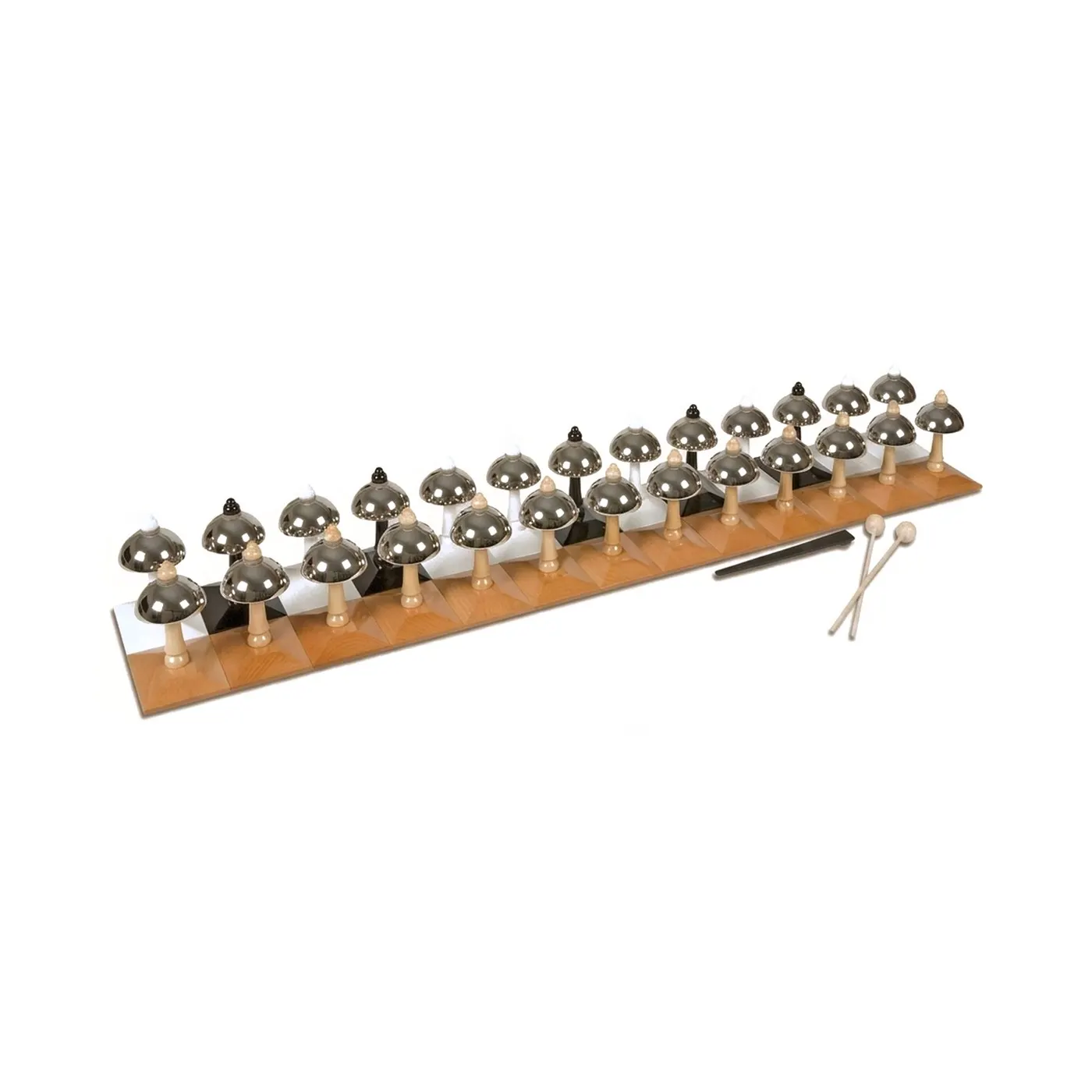 Montessori Bells Complete Set €1,421.90
Advice, warranty and returns are handled by us.
Why it costs €151.90
Behind the price of the original are things you can check yourself.
AMI approval
The material is approved by the Association Montessori Internationale (AMI). Nienhuis has made Montessori materials since 1929.
A verifiable original
The EAN 8719924004064 is on the box. It is the maker's number, not ours.
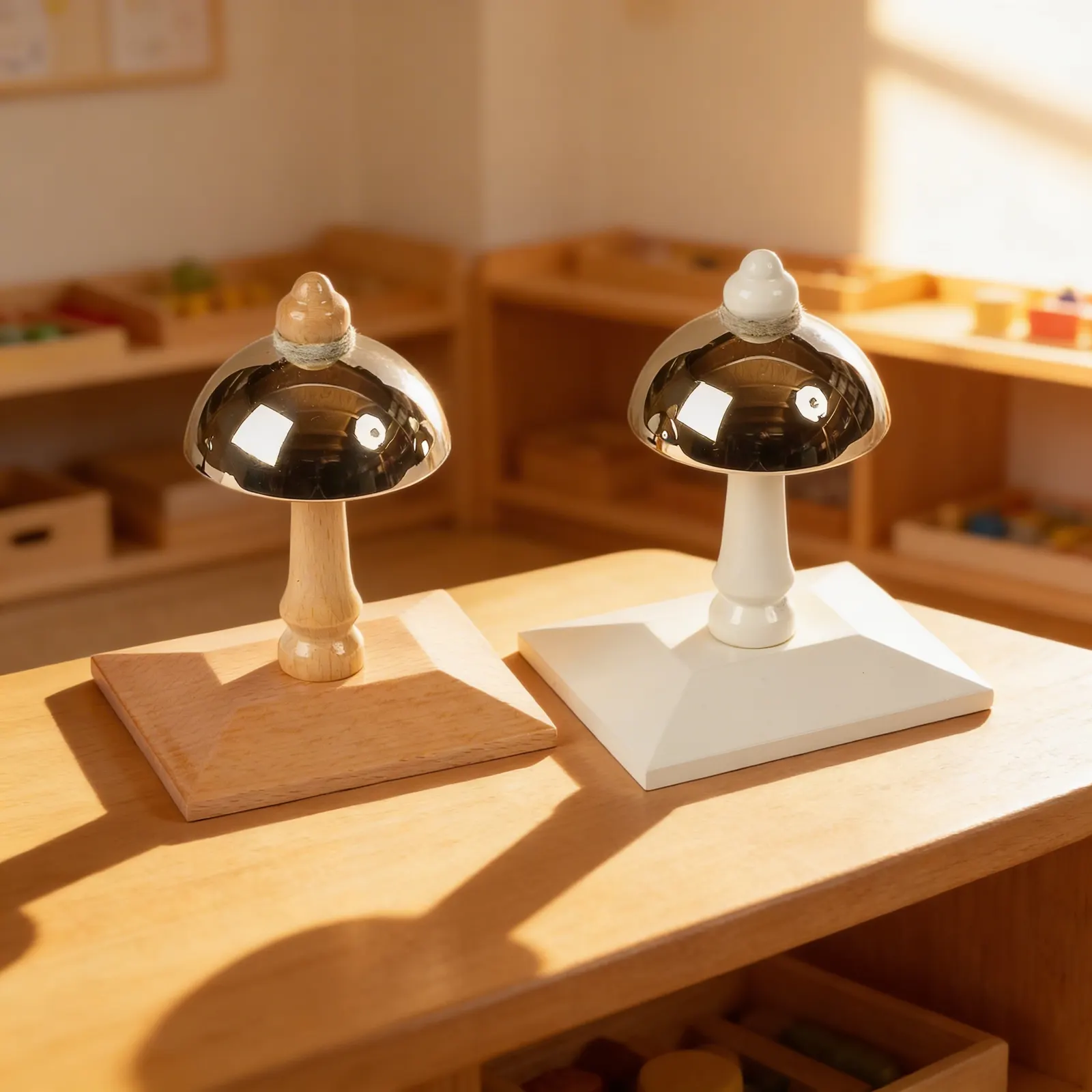
2 Bells Mounted in a child's hands
A pair of mounted bells with the tone G, the fifth note of the C major scale, a perfect fifth above C. The bells have polished metal domes and are mounted on wood. As an auditory sensorial material in the Montessori sense, the pair is meant for listening to a tone and comparing it with others. The metal domes are wiped with a soft dry cloth, the wooden parts with a damp one. Packed, the pair measures 15 × 15 × 11 cm and weighs 480 g. For children aged 3 to 6.
Auditory Discrimination
Matching identical pitches develops acute listening skills and sound memory essential for language and music.
Musical Foundation
Introduction to specific pitch notation prepares children for understanding musical scales and intervals.
Concentration
Focusing on subtle sound qualities develops sustained attention and mindful listening habits.
Sensorial Refinement
Isolating the quality of pitch enhances the child's ability to perceive subtle differences in their acoustic environment.
How to present it
Place both bells on a table mat, spacing them about 12 inches apart. Have a small mallet ready. Ensure the room is quiet to allow full concentration on the pure tones.
- 1Strike the first bell gently with the mallet, allowing the G note to ring clearly
- 2Wait for complete silence, then strike the second bell with the same gentle motion
- 3Invite the child to close their eyes while you strike one bell, then have them identify which bell was played
- 4Introduce the three-period lesson: 'This is G' (strike bell), 'Show me G', 'What note is this?'
3 tips for parents
- Create a quiet 'listening time' at home when exploring musical sounds together
- Sing songs in G major to reinforce the pitch your child is learning
- Notice and name G notes when heard in daily life, doorbells, phones, or instruments

If you are not sure it suits your child, we answer in person.
Norbert Kovalčín, founder of Faborino · write to him
There is no review here yet. We will ask you for one after you buy. Write the first review
What's in the Box
- G Note Bells: 2 identical bells with metal domes
- Wooden Posts: With decorative turned finials
- Square Bases: 2 stable mounting bases
Size and material
| Packaging | 15 × 15 × 11 cm |
| Bell Domes | Polished metal |
| Posts | Turned wood with decorative finial |
| Bases | Wood |
| Recommended Age | 3-6 years |
Care
Wipe metal domes with soft dry cloth; clean bases with damp cloth
Frequently Asked Questions
Why are both bells tuned to the same G note?
Having two identical G bells allows children to explore sound matching, develop auditory memory, and understand the concept of 'same' in pitch. This focused approach helps isolate the learning objective and builds a foundation for later work with different pitches.
What activities can children do with these matching bells?
Children can practice sound matching by striking one bell and finding its pair, play memory games where they listen and reproduce patterns, explore concepts of loud and soft, and begin understanding musical notation by associating the G note with its written symbol.
How do these bells support early music education?
The bells introduce fundamental concepts of pitch recognition, careful listening, and musical memory. The single note focus allows children to truly understand one pitch before moving to intervals and scales, following the Montessori principle of isolation of difficulty.
What is the quality and construction of these bells?
Each bell features a precision-tuned metal dome that produces a clear, sustained G note. The bells are mounted on beautifully turned wooden posts with decorative finials and stable square bases, combining musical accuracy with aesthetic appeal.
How do these bells complement other Montessori music materials?
These G bells can be used alongside other single-note bells to build intervals and scales, with tone bars for pitch matching exercises, and with the musical staff material to introduce note reading. They form part of a comprehensive sensorial music curriculum.
Product safety
Manufacturer: Nienhuis Montessori, Anders Celsiusstraat 15, 7442 PB Nijverdal, Netherlands
2 Bells Mounted