
2 Bells MountedG Sharp
The first photo is the maker's own. The other shots are illustrative.
Inv. no. NIE-0063A009
- Maker
- Nienhuis Montessori, since 1929
- Approval
- AMI
- Bell Domes
- Polished metal
- Bases
- Ceramic (black and white)
- EAN
- 8719924004071
Final price incl. VAT. Free delivery.
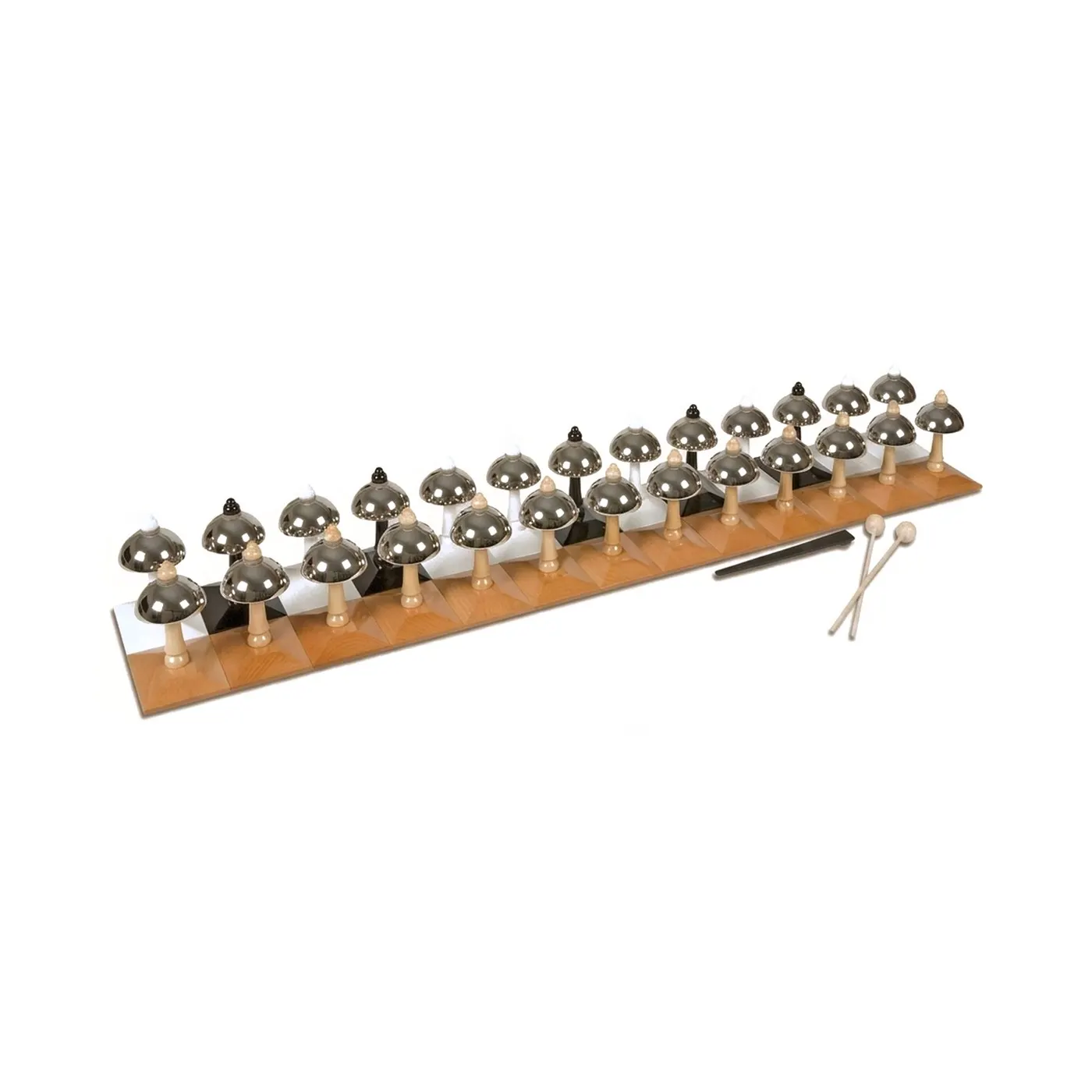 Montessori Bells Complete Set €1,421.90
Advice, warranty and returns are handled by us.
Why it costs €151.90
Behind the price of the original are things you can check yourself.
AMI approval
The material is approved by the Association Montessori Internationale (AMI). Nienhuis has made Montessori materials since 1929.
A verifiable original
The EAN 8719924004071 is on the box. It is the maker's number, not ours.
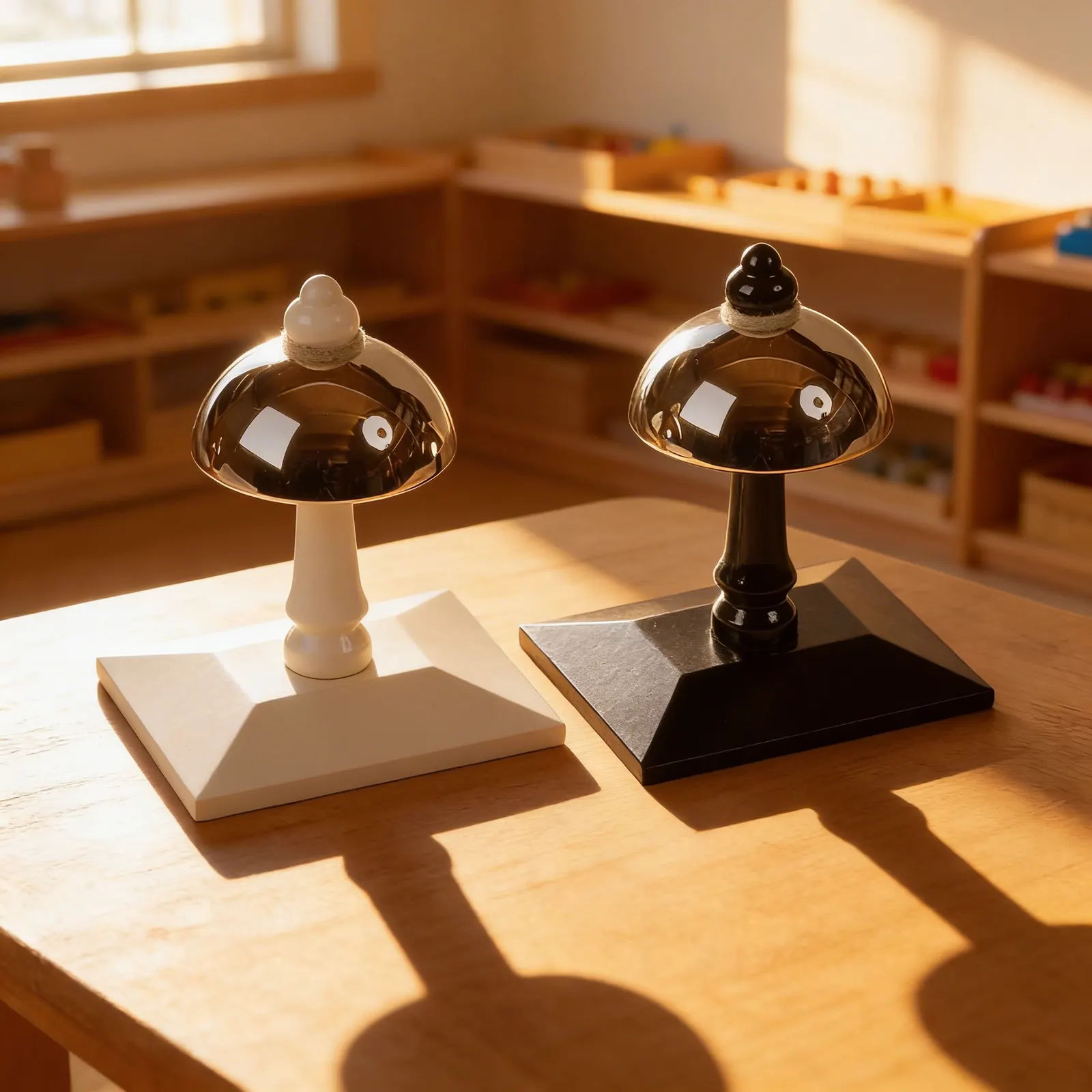
2 Bells Mounted in a child's hands
G sharp, a chromatic bell and one of the harder pairs to place, sitting between two naturals a child already knows well. That is precisely its value: the surrounding notes are familiar, so the new one has to be located by its difference from both rather than learned on its own. Replacing a single bell is also why these are sold individually, since one damaged bell should not retire a whole set. Metal on a wooden base, for ages 3 to 6.
Auditory Discrimination
Develops the ability to perceive subtle differences in pitch through careful listening and comparison of matched tones.
Musical Intelligence
Introduces fundamental concepts of pitch and tone quality, laying groundwork for future musical understanding.
Concentration
Requires focused attention to distinguish and match sounds, strengthening the child's capacity for sustained concentration.
Sensorial Refinement
Isolates the auditory sense to develop acute perception of sound qualities and pitch relationships.
How to present it
Place both G Sharp bells on a table mat, spaced apart. Position the mallet between them. Ensure the environment is quiet to allow full concentration on the sounds.
- 1Demonstrate striking the first bell gently with the mallet, allowing the sound to ring fully
- 2After the sound fades, strike the second bell with the same gentle motion
- 3Invite the child to strike each bell, listening carefully to each tone
- 4Mix the bell positions and ask the child to identify which produces the same sound
3 tips for parents
- Create a quiet time at home for exploring sounds without competing noises from electronics or siblings
- Practice gentle movements with your child, as controlled striking produces the clearest bell tones
- Extend learning by finding G Sharp on a piano or keyboard to connect the bell sound to other instruments

If you are not sure it suits your child, we answer in person.
Norbert Kovalčín, founder of Faborino · write to him
There is no review here yet. We will ask you for one after you buy. Write the first review
What's in the Box
- G Sharp Bell with White Base: Precision-tuned metal bell
- G Sharp Bell with Black Base: Matching pitch for pairing work
Size and material
| Packaging | 15 × 15 × 11 cm |
| Bell Domes | Polished metal |
| Bases | Ceramic (black and white) |
| Stems | Plastic pedestal |
| Recommended Age | 3-6 years |
Care
Wipe metal bells with soft dry cloth; clean bases with damp cloth
Frequently Asked Questions
What is the purpose of having two bells with the same pitch?
The matched pair allows children to explore the concept of 'same' versus 'different' in sound. One bell serves as the control while the other is used for matching exercises, helping develop precise auditory discrimination skills essential for music education and language development.
Why do the bells have different colored bases if they produce the same tone?
The contrasting black and white bases provide visual cues during sorting and matching activities. This design element helps children organize their work and supports the Montessori principle of isolation of difficulty by separating the visual aspect from the auditory challenge.
How are these bells used in a Montessori classroom?
Children typically begin by learning to strike the bell properly with the mallet, then progress to matching exercises where they compare sounds between multiple bell pairs. Advanced activities include grading bells by pitch, playing simple melodies, and composing their own musical patterns.
What makes these bells suitable for ages 3-6?
The bells are sized appropriately for small hands, with stable bases that prevent tipping. The clear, sustained tone produced is easy for young children to perceive, and the simple striking motion develops hand-eye coordination while building foundational musical concepts.
How do I care for and maintain the metal bells?
Keep bells dry and handle with clean hands to prevent tarnishing. Wipe with a soft, dry cloth after use. Store in a climate-controlled environment away from extreme temperatures. The metal domes should not be touched directly as oils from hands can affect the tone quality over time.
Product safety
Manufacturer: Nienhuis Montessori, Anders Celsiusstraat 15, 7442 PB Nijverdal, Netherlands
2 Bells Mounted