
2nd And 3rd Level Geometry Task Cards
The first photo is the maker's own. The other shots are illustrative.
Inv. no. NIE-ELC3063
- Maker
- Nienhuis Montessori, since 1929
- Material
- Durable plastic
- Finish
- Pre-cut with rounded corners
- EAN
- 8719924043957
Final price incl. VAT. Delivery €5.90, €26.10 to go for free delivery.
Advice, warranty and returns are handled by us.
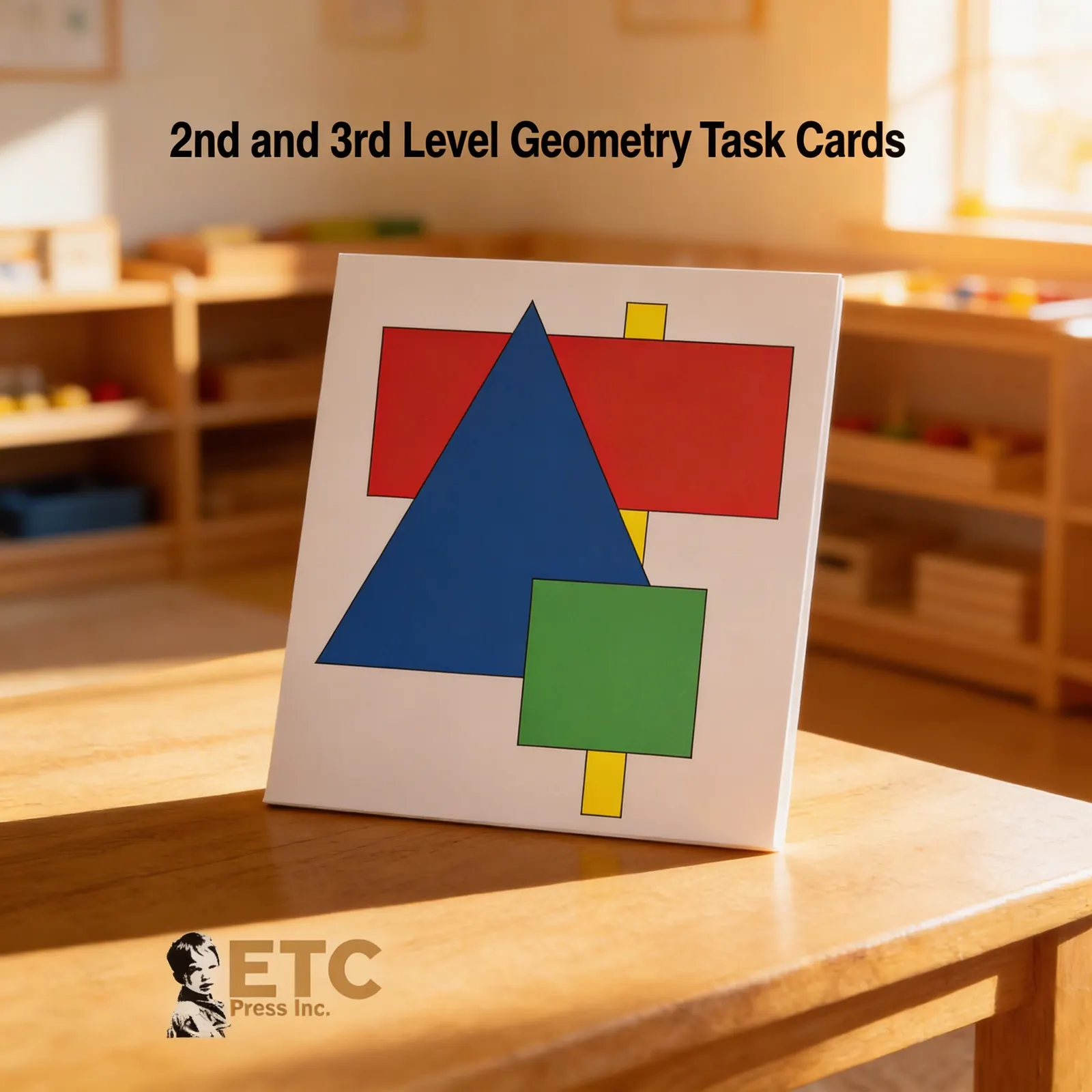
2nd And 3rd Level Geometry Task Cards in a child's hands
Second and third level geometry task cards, the complete follow up for the later presentations. Where the first level names shapes, these take the child into relationships between them, and the jump is real: a card at this level asks something that cannot be answered by looking at one figure. The first level set covers the ground below it. Durable plastic with rounded corners. In English.
Visual Discrimination
Identifying individual shapes within overlapping compositions strengthens visual perception and attention to detail.
Geometric Analysis
Analyzing complex shape relationships develops mathematical thinking and spatial intelligence.
Abstract Reasoning
Progressing from concrete materials to abstract representations builds cognitive flexibility.
Concentration Development
Focused shape analysis exercises extend attention span and promote mindful observation.
How to present it
Place the geometry task cards face down in sequence order. Have colored pencils and blank paper available. Ensure the child has worked extensively with geometric cabinet and constructive triangles.
- 1Present one card showing overlapping shapes to the child
- 2Ask the child to identify each individual shape within the composition
- 3Child draws each identified shape separately on paper
- 4Compare drawn shapes with the original overlapping composition
- 5Progress to cards with three or more overlapping shapes
3 tips for parents
- Look for overlapping shapes in everyday objects like window panes or floor tiles
- Practice identifying shapes within logos or architectural details during outings
- Support patience during complex visual analysis without rushing to solutions

If you are not sure it suits your child, we answer in person.
Norbert Kovalčín, founder of Faborino · write to him
There is no review here yet. We will ask you for one after you buy. Write the first review
What's in the Box
- Geometry Task Cards: Multiple cards with progressive exercises
- Storage Box: For organized card storage
Size and material
| Packaging | 28 × 12 × 2 cm |
| Material | Durable plastic |
| Finish | Pre-cut with rounded corners |
| Recommended Age | 6-12 years |
Care
Wipe with dry cloth; avoid moisture
Frequently Asked Questions
What age group are these 2nd and 3rd Level Geometry Task Cards designed for?
These task cards are designed for children ages 3-6, though they work best with children who have already been introduced to basic geometric shapes through Montessori sensorial materials.
How do these cards differ from basic geometry materials?
Unlike basic geometry materials that introduce individual shapes, these cards present overlapping and complex compositions where children must identify multiple shapes within a single image, advancing their visual discrimination and spatial reasoning abilities.
What skills do children develop using these geometry task cards?
Children develop visual discrimination, spatial reasoning, shape recognition, analytical thinking, and the ability to mentally isolate individual forms within complex compositions. These skills support mathematical thinking and abstract reasoning.
Do these cards require any other materials to use effectively?
While the cards can be used independently, they work best when children have prior experience with Montessori geometry cabinet materials. Having geometric shapes or insets available can help children verify their observations.
How are the task cards organized for progressive learning?
The cards progress systematically from simpler overlapping shapes to more complex compositions. The 2nd level introduces basic overlapping forms, while the 3rd level presents intricate arrangements requiring advanced visual analysis skills.
Product safety
Manufacturer: Nienhuis Montessori, Anders Celsiusstraat 15, 7442 PB Nijverdal, Netherlands
2nd And 3rd Level Geometry Task Cards