
2nd Blue Cylinder
The first photo is the maker's own. The other shots are illustrative.
Inv. no. NIE-00230010
- Maker
- Nienhuis Montessori, since 1929
- Primary Material
- Solid wood
- Finish
- Lacquer paint
- EAN
- 8719924000790
Final price incl. VAT. Delivery €5.90, €144.20 to go for free delivery.
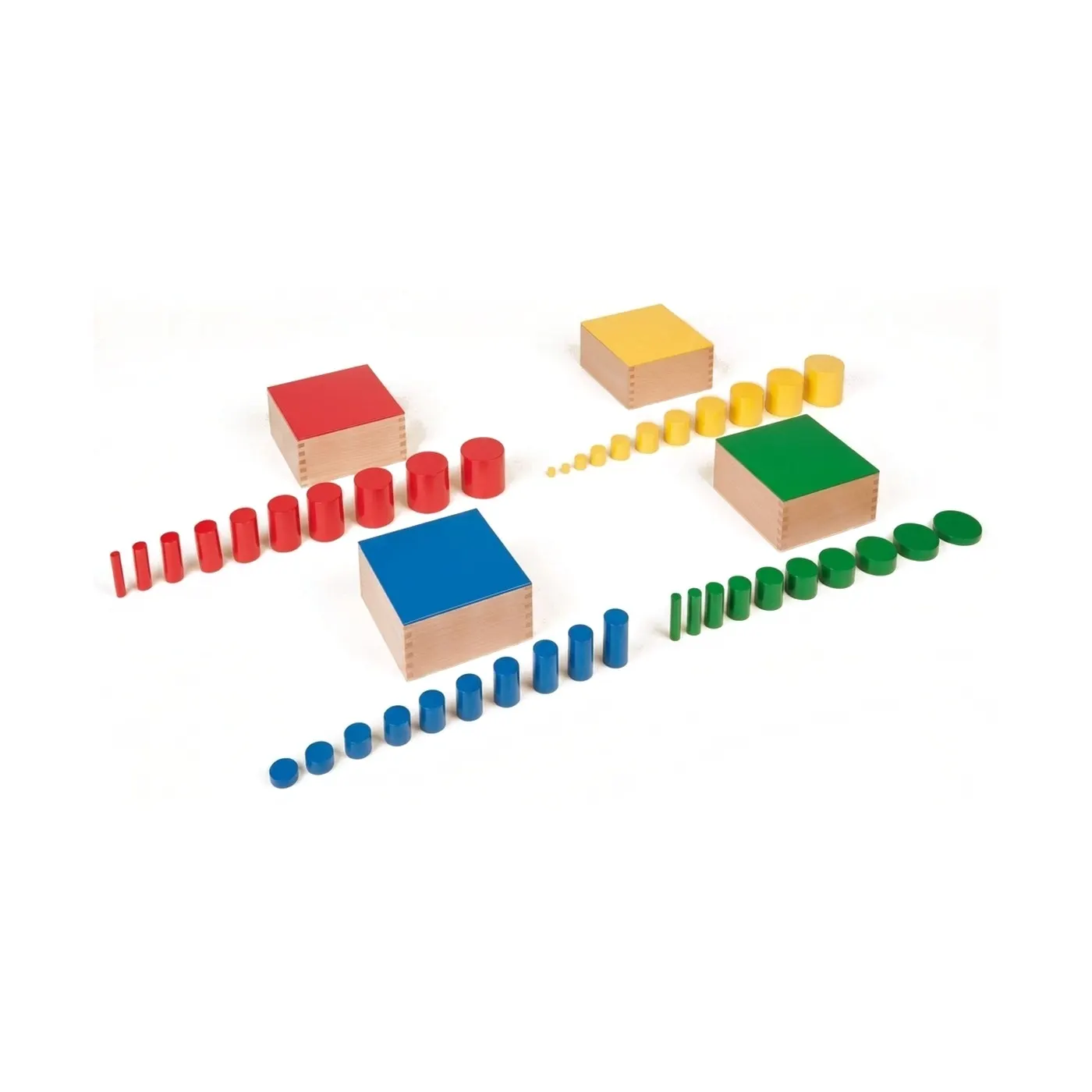 Knobless Cylinders Set €238.90
Advice, warranty and returns are handled by us.
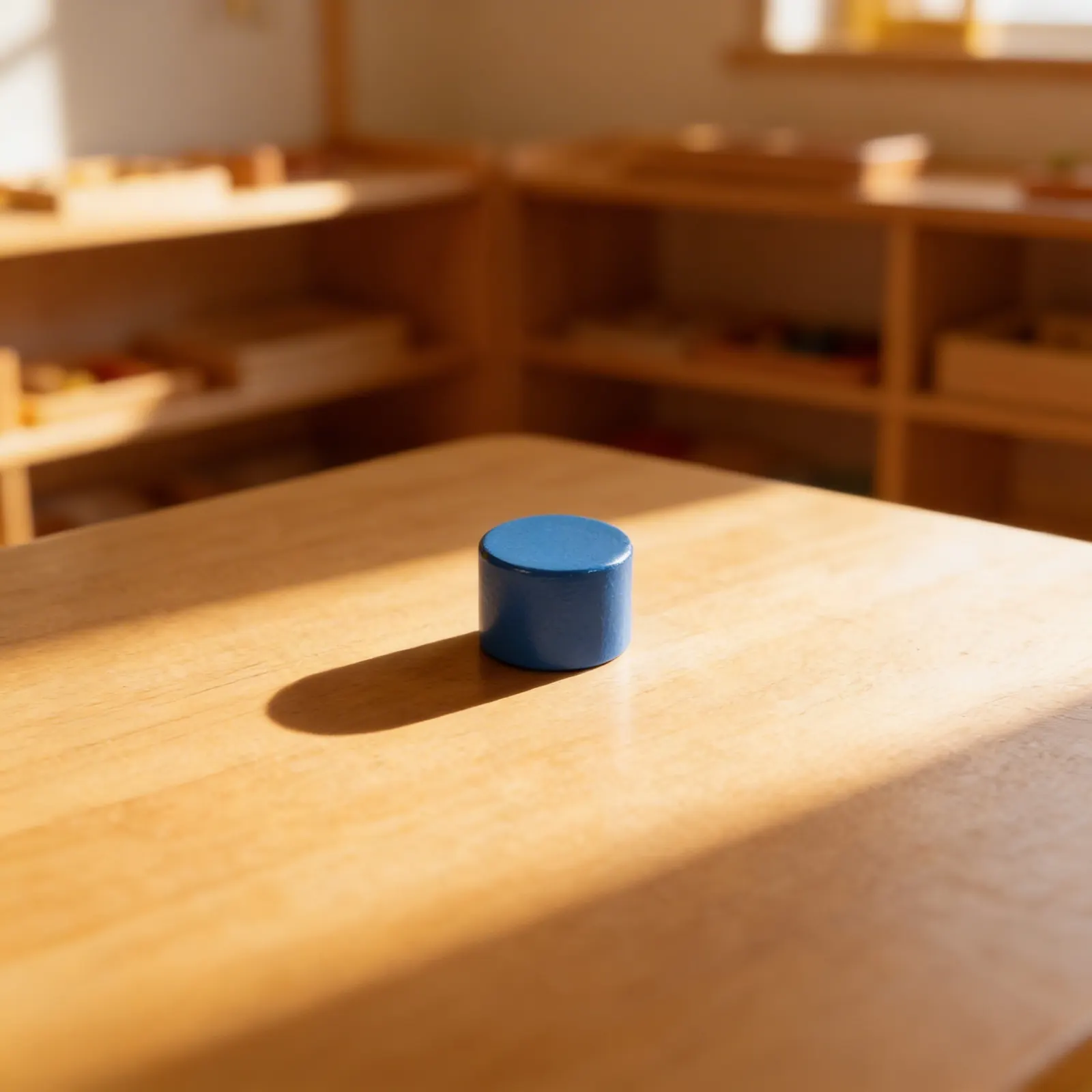
2nd Blue Cylinder in a child's hands
The second blue cylinder from the knobless cylinders, a single replacement piece. A set with no built in control of error is a set two children can work at together: one lays the series, the other checks it, and the disagreement between them has to be settled by looking rather than by a socket refusing to take a piece. Few sensorial materials allow that. Painted wood. The complete blue set is a separate item.
Visual Discrimination
Helps children perceive subtle differences in dimension when used with other cylinders in the series.
Mathematical Preparation
Concrete exploration of size relationships prepares the mathematical mind for later abstract concepts.
Fine Motor Control
Grasping and manipulating the cylinder refines pincer grip and hand-eye coordination.
Order and Sequence
When used as part of a set, develops understanding of gradation and serialization.
How to present it
Place the 2nd Blue Cylinder block on a table mat at child's dominant side. Ensure adequate space for removing and arranging cylinders. Have a soft cloth nearby for handling.
- 1Demonstrate removing the thickest cylinder using thumb and two fingers, emphasizing the three-finger grip
- 2Place the removed cylinder gently on the mat in front of the block
- 3Continue removing cylinders from thick to thin, placing each to the right of the previous
- 4Return cylinders randomly, demonstrating how to feel for the correct fit
- 5Invite the child to remove and replace all cylinders independently
3 tips for parents
- At home, sort household items by thickness: markers, spoons, or tubes
- During meals, compare thickness of foods: carrot sticks, breadsticks, pasta shapes
- Avoid correcting errors, the wobbling cylinder teaches more than adult intervention

If you are not sure it suits your child, we answer in person.
Norbert Kovalčín, founder of Faborino · write to him
There is no review here yet. We will ask you for one after you buy. Write the first review
What's in the Box
- Blue Cylinder: 2nd size in series
Size and material
| Packaging | 3 × 3 × 2 cm |
| Primary Material | Solid wood |
| Finish | Lacquer paint |
| Recommended Age | 3-6 years |
Care
Wipe with slightly damp cloth, dry immediately
Frequently Asked Questions
What is the purpose of the 2nd Blue Cylinder in Montessori education?
The 2nd Blue Cylinder is a sensorial material that helps children aged 3-6 develop visual discrimination skills, understand dimensional variations, and refine their perception of size relationships. It prepares the child for mathematical concepts through hands-on exploration.
How does this cylinder differ from other cylinder blocks?
While this is an individual blue cylinder, it's typically part of the Cylinder Block exercises. Each cylinder varies in one or two dimensions (height, diameter, or both), allowing children to explore specific dimensional relationships through tactile and visual experiences.
What skills does the Blue Cylinder help develop?
This material develops fine motor control, hand-eye coordination, visual discrimination, concentration, and problem-solving skills. It also indirectly prepares children for mathematical concepts like dimension, volume, and spatial relationships.
How should children use the 2nd Blue Cylinder?
Children handle the cylinder using the three-finger grip (thumb, index, and middle finger), which prepares them for writing. They explore its dimensions through touch and sight, comparing it with other cylinders or materials to understand size relationships.
Why is the cylinder painted blue?
The blue color follows Montessori's systematic approach to sensorial materials. The consistent color helps children focus on dimensional differences rather than being distracted by varied colors, allowing for clearer discrimination of size and proportion.
Product safety
Manufacturer: Nienhuis Montessori, Anders Celsiusstraat 15, 7442 PB Nijverdal, Netherlands
2nd Blue Cylinder