
3d Object Fitting Exercise
The first photos are the maker's own. The other shots are illustrative.
Inv. no. NIE-043500
- Maker
- Nienhuis Montessori, since 1929
- Approval
- AMI
- Primary Material
- Birch plywood and beechwood
- Finish
- Smooth sanded, no coating
- EAN
- 8719924012649
Final price incl. VAT. Delivery €5.90, €51.10 to go for free delivery.
Advice, warranty and returns are handled by us.
Why it costs €97.90
Behind the price of the original are things you can check yourself.
AMI approval
The material is approved by the Association Montessori Internationale (AMI). Nienhuis has made Montessori materials since 1929.
A verifiable original
The EAN 8719924012649 is on the box. It is the maker's number, not ours.
3d Object Fitting Exercise in a child's hands
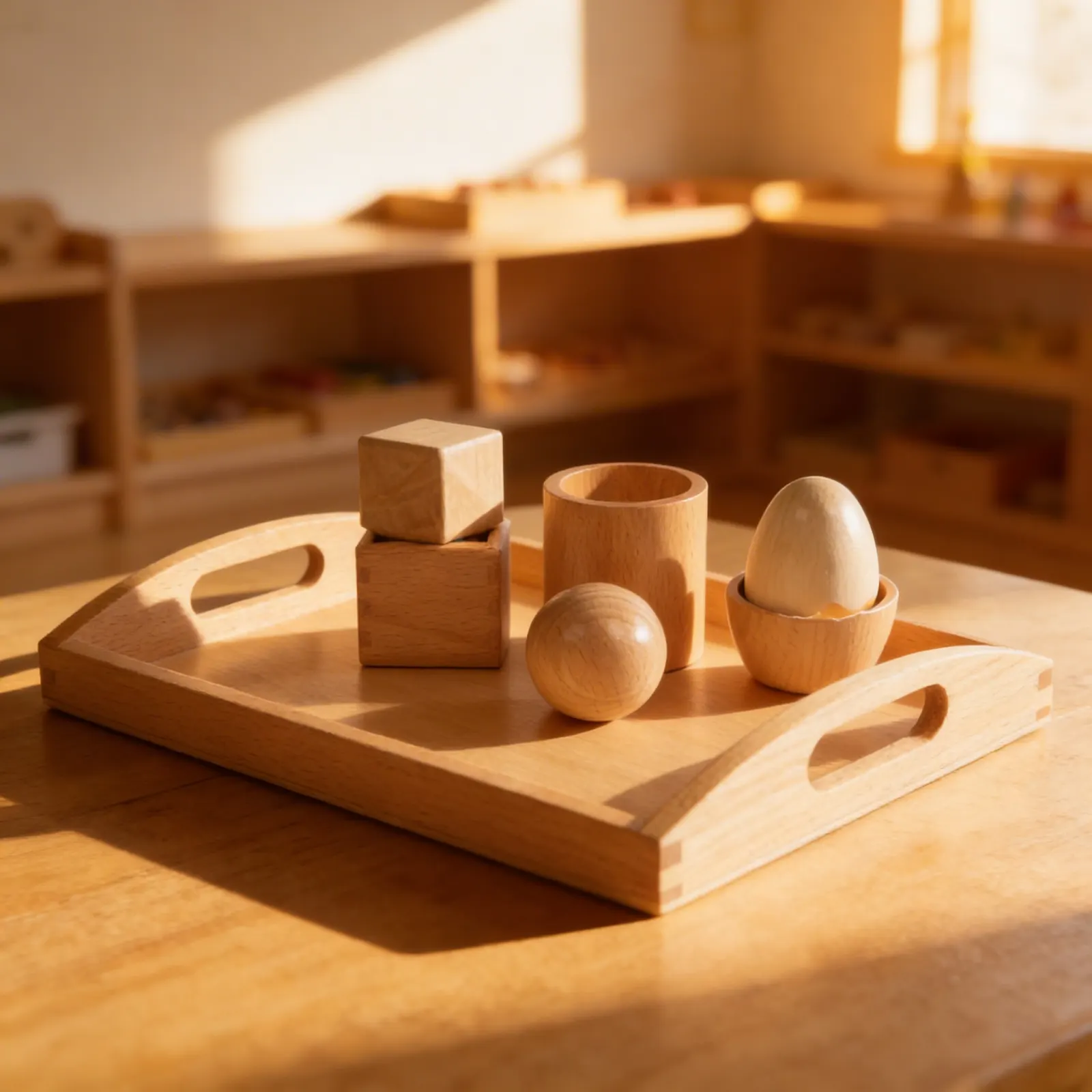
By eight or nine months a baby can put a wooden egg into a cup and take it out again. A ball is a harder problem, because a ball will not come out by reaching: the cup has to be turned over. That single difference is the whole exercise, and it is one of the earliest moments a child solves something rather than repeating it. A cube into a box is harder again, because the corners of both have to be lined up before it will go. Natural beechwood, nothing painted, nothing that needs explaining. Natural beechwood, for ages 0 to 3.
Visual-Motor Coordination
Matching each solid to its base strengthens hand-eye coordination and spatial reasoning essential for later mathematical concepts.
Shape Discrimination
Handling three-dimensional forms builds the foundation for geometry while refining the visual and tactile senses.
Concentration Development
The self-correcting nature of fitting exercises promotes focused attention and problem-solving skills.
Order and Sequence
Returning shapes to their bases after exploration instills habits of completing work cycles and maintaining the prepared environment.
How to present it
Place the three pairs on a low shelf at child's eye level: the wooden egg with its cup, the ball with its cup and the cube with its box. Ensure each object rests beside its own cup or box.
- 1Invite the child by carrying a chosen pair to a work mat
- 2Remove one object (start with the ball) and explore it with both hands
- 3Demonstrate fitting the ball into its cup with gentle pressure
- 4Return the ball and invite the child to try
- 5Continue with remaining objects in order of difficulty: cube, egg
3 tips for parents
- Practice shape vocabulary during daily activities: 'Your ball is a sphere like in your shape work'
- Create a basket of household objects matching these three forms for extended learning
- Allow your child to carry the pieces independently, even if some fall initially

If you are not sure it suits your child, we answer in person.
Norbert Kovalčín, founder of Faborino · write to him
There is no review here yet. We will ask you for one after you buy. Write the first review
What's in the Box
- Wooden egg with cup: The egg is put into the cup and taken out again
- Ball with cup: The ball is put into the cup
- Cube with box: The cube is put into the box
Size and material
| Packaging | 24 × 18 × 6 cm |
| Primary Material | Birch plywood and beechwood |
| Finish | Smooth sanded, no coating |
| Recommended Age | 12-36 months |
Care
Wipe with slightly damp cloth, air dry completely
Frequently Asked Questions
What age is this 3D object fitting exercise suitable for?
This material is designed for children ages 0-3 years, with most children beginning to show interest around 12-18 months when they can sit independently and grasp objects with control.
What skills does this fitting exercise develop?
This exercise develops hand-eye coordination, spatial awareness, fine motor control, shape discrimination, and concentration. It also promotes independence, as children can choose the pieces and work with them on their own.
What are the dimensions and materials used?
The pieces are made of birch plywood and beechwood. The set includes three pairs: a wooden egg with a cup, a ball with a cup and a cube with a box, sized appropriately for toddler hands.
How do children use this material?
Children explore each shape through touch, then practice fitting each object into its matching cup or box. The exercise progresses from simple exploration to precise placement, building coordination and understanding of 3D forms.
Is this material self-correcting?
Yes, each object fits only in its own cup or box, providing immediate feedback to the child. This self-correcting feature allows independent learning and builds confidence through successful completion of the exercise.
Product safety
Manufacturer: Nienhuis Montessori, Anders Celsiusstraat 15, 7442 PB Nijverdal, Netherlands
3d Object Fitting Exercise