
3rd Green Cylinder
The first photo is the maker's own. The other shots are illustrative.
Inv. no. NIE-00230013
- Maker
- Nienhuis Montessori, since 1929
- Primary Material
- Painted wood
- Finish
- Glossy green paint
- EAN
- 8719924000820
Final price incl. VAT. Delivery €5.90, €143.50 to go for free delivery.
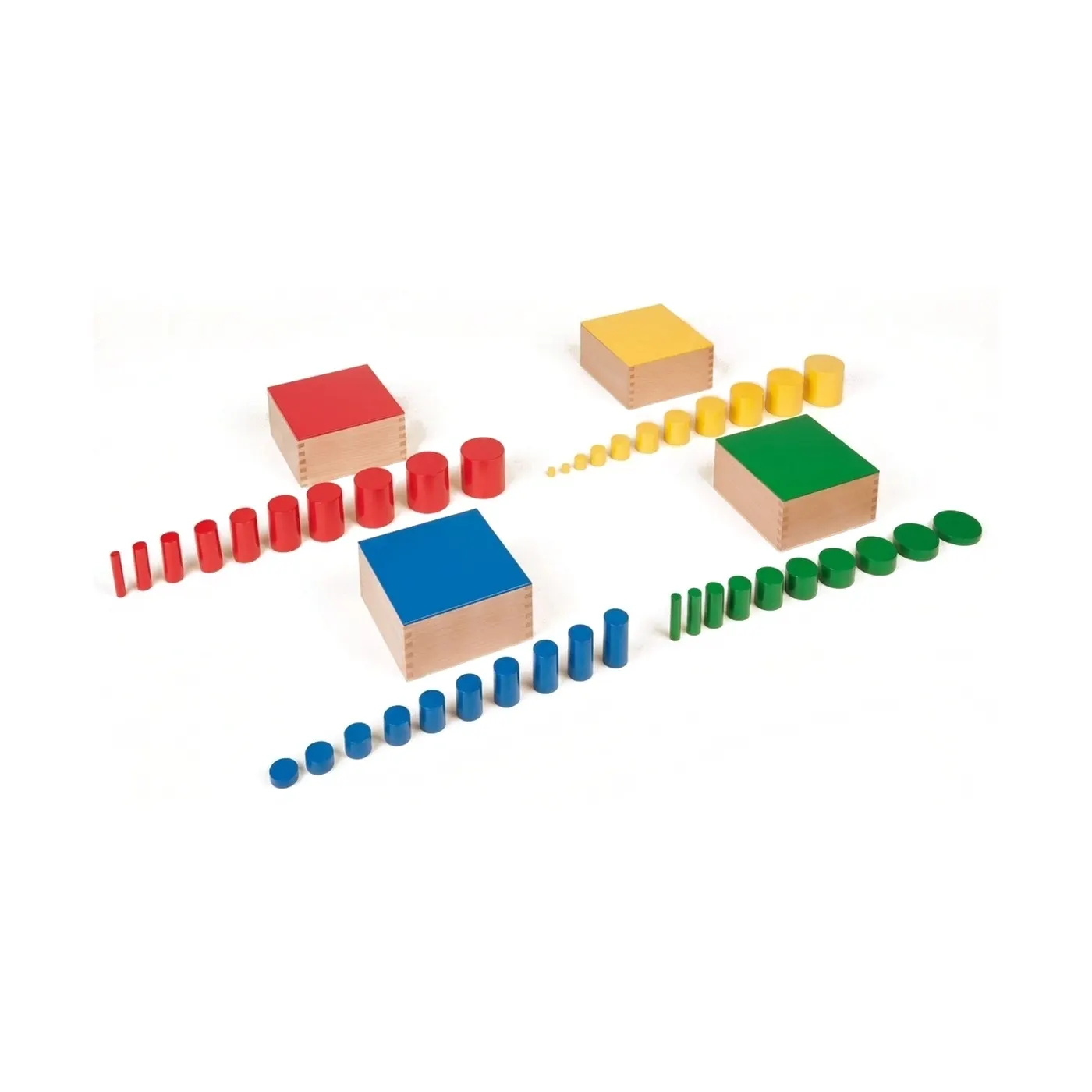 Knobless Cylinders Set €238.90
Advice, warranty and returns are handled by us.
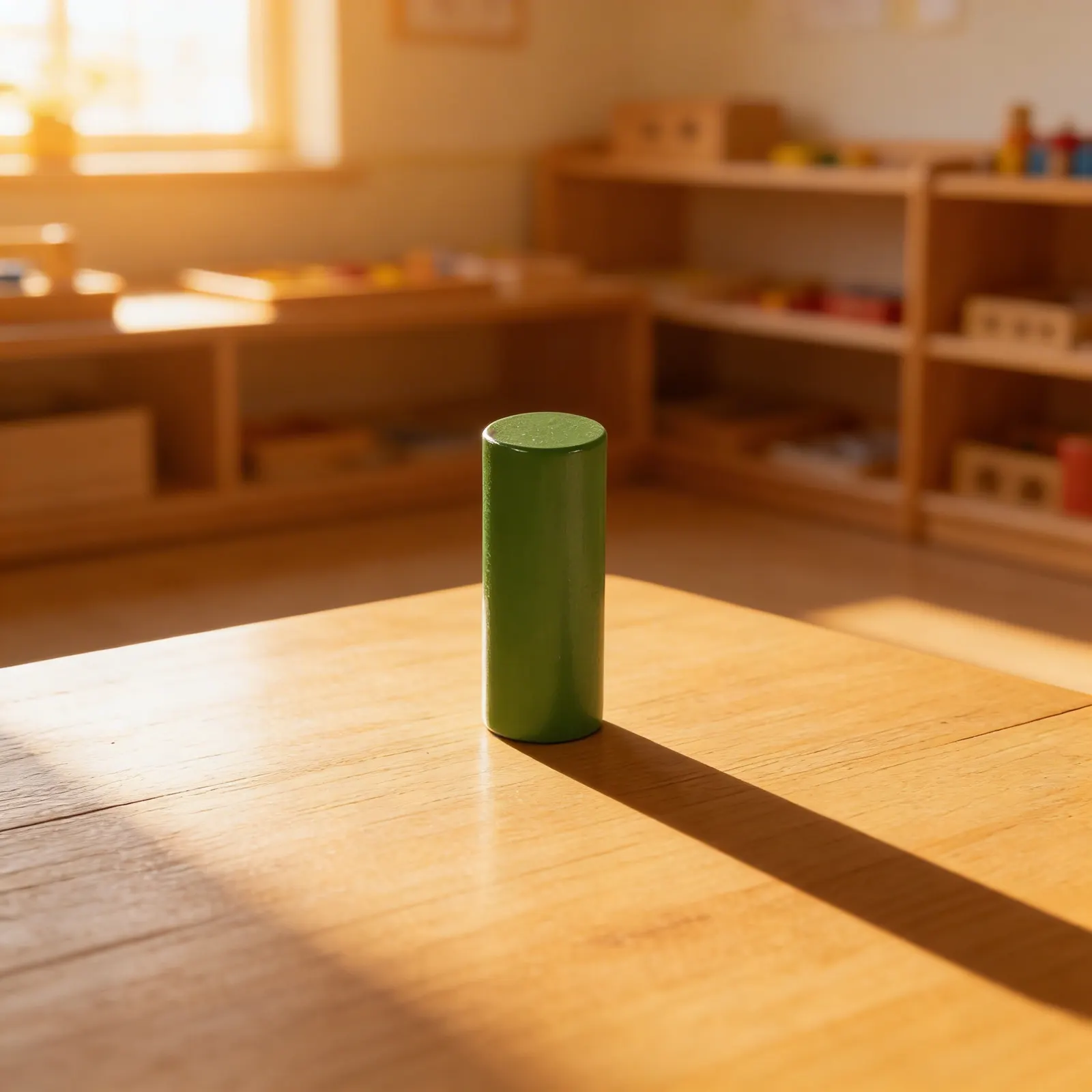
3rd Green Cylinder in a child's hands
The third green cylinder from the knobless cylinders, a single replacement piece. Without knobs the whole cylinder goes into the hand rather than being pinched at the top, which changes what the material trains: the knobbed blocks prepare three fingers for a pencil, the knobless sets ask the palm and all five to judge a shape. Both are worth having, and the second only works with a full set. Painted wood. The complete green set is a separate item.
Visual Discrimination
Develops ability to perceive subtle differences in dimensions through systematic comparison and ordering activities.
Fine Motor Control
Strengthens pincer grip and hand muscles essential for writing preparation through precise grasping and placement.
Mathematical Preparation
Introduces concepts of gradation, seriation, and dimensional relationships that form the foundation for later mathematical work.
Concentration Development
Requires sustained focus and attention to detail when working with the complete cylinder series.
How to present it
Place the Third Green Cylinder on a work mat alongside other green cylinders from the set. Ensure adequate space for arranging all cylinders in a line.
- 1Examine the cylinder using thumb and two fingers, rotating slowly to feel the diameter
- 2Compare with another green cylinder by holding one in each hand at eye level
- 3Place cylinders in order from thickest to thinnest diameter
- 4Mix the cylinders and invite the child to reorder them independently
3 tips for parents
- Practice diameter discrimination at home by sorting items like marker caps or spice jars
- When child works with cylinders, resist correcting - let them discover errors independently
- Notice if your child begins comparing diameters of everyday objects like cups or tubes

If you are not sure it suits your child, we answer in person.
Norbert Kovalčín, founder of Faborino · write to him
There is no review here yet. We will ask you for one after you buy. Write the first review
What's in the Box
- Green Cylinder: Third cylinder from green series
Size and material
| Packaging | 5 × 2 × 2 cm |
| Primary Material | Painted wood |
| Finish | Glossy green paint |
| Recommended Age | 3-6 years |
Care
Wipe with slightly damp cloth, dry immediately
Frequently Asked Questions
What dimensions does the 3rd Green Cylinder help children understand?
The 3rd Green Cylinder varies in both height and diameter proportionally, helping children understand how objects can change in multiple dimensions simultaneously. This teaches the concept of scale and proportional relationships.
How does this cylinder prepare children for writing?
The knobless design requires a three-finger pincer grasp to manipulate, strengthening the same muscles used for holding a pencil. The precise placement activities develop hand-eye coordination and fine motor control essential for writing.
Can this cylinder be used independently or does it need the full set?
While this cylinder can be used alone for grasping and placement exercises, it's designed to work best with the complete set of 10 green cylinders for grading activities and visual discrimination lessons.
What's the difference between knobless and knobbed cylinders?
Knobless cylinders require more refined motor control to grasp and are typically introduced after knobbed cylinders. They offer advanced sensorial work and better prepare the hand for writing through the pincer grasp required.
What activities can children do with this single cylinder?
Children can practice careful grasping, explore its weight and dimensions, use it for vocabulary lessons (tall/short, thick/thin), incorporate it into pattern work, or use it as a measuring tool for comparing other objects.
Product safety
Manufacturer: Nienhuis Montessori, Anders Celsiusstraat 15, 7442 PB Nijverdal, Netherlands
3rd Green Cylinder