
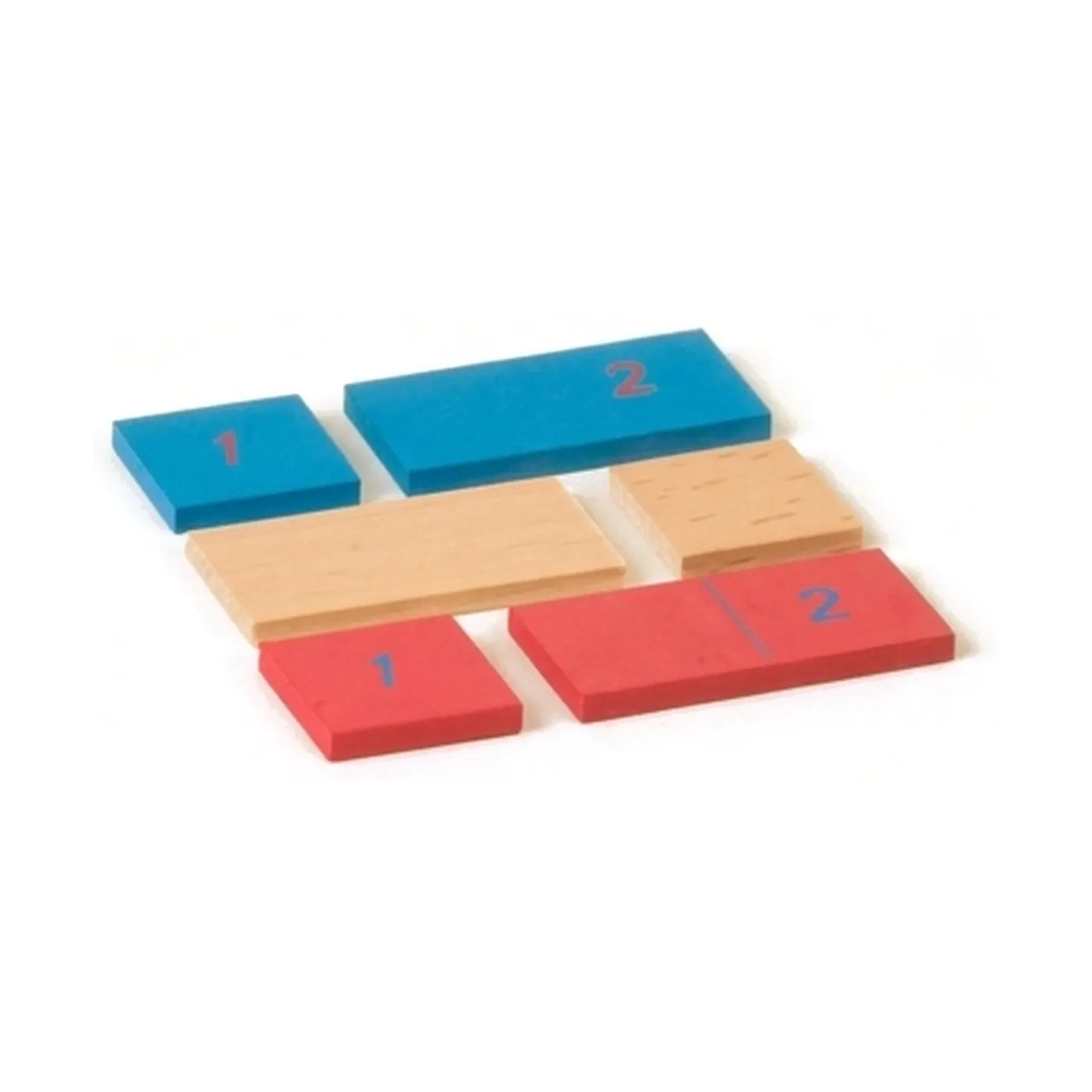
Addition Strip Board (Nienhuis)
The first photo is the maker's own. The other shots are illustrative.
Inv. no. NIE-009200
- Maker
- Nienhuis Montessori, since 1929
- Approval
- AMI
- Board
- Laminated paper or cardboard
- Strips
- Painted wood (blue and red)
- EAN
- 8719924005443
€76.90
Final price incl. VAT. Delivery €5.90, €72.10 to go for free delivery.
✓ In Stock. Delivery in 5 to 9 working days.
1
30 daysto return
Advicebefore and after
Invoicefor companies
Advice, warranty and returns are handled by us.
The original
Why it costs €76.90
Behind the price of the original are things you can check yourself.
AMI approval
The material is approved by the Association Montessori Internationale (AMI). Nienhuis has made Montessori materials since 1929.
A verifiable original
The EAN 8719924005443 is on the box. It is the maker's number, not ours.
What the child does
Addition Strip Board (Nienhuis) in a child's hands
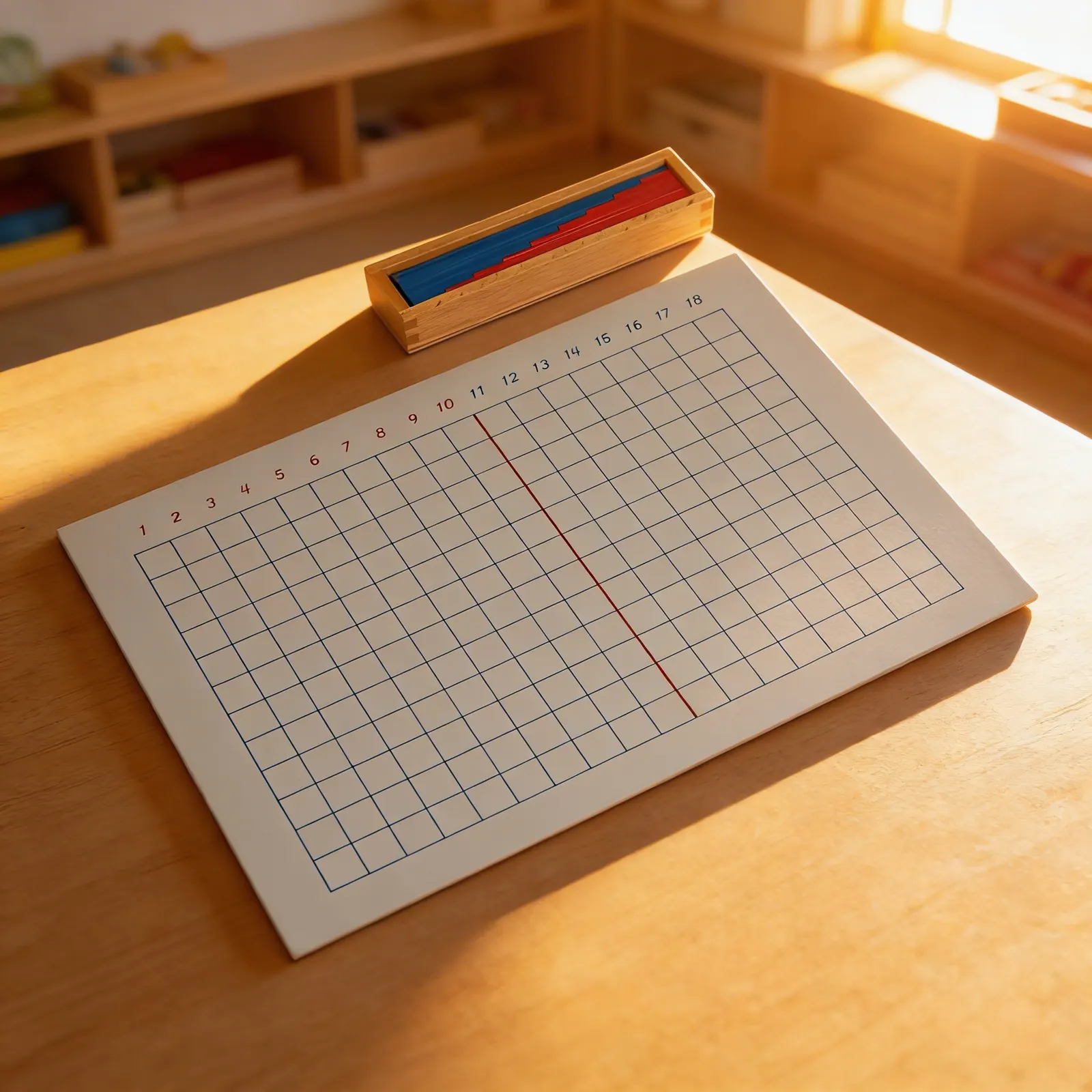
A hardboard chart twelve squares by eighteen with the numbers one to eighteen printed across the top, worked with nine red strips divided into squares and nine solid blue ones, all numbered one to nine, in a hardwood box. Laying a blue strip and a red strip end to end and reading off where they stop is a sum done by length rather than by counting, and doing all eighty one of them in order is where the addition tables stop being a list to memorise and start being a pattern a child has walked through. Painted and natural wood, for ages 3 to 6.
Addition Fact Memorization
Systematic work with the strip board helps children discover and internalize all addition combinations that sum to 18 or less.
Pattern Recognition
Children identify mathematical patterns such as commutative property and number bonds through hands-on exploration.
Visual-Spatial Understanding
The grid layout with emphasis at 10 supports understanding of base-ten system and develops spatial number sense.
Fine Motor Precision
Placing strips accurately on the grid refines pincer grip and hand-eye coordination essential for later writing.
Activity Guide
How to present it
Place the Addition Strip Board on a mat with the box of blue and red wooden strips beside it. Ensure strips are organized by length in their compartments.
- 1Select a blue strip (first addend) and place it starting at 1 on the grid
- 2Choose a red strip (second addend) and place it directly after the blue strip
- 3Read where the red strip ends to find the sum
- 4Record the equation on paper: blue number + red number = sum
- 5Continue with different combinations, exploring patterns
3 tips for parents
- Practice skip counting during daily activities to reinforce number patterns seen on the board
- Point out addition in everyday life: 'You have 3 crackers and I give you 2 more'
- Celebrate when your child discovers patterns like doubles (4+4) or near-doubles (4+5)
From the same makerNienhuis
Spare parts
Why it is in our selection
If you are not sure it suits your child, we answer in person.
Norbert Kovalčín, founder of Faborino · write to him
There is no review here yet. We will ask you for one after you buy. Write the first review
Details
What's in the Box
- Addition Strip Board: Numbered grid 1-18 with red line at 10
- Blue Wooden Strips: Set representing numbers 1-9
- Red Wooden Strips: Set representing numbers 1-9
- Wooden Storage Box: For organizing strip sets
Size and material
| Packaging | 42 × 30 × 5 cm |
| Board | Laminated paper or cardboard |
| Strips | Painted wood (blue and red) |
| Storage Box | Natural wood |
| Recommended Age | 4-6 years |
Care
| Cleaning | Wipe board with slightly damp cloth; dry immediately |
| Storage | Keep strips organized in box; store flat to prevent warping |
Frequently Asked Questions
What age is the Addition Strip Board suitable for?
The Addition Strip Board is designed for children ages 3-6 years old, though it's most commonly introduced around age 4-5 when children have mastered one-to-one correspondence and can count to at least 10.
How does the Addition Strip Board teach addition?
Children place blue and red wooden strips on a numbered grid to physically combine quantities. For example, to solve 5+3, they place a blue strip covering 1-5 and a red strip covering 6-8, visually seeing that together they reach 8.
What's included with the Addition Strip Board?
The set includes a wooden board with numbered grid from 1-18, 9 blue wooden strips (representing numbers 1-9), 9 red wooden strips (also 1-9), and typically comes with a wooden storage box for organizing the strips.
What mathematical concepts does this material teach?
Beyond basic addition facts, children discover commutative property (3+5=5+3), explore number bonds, recognize patterns in sums, and build a concrete foundation for memorizing addition tables up to 9+9.
How is this different from traditional addition teaching methods?
Unlike abstract worksheets or flashcards, the Addition Strip Board provides hands-on manipulation where children physically see and feel quantities combining, making abstract addition concepts concrete and memorable through sensorial experience.
Product safety
Manufacturer: Nienhuis Montessori, Anders Celsiusstraat 15, 7442 PB Nijverdal, Netherlands
Addition Strip Board (Nienhuis)
€76.90