
AfricaLabels: Puzzle Map Accessories
The first photo is the maker's own. The other shots are illustrative.
Inv. no. NIE-555900
- Maker
- Nienhuis Montessori, since 1929
- Approval
- AMI
- Labels
- Durable paper cardstock
- Container
- Clear acrylic plastic
- EAN
- 8719924029562
Final price incl. VAT. Delivery €5.90, €129.10 to go for free delivery.
Advice, warranty and returns are handled by us.
Why it costs €19.90
Behind the price of the original are things you can check yourself.
AMI approval
The material is approved by the Association Montessori Internationale (AMI). Nienhuis has made Montessori materials since 1929.
A verifiable original
The EAN 8719924029562 is on the box. It is the maker's number, not ours.
Africa in a child's hands
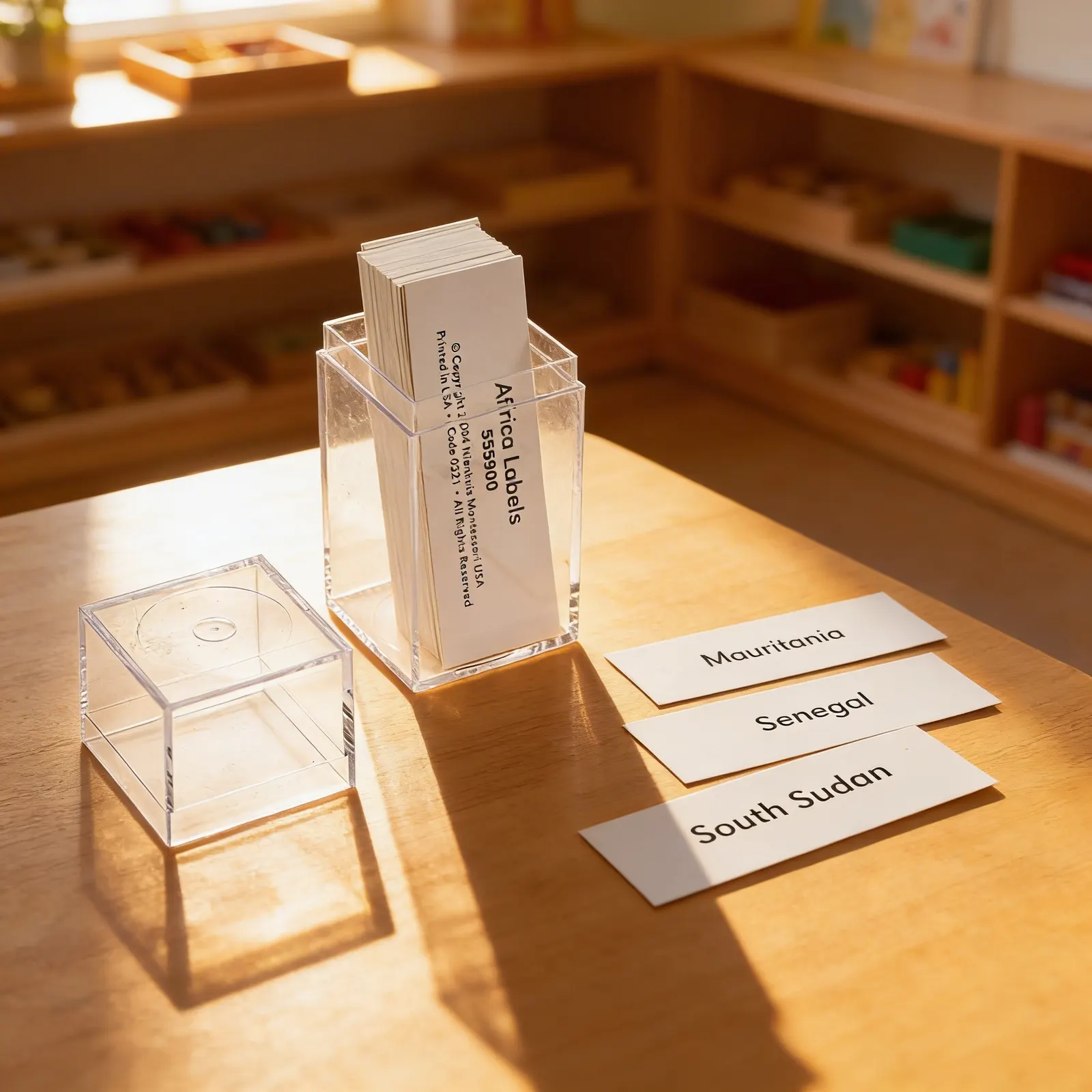
The printed labels for the Africa map: the names on their own, to be placed on the unlabeled control map one at a time. This is the item that makes the blank map work, and it is the easy one to forget when ordering. The unlabeled map they go onto and the labeled map they get checked against are both separate items, as is the puzzle map. Reading a name and finding where it belongs is a different act from recognising a shape, which is why the labels come apart from the map at all.
Geography Knowledge
Builds understanding of African countries and their locations through hands-on labeling work.
Reading Practice
Reinforces reading skills as children match written country names to map regions.
Fine Motor Skills
Develops pincer grip and hand control while handling and placing small label cards.
Cultural Awareness
Introduces children to the diverse nations of Africa, fostering global perspective.
How to present it
Place the Africa puzzle map on a work mat. Position the acrylic container of labels to the right of the map. Ensure adequate lighting for reading the paper labels clearly.
- 1Remove one puzzle piece and place it above the map
- 2Search through the visible labels in the container to find the matching country name
- 3Place the selected label below the removed puzzle piece
- 4Continue removing pieces and matching labels, creating organized columns
- 5After matching all desired pieces, return labels to container before replacing puzzle pieces
3 tips for parents
- Practice reading country names from books or maps to reinforce label recognition
- Point out African countries mentioned in news or stories to create real-world connections
- Support careful handling by demonstrating how to hold paper labels at the edges

If you are not sure it suits your child, we answer in person.
Norbert Kovalčín, founder of Faborino · write to him
There is no review here yet. We will ask you for one after you buy. Write the first review
What's in the Box
- Label cards: Approx. 5 country/region labels
- Acrylic storage container: With secure lid
- Display cube: For presentation
Size and material
| Packaging | 8 × 4 × 4 cm |
| Labels | Durable paper cardstock |
| Container | Clear acrylic plastic |
| Recommended Age | 3-6 years |
Care
Wipe container with damp cloth; keep labels dry
Frequently Asked Questions
What size are these labels and do they fit the Montessori Africa puzzle map?
These labels are specifically sized to complement standard Montessori Africa puzzle maps. Each label clearly displays the country name in readable text appropriate for young children learning geography.
How many country labels are included in this set?
The set includes labels for all 54 recognized African countries, matching the pieces typically found in Montessori Africa puzzle maps used in the 3-6 age group classroom.
What is the storage container made of and how durable is it?
The labels are stored in a transparent acrylic container that is both durable and child-friendly. The clear design allows children to see all labels at once, promoting independent selection and organization.
Can children who cannot read yet use these labels effectively?
Yes, these labels support pre-readers by helping them match shapes and beginning letter recognition. Teachers often use them for lessons on initial sounds, and children can match labels to control maps with country names.
How do these labels support the Montessori geography curriculum?
These labels enhance map work by introducing reading skills alongside geography. Children practice country identification, develop fine motor skills through label placement, and build vocabulary while learning about African nations and their locations.
Product safety
Manufacturer: Nienhuis Montessori, Anders Celsiusstraat 15, 7442 PB Nijverdal, Netherlands
Africa