
AfricaPolitical (50)
The first photo is the maker's own. The other shots are illustrative.
Inv. no. NIE-551600
- Maker
- Nienhuis Montessori, since 1929
- Approval
- AMI
- Construction
- Paper
- Finish
- Matte surface for easy tracing
- EAN
- 8719924029142
Final price incl. VAT. Delivery €5.90, €125.10 to go for free delivery.
Advice, warranty and returns are handled by us.
Why it costs €23.90
Behind the price of the original are things you can check yourself.
AMI approval
The material is approved by the Association Montessori Internationale (AMI). Nienhuis has made Montessori materials since 1929.
A verifiable original
The EAN 8719924029142 is on the box. It is the maker's number, not ours.
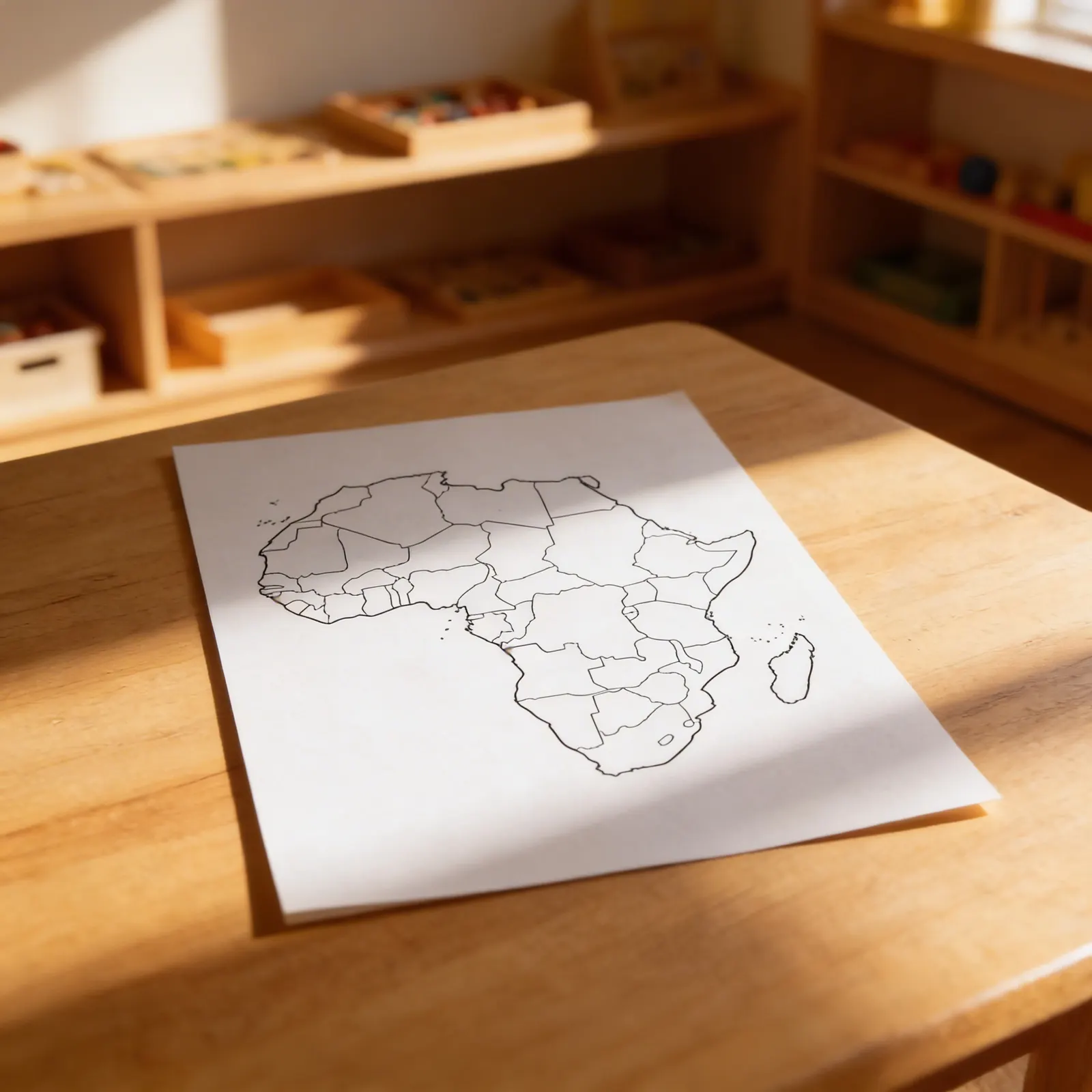
Africa in a child's hands
Africa: Political (50) is a set of fifty sheets with the same political map of the continent, divided into countries. On a sheet the child can colour each country differently, trace the borders with a pencil or write a name beside every country, and a clean sheet is there for the next attempt. The paper is white, the sheets are for use indoors according to Nienhuis, and the pack weighs 600 g. Finished sheets can be put aside and compared with later attempts. The maps are for children aged 3 to 6.
Geographic Awareness
Children learn to identify African countries and understand political boundaries through visual and tactile exploration.
Cultural Understanding
Map work introduces children to the diversity of African nations, preparing them for cultural studies and flag work.
Fine Motor Skills
Tracing country outlines and placing pins develops hand control and precision movements.
Spatial Intelligence
Working with maps enhances understanding of spatial relationships and develops cartographic literacy.
How to present it
Place the political map on a large work mat or table. Gather colored pencils, tracing paper, and a pointer or thin stick for outlining countries.
- 1Invite the child to explore the map visually, noticing how lines divide Africa into different sections
- 2Use a pointer to slowly trace the outline of one country, naming it clearly
- 3Offer tracing paper and show how to trace a single country's boundaries
- 4Introduce pin work by placing a pin or flag in each country as you name it
- 5Create labels for countries and match them to their locations on the map
3 tips for parents
- Look for Africa's shape in everyday contexts like puzzles or books to reinforce recognition
- Share stories or photos from specific African countries when your child shows interest in particular nations
- Create simple matching games using country shapes cut from cardstock to practice at home

If you are not sure it suits your child, we answer in person.
Norbert Kovalčín, founder of Faborino · write to him
There is no review here yet. We will ask you for one after you buy. Write the first review
What's in the Box
- Political Map of Africa: pack of 50 sheets
Size and material
| Packaging | 44 × 28 × 1 cm |
| Construction | Paper |
| Finish | Matte surface for easy tracing |
| Recommended Age | 3-6 years |
Care
| Cleaning | Wipe with dry cloth; avoid moisture |
| Storage | Store flat or rolled in protective tube |
Frequently Asked Questions
What size is this political map of Africa and what material is it made from?
This is a large-format educational map designed for classroom use, printed on durable material suitable for repeated handling by young children. The map is sized appropriately for floor work and wall display, making it ideal for group lessons and individual exploration in the Montessori classroom.
How can children ages 3-6 use this political map in their learning?
Children can trace the country boundaries to develop fine motor skills, use it as a base for pin map activities to mark capitals or geographical features, and engage in cultural studies by learning country names and locations. The map supports hands-on learning through movement and repetition, key principles in Montessori education.
Does this map show all 54 African countries with clear boundaries?
Yes, the political map displays all recognized African nations with clearly defined borders and continental outlines. Each country is distinctly shown, making it easy for young children to identify individual nations and understand their relationships to neighboring countries.
What other Montessori materials work well with this Africa political map?
This map pairs excellently with the Africa puzzle map, flag materials, cultural folders about African countries, and the colored globe showing continents. It also complements pin maps, outline maps for coloring, and three-part cards featuring African landmarks and cultural elements.
How does this map support the Montessori geography curriculum for ages 3-6?
The map aligns with the Montessori sequence of introducing continents after the child understands land and water forms. It provides concrete, visual learning that moves from whole (continent) to parts (countries), supporting the child's natural development of spatial awareness and cultural understanding during the sensitive period for order and classification.
Product safety
Manufacturer: Nienhuis Montessori, Anders Celsiusstraat 15, 7442 PB Nijverdal, Netherlands
Africa