
Algebraic Peg Board Activity Set2
The first photo is the maker's own. The other shots are illustrative.
Inv. no. NIE-061401
- Maker
- Nienhuis Montessori, since 1929
- Approval
- AMI
- Storage Box
- Natural wood construction
- Activity Cards
- Durable cardstock or laminated paper
- EAN
- 8719924013417
Final price incl. VAT. Delivery €5.90, €94.10 to go for free delivery.
Advice, warranty and returns are handled by us.
Why it costs €54.90
Behind the price of the original are things you can check yourself.
AMI approval
The material is approved by the Association Montessori Internationale (AMI). Nienhuis has made Montessori materials since 1929.
A verifiable original
The EAN 8719924013417 is on the box. It is the maker's number, not ours.
Algebraic Peg Board Activity Set in a child's hands
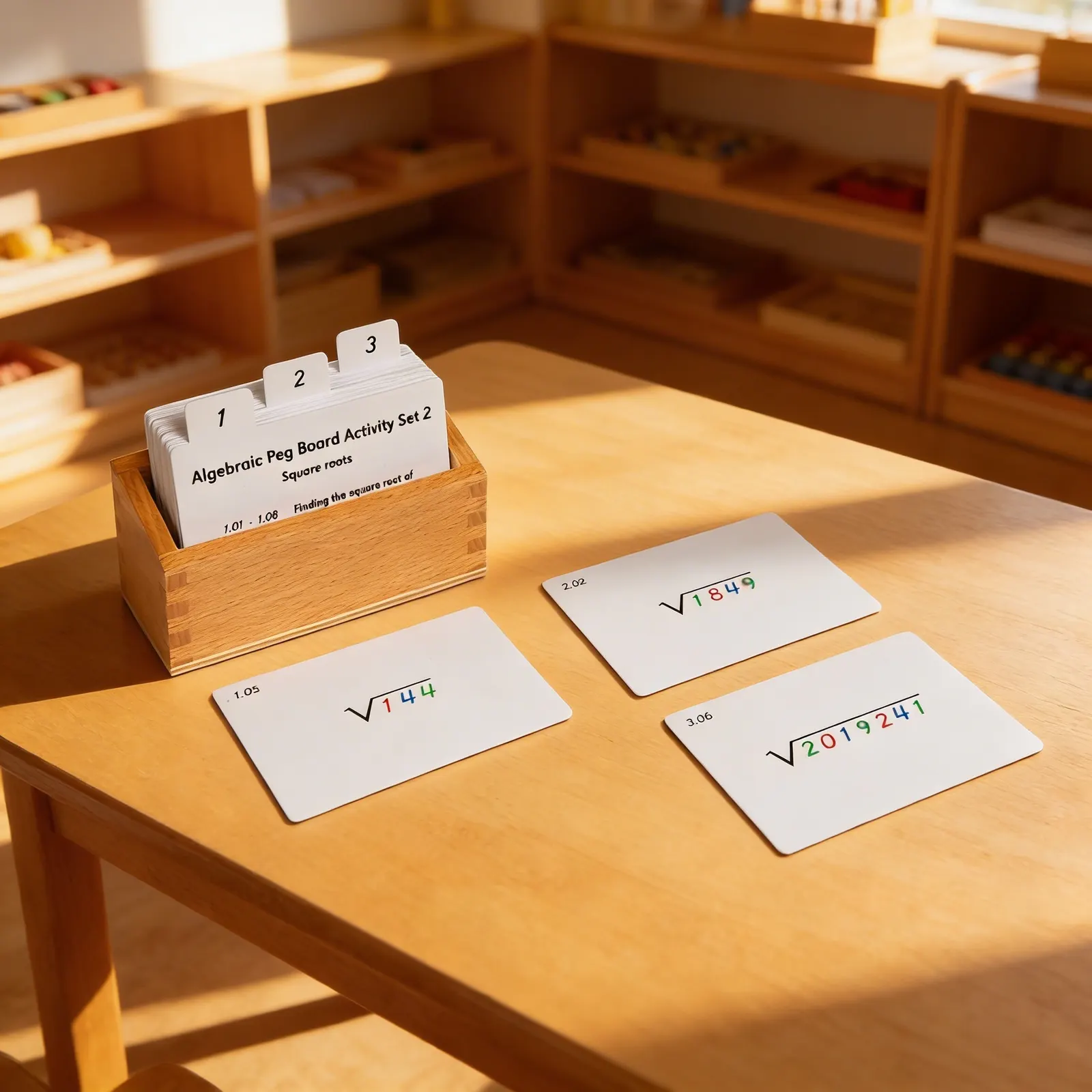
Tangible to conceptual, this Algebraic Peg Board Activity Set introduces advanced mathematical concepts through real-world practice of square roots and algebraic relationships. The wooden storage box contains systematically organized cards showing color-coded peg patterns that visually represent square root problems, helping children ages 3-6 build concrete understanding of abstract mathematical principles through Montessori's sensorial approach.
Mathematical Abstraction
Bridges concrete manipulatives with abstract algebraic concepts through visual and tactile exploration.
Pattern Recognition
Color-coded systems develop mathematical pattern awareness and logical thinking skills.
Sequential Learning
Numbered organization supports progressive skill building from simple to complex concepts.
Visual-Spatial Intelligence
Peg patterns strengthen spatial reasoning and mathematical visualization abilities.
How to present it
Place the peg board on a work mat with the wooden storage box to the right. Remove pattern cards and sort by difficulty level. Arrange colored pegs in separate containers.
- 1Select the simplest square root pattern card (2² = 4) and place it above the peg board
- 2Match colored pegs to the pattern shown on the card, building the square formation
- 3Once complete, count the total pegs and relate to the square root shown on the card
- 4Remove pegs systematically and select the next pattern card in sequence
- 5Progress through increasingly complex patterns, noting the growing square formations
3 tips for parents
- Notice square patterns in everyday life (floor tiles, windows) and relate to peg board work
- Avoid rushing to explain the mathematical concepts - let discovery happen through manipulation
- Support pattern work at home with simple materials like buttons or coins arranged in squares

If you are not sure it suits your child, we answer in person.
Norbert Kovalčín, founder of Faborino · write to him
There is no review here yet. We will ask you for one after you buy. Write the first review
What's in the Box
- Wooden Storage Box: with numbered dividers
- Square Root Activity Cards: multiple difficulty levels
- Numbered Divider Tabs: for systematic organization
- Color-Coded Pattern Cards: for algebraic concept visualization
Size and material
| Packaging | 14 × 11 × 7 cm |
| Storage Box | Natural wood construction |
| Activity Cards | Durable cardstock or laminated paper |
| Recommended Age | 6-12 years |
Care
Wipe wooden box with slightly damp cloth; keep cards dry
Frequently Asked Questions
How does this peg board teach algebraic concepts to young children?
The peg board uses color-coded patterns to create visual representations of mathematical relationships. Children physically place pegs to form squares and rectangles, discovering that certain arrangements create perfect squares. This concrete manipulation helps them understand that 4 pegs can form a 2x2 square, 9 pegs form a 3x3 square, building an intuitive grasp of square roots before formal instruction.
What mathematical concepts can children explore with this set?
Children explore square numbers, square roots, multiplication patterns, and basic algebraic relationships. The activity cards guide them through creating visual arrays that demonstrate concepts like 2²=4, 3²=9, and 4²=16. They also discover patterns in number sequences and develop spatial reasoning while building geometric shapes with the pegs.
Is this appropriate for children who haven't learned multiplication yet?
Yes, this material is specifically designed for the absorbent mind of 3-6 year olds. Children don't need to know multiplication tables to benefit from the visual and tactile experiences. They naturally discover mathematical patterns through hands-on exploration, preparing their minds for later abstract understanding of these concepts.
What skills does this activity develop beyond mathematics?
Beyond mathematical understanding, children develop fine motor control through precise peg placement, visual discrimination by matching colors and patterns, concentration through focused work, and logical thinking by following sequential pattern cards. The activity also builds patience, order, and the ability to self-correct errors.
How many activity cards are included and how are they organized?
The set includes systematically organized cards stored in the wooden box, progressing from simple to complex patterns. Cards are color-coded to match the pegs and arranged to guide children through discovering mathematical relationships independently. The organization allows children to work at their own pace and return to previous concepts as needed.
Product safety
Manufacturer: Nienhuis Montessori, Anders Celsiusstraat 15, 7442 PB Nijverdal, Netherlands
Algebraic Peg Board Activity Set