
Animal Cell Nomenclature Cards
The first photo is the maker's own. The other shots are illustrative.
Inv. no. NIE-020901
- Maker
- Nienhuis Montessori, since 1929
- Approval
- AMI
- Product size
- 15.5 × 16.5 × 6.5 cm
- Cards
- Plastic
- Storage
- Wooden box
- EAN
- 8719924057435
Final price incl. VAT. Delivery €5.90, €85.10 to go for free delivery.
Advice, warranty and returns are handled by us.
Why it costs €63.90
Behind the price of the original are things you can check yourself.
AMI approval
The material is approved by the Association Montessori Internationale (AMI). Nienhuis has made Montessori materials since 1929.
A verifiable original
The EAN 8719924057435 is on the box. It is the maker's number, not ours.
Animal Cell Nomenclature Cards in a child's hands
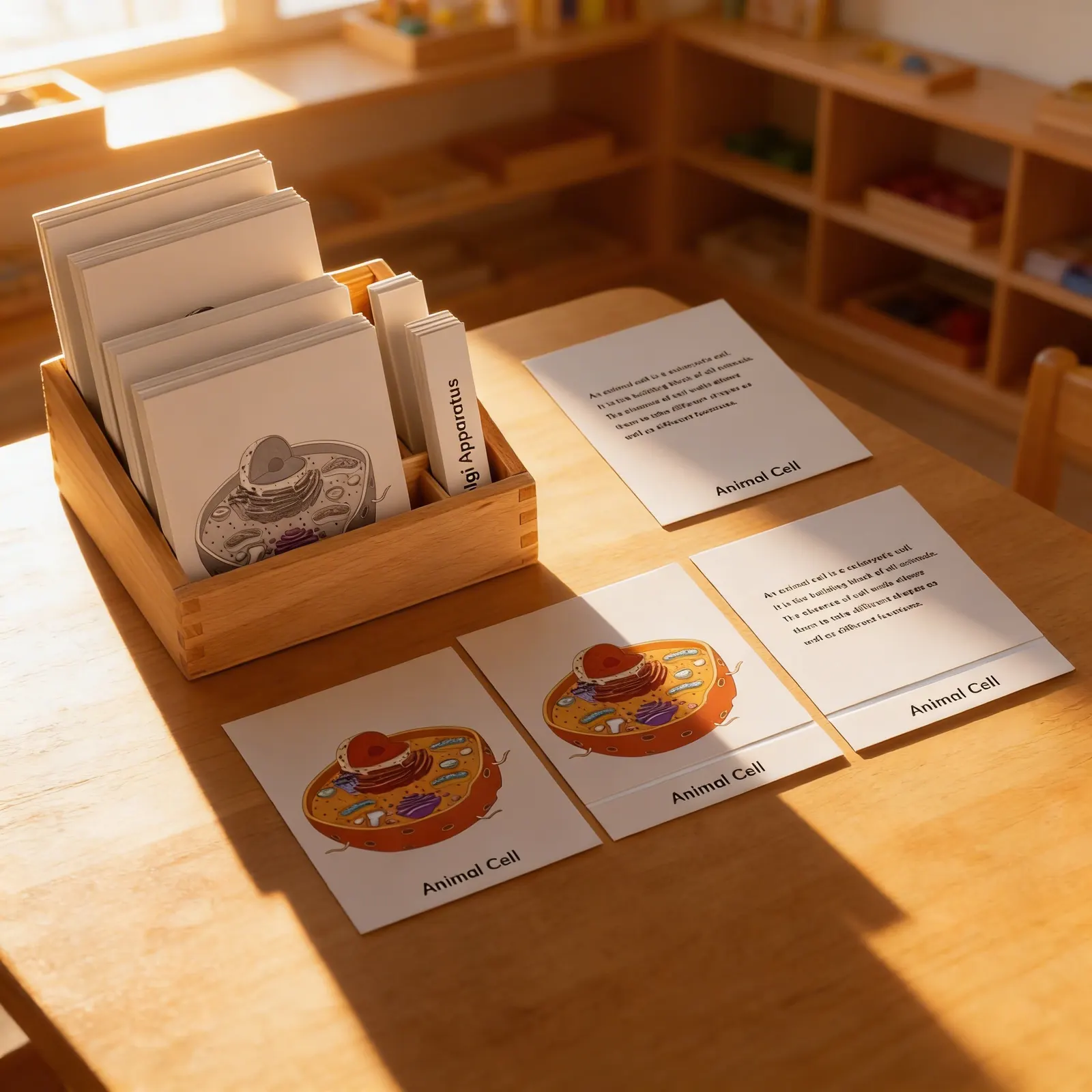
Animal cell nomenclature cards with 19 parts: each part has a shape card with a separate label, a definition card with a separate label and 2 control cards with the caption at the bottom. The cards are made of plastic for durability and are stored in a wooden box measuring 15.5 × 16.5 × 6.5 centimetres. The set is used alongside the plant cell, and that comparison is its whole point: the child sees what the two have in common and what they do not, namely that only the plant has a cell wall and chloroplasts. The difference is clearer from two pictures side by side than from any explanation. Plastic and wood, for children aged 6 to 12.
Scientific Vocabulary
Introduces precise biological terminology through concrete visual representations, building a foundation for future scientific learning.
Visual Discrimination
Matching activities develop the ability to identify and differentiate cellular structures and their corresponding labels.
Reading Comprehension
Definition cards support emerging readers in connecting scientific concepts to written descriptions.
Classification Skills
Organizing and categorizing cell parts develops logical thinking and systematic approach to learning.
How to present it
Place the wooden box on a mat. Remove the picture cards showing the complete animal cell. Arrange the label cards and definition cards in separate columns to the right.
- 1Present the complete cell diagram, pointing to and naming 2-3 main structures
- 2Match the corresponding label cards to each structure you've introduced
- 3Read the definition cards for these structures, placing them next to their labels
- 4Invite the child to continue matching remaining structures independently
- 5Use the control card to verify correct matches
3 tips for parents
- Look for cells in everyday contexts - discuss how foods like eggs are single cells
- Visit science museums with microscope exhibits to see real cells
- Support vocabulary development by using scientific terms naturally in conversation

If you are not sure it suits your child, we answer in person.
Norbert Kovalčín, founder of Faborino · write to him
There is no review here yet. We will ask you for one after you buy. Write the first review
What's in the Box
- Shape Cards: 19 animal cell parts, each with a separate label
- Definition Cards: A definition for every part, with a separate label
- Control Cards: 2 for every part, with the caption at the bottom
- Wooden Storage Box: 15.5 × 16.5 × 6.5 cm
Size and material
| Product size | 15.5 × 16.5 × 6.5 cm |
| Packaging | 18 × 17 × 12 cm |
| Cards | Plastic |
| Storage | Wooden box |
| Recommended Age | 6-12 years |
Care
Wipe cards with damp cloth; dust wooden box regularly
Frequently Asked Questions
What cell parts are included in this set?
The cards typically include major animal cell structures such as nucleus, cell membrane, cytoplasm, mitochondria, endoplasmic reticulum, Golgi apparatus, ribosomes, and lysosomes, with age-appropriate definitions for each component.
How do these cards differ from traditional biology textbooks?
Unlike textbooks, these cards allow hands-on manipulation and self-corrected learning. Children can physically match, sort, and arrange the cards, making abstract cellular concepts concrete and engaging for young learners.
Can these cards be used alongside plant cell materials?
Absolutely! These cards complement plant cell nomenclature cards beautifully, allowing children to compare and contrast cellular structures between plant and animal cells, deepening their understanding of living organisms.
What's the recommended presentation sequence for this material?
Start with picture-to-picture matching, progress to label reading and matching, then introduce definition cards. Finally, children can create their own booklets or drawings, reinforcing learning through multiple sensory experiences.
Product safety
Manufacturer: Nienhuis Montessori, Anders Celsiusstraat 15, 7442 PB Nijverdal, Netherlands
Animal Cell Nomenclature Cards