
Animal NamesLanguage Classification Cards
The first photo is the maker's own. The other shots are illustrative.
Inv. no. NIE-562300
- Maker
- Nienhuis Montessori, since 1929
- Approval
- AMI
- Card Material
- White card stock
- EAN
- 8719924029999
Final price incl. VAT. Delivery €5.90, €116.10 to go for free delivery.
Advice, warranty and returns are handled by us.
Why it costs €32.90
Behind the price of the original are things you can check yourself.
AMI approval
The material is approved by the Association Montessori Internationale (AMI). Nienhuis has made Montessori materials since 1929.
A verifiable original
The EAN 8719924029999 is on the box. It is the maker's number, not ours.
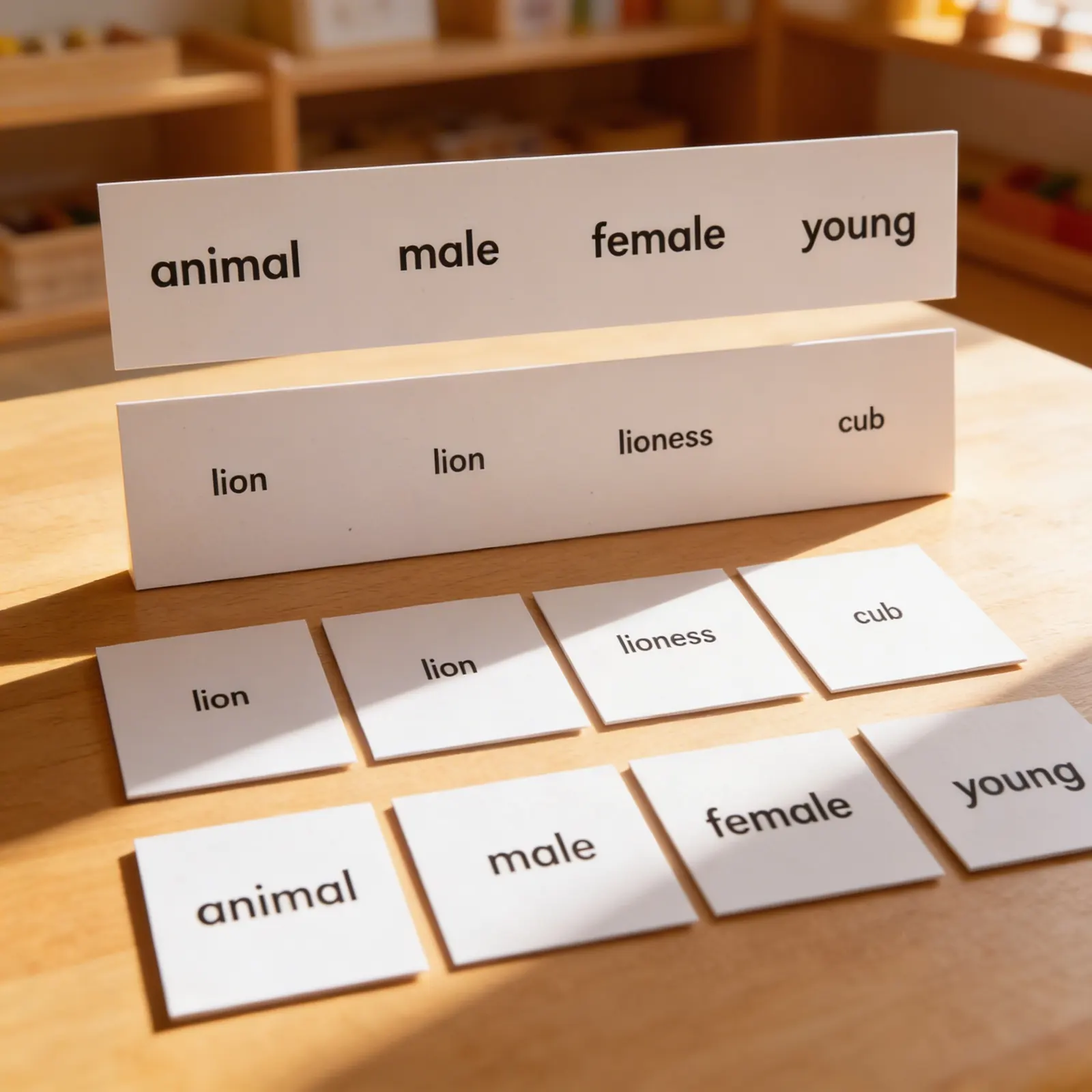
Animal Names in a child's hands
Twenty seven wild and domestic animals with the names of the male, the female and the young, a hundred and twelve cards in all with twenty seven controls and title cards. The cards are in English, which keeps separate words for these: a horse is a stallion, a mare and a foal, and none of the three sounds like the others. That is a vocabulary a child cannot deduce and has to be given, which is exactly what a card set is for. White card stock, for ages 3 to 6.
Language Development
Expands zoological vocabulary with the names of the male, female and young through concrete matching work.
Reading Practice
Reinforces reading skills through clear text recognition and word-to-concept matching.
How to present it
3 tips for parents
- Visit zoos or aquariums to see the animals from the cards in person
- Create homemade cards featuring pets or local wildlife
- Read non-fiction books about the animals named on the cards

If you are not sure it suits your child, we answer in person.
Norbert Kovalčín, founder of Faborino · write to him
There is no review here yet. We will ask you for one after you buy. Write the first review
What's in the Box
- Title Cards: Included
- Animal Name Cards: 112 cards in English naming the male, female and young of 27 animals
- Control Cards: 27 cards
Size and material
| Packaging | 28 × 5 × 2 cm |
| Card Material | White card stock |
| Recommended Age | 3-6 years |
Care
Wipe with slightly damp cloth, dry immediately
Frequently Asked Questions
What does this card set contain?
The set contains the names of 27 wild and domestic animals: 112 cards naming the male, female and young, 27 control cards and title cards. The cards are in English.
Can these cards be used alongside other Montessori biology materials?
Yes, these cards complement other biology materials beautifully. They can be used with animal figurines, the farm or zoo environments, nomenclature cards, and later with more advanced classification work, creating a comprehensive approach to zoological studies.
How do children self-correct when using these animal classification cards?
Children can self-correct by using the control cards, through peer collaboration, or by referring to animal books and charts. The material's design encourages independent checking and builds confidence.
Product safety
Manufacturer: Nienhuis Montessori, Anders Celsiusstraat 15, 7442 PB Nijverdal, Netherlands
Animal Names