
Animal Puzzle Activity Set
The first photos are the maker's own. The other shots are illustrative.
Inv. no. NIE-020301
- Maker
- Nienhuis Montessori, since 1929
- Approval
- AMI
- Storage Box
- Natural wood
- Puzzle Boards
- Wood with laminated surface
- EAN
- 8719924010942
Final price incl. VAT. Delivery €5.90, €44.10 to go for free delivery.
Advice, warranty and returns are handled by us.
Why it costs €104.90
Behind the price of the original are things you can check yourself.
AMI approval
The material is approved by the Association Montessori Internationale (AMI). Nienhuis has made Montessori materials since 1929.
A verifiable original
The EAN 8719924010942 is on the box. It is the maker's number, not ours.
Animal Puzzle Activity Set in a child's hands
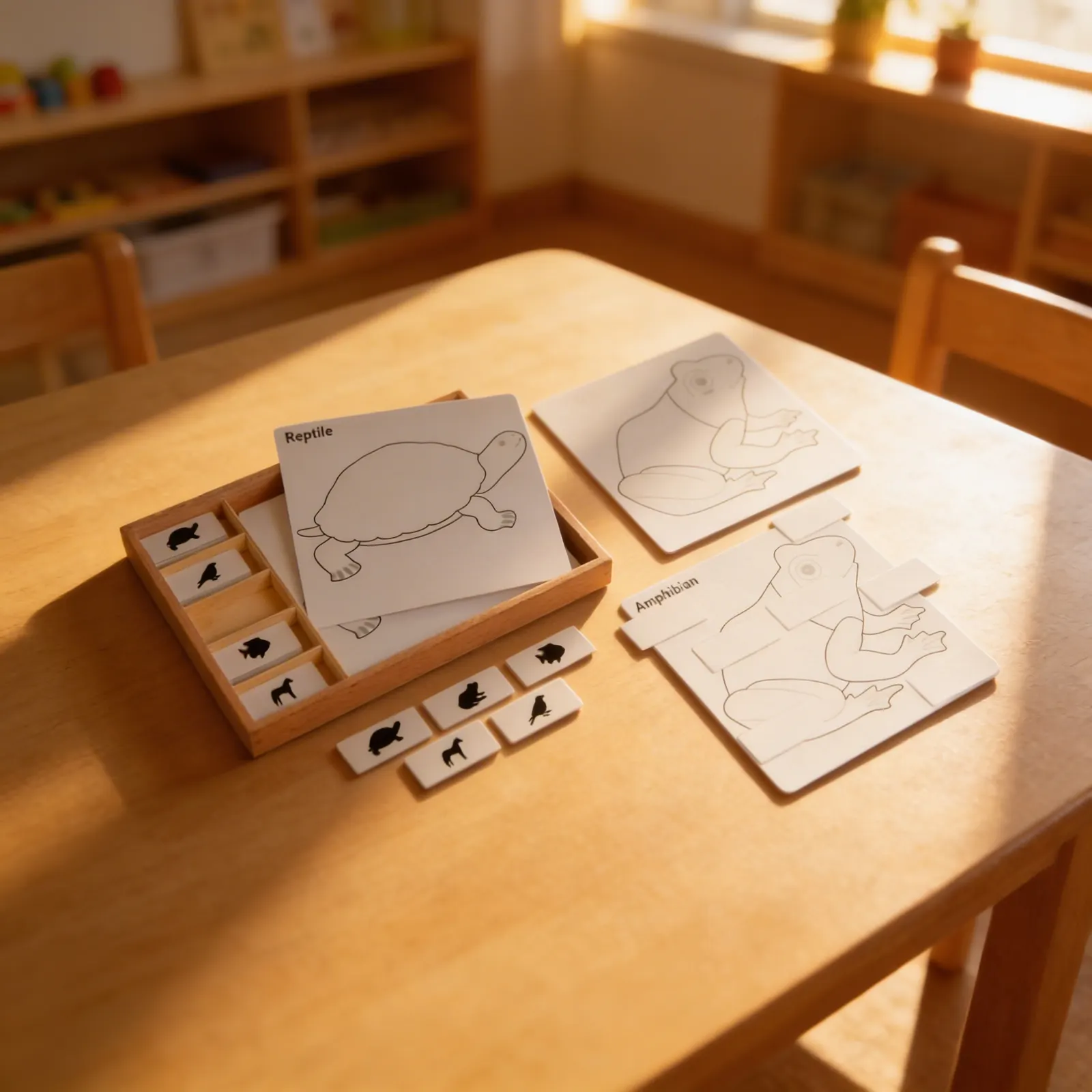
A complete teaching aid, this Animal Puzzle Activity Set gives young learners a first look at zoological classification through active discovery of animal anatomy. Each wooden puzzle board features labeled body parts that help children identify and understand the unique characteristics of different animal groups. The set includes matching silhouette cards for classification activities and comes organized in a compartmentalized wooden storage box.
Zoological Classification
Children learn to identify and categorize animals based on their physical characteristics and anatomical features.
Vocabulary Development
Labeled body parts introduce scientific terminology while building language skills through concrete visual references.
Visual Discrimination
Matching puzzle pieces to silhouettes refines perception and strengthens the ability to recognize shapes and forms.
Fine Motor Coordination
Manipulating puzzle pieces develops pincer grasp and hand-eye coordination essential for writing preparation.
How to present it
Place the wooden storage box on a work mat. Select one animal puzzle board and its corresponding silhouette card. Arrange the puzzle pieces in a basket to the left of the board.
- 1Invite the child to examine the empty puzzle board, reading each labeled section together
- 2Select one puzzle piece and identify its corresponding body part label on the board
- 3Place each piece deliberately, naming the body part as you position it
- 4Once complete, introduce the silhouette card for matching and classification
- 5Return pieces to the storage compartment, maintaining organization
3 tips for parents
- Visit zoos or aquariums to observe real animals after working with specific puzzles
- Create a nature journal to draw and label animals found in your environment
- Read non-fiction books about animals featured in the puzzle collection

If you are not sure it suits your child, we answer in person.
Norbert Kovalčín, founder of Faborino · write to him
There is no review here yet. We will ask you for one after you buy. Write the first review
What's in the Box
- Animal puzzle boards: Approx. 14 puzzles with labeled body parts
- Silhouette classification cards: Matching cards for each animal
- Wooden storage box: With individual compartments for organization
Size and material
| Packaging | 33 × 25 × 5 cm |
| Storage Box | Natural wood |
| Puzzle Boards | Wood with laminated surface |
| Classification Cards | Laminated cardstock |
| Recommended Age | 3-6 years |
Care
Wipe wooden surfaces with slightly damp cloth; clean laminated pieces with dry cloth
Frequently Asked Questions
What animals are included in this puzzle set?
The set typically includes 5-8 different animal puzzles representing various animal groups such as mammals, birds, fish, reptiles, and insects. Each puzzle features anatomically accurate body parts with clear labels to help children learn animal characteristics and classification.
How does this set help children learn zoological classification?
Children learn classification by examining and comparing anatomical features across different animals. The matching silhouette cards encourage sorting activities where children group animals by shared characteristics, introducing basic taxonomy concepts through hands-on exploration rather than memorization.
What makes this different from regular animal puzzles?
Unlike typical puzzles, this Montessori material features labeled body parts on each piece, teaching anatomical vocabulary and animal characteristics. The inclusion of classification cards and the systematic approach to presenting different animal groups makes it an educational tool for understanding zoology rather than just puzzle play.
Is this appropriate for a 3-year-old who's just starting to learn about animals?
Yes, the puzzles are designed with large, easy-to-handle pieces suitable for 3-year-olds. Younger children can start by simply completing the puzzles and matching animals to silhouettes, while older children progress to reading labels, comparing body parts, and sorting animals into groups.
How should I present this material to maximize learning?
Start with one animal puzzle at a time, allowing the child to explore and name familiar body parts. Gradually introduce anatomical vocabulary using the labels. Once comfortable with individual puzzles, use the silhouette cards for matching games and classification activities, encouraging children to notice similarities and differences between animal groups.
Product safety
Manufacturer: Nienhuis Montessori, Anders Celsiusstraat 15, 7442 PB Nijverdal, Netherlands
Animal Puzzle Activity Set