
Animal PuzzleFish
The first photo is the maker's own. The other shots are illustrative.
Inv. no. NIE-0199C0
- Maker
- Nienhuis Montessori, since 1929
- Approval
- AMI
- Base Material
- Birch plywood
- EAN
- 8719924010805
Final price incl. VAT. Delivery €5.90, €109.10 to go for free delivery.
Advice, warranty and returns are handled by us.
Why it costs €39.90
Behind the price of the original are things you can check yourself.
AMI approval
The material is approved by the Association Montessori Internationale (AMI). Nienhuis has made Montessori materials since 1929.
A verifiable original
The EAN 8719924010805 is on the box. It is the maker's number, not ours.
Animal Puzzle in a child's hands
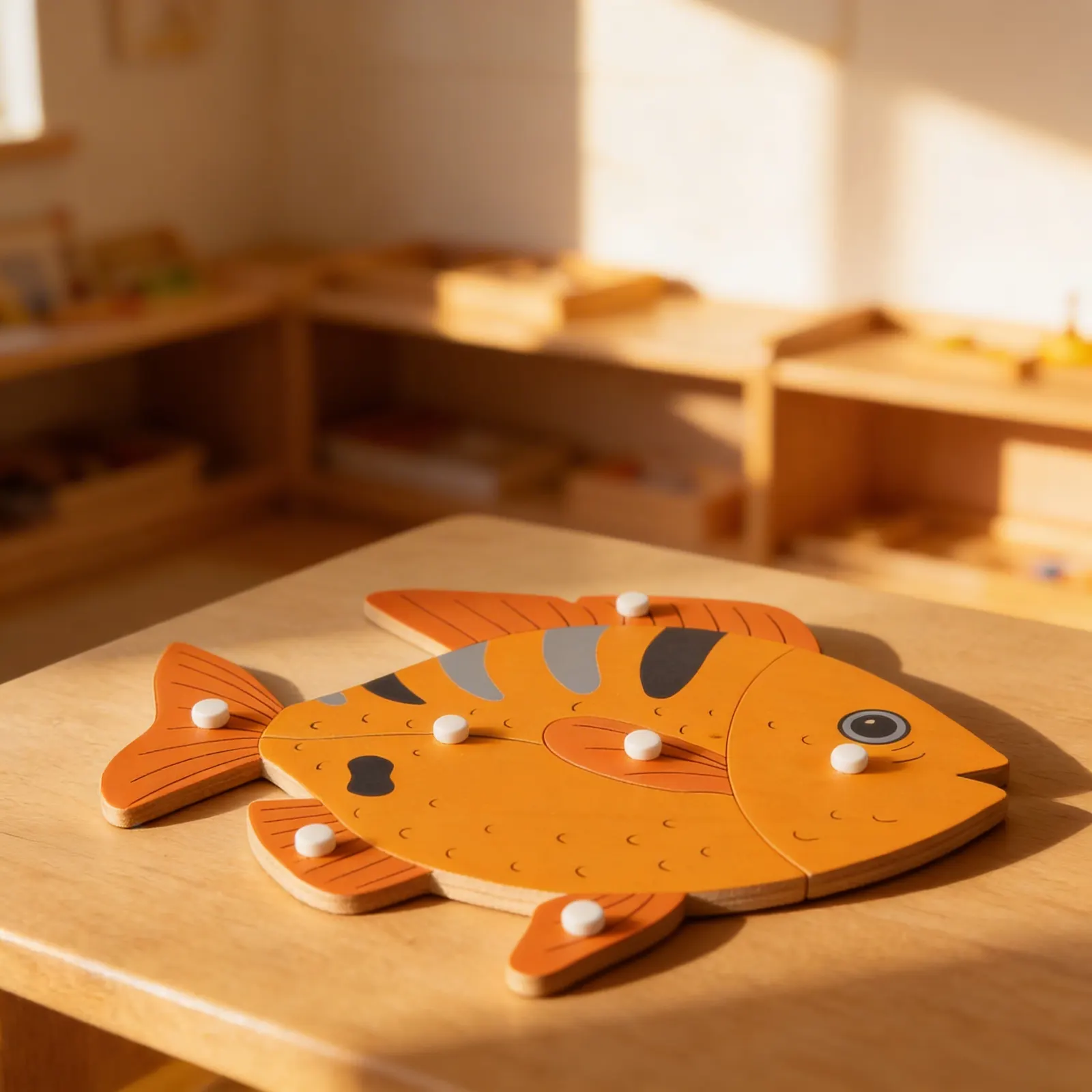
Animal Puzzle: Fish is a wooden puzzle of a fish from the Nienhuis Montessori range. According to the manufacturer it is made of birch plywood, is orange in colour and is meant for indoor use. The child takes the pieces out of the puzzle and fits them back together into the fish, and the puzzle is finished when every piece sits in its place. The work can be repeated as often as the child likes. In the catalogue it belongs to the zoology materials. Packed, the puzzle measures 25 × 25 × 3 cm and weighs 600 g. For ages 3 to 6.
Zoology Foundation
Introduces vertebrate anatomy and fish characteristics through concrete manipulation.
Fine Motor Refinement
White knobs promote proper pencil grip while assembling intricate puzzle pieces.
Visual Discrimination
Children learn to identify subtle differences in shape and pattern while matching pieces.
Concentration Development
Multi-piece assembly requires sustained focus and sequential thinking skills.
How to present it
Place the puzzle on a tray with the frame on the left and pieces arranged randomly on the right. Ensure the work surface is at the child's elbow height when seated.
- 1Invite the child to explore the empty puzzle frame, tracing the outline with their finger
- 2Select the head piece first, grasping the white knob with thumb and index finger
- 3Continue with the body sections, working from head to tail in sequence
- 4Add the fins last - dorsal (top), pectoral (sides), and pelvic fins
- 5Once complete, invite the child to remove and replace pieces independently
3 tips for parents
- Visit an aquarium or fish market to observe real fish anatomy before or after puzzle work
- Read simple books about fish to reinforce the vocabulary learned with the puzzle
- During bath time, discuss how fish move in water compared to how your child moves

If you are not sure it suits your child, we answer in person.
Norbert Kovalčín, founder of Faborino · write to him
There is no review here yet. We will ask you for one after you buy. Write the first review
What's in the Box
- Animal puzzle: Fish: wooden puzzle (birch, birch plywood)
Size and material
| Packaging | 25 × 25 × 3 cm |
| Base Material | Birch plywood |
| Recommended Age | 3-6 years |
Care
Wipe with damp cloth, dry immediately
Frequently Asked Questions
What age is the Animal Puzzle: Fish appropriate for?
This puzzle is designed for children ages 3-6 years old. The white knobs make it accessible for younger children still developing pincer grip, while the anatomical concepts provide learning opportunities that grow with the child through age 6.
What parts of the fish are included in this puzzle?
Each piece is designed to teach children about vertebrate structure and how the parts work together.
How does this puzzle support Montessori learning principles?
This puzzle follows Montessori principles by offering concrete, hands-on learning about abstract concepts. Children can manipulate real objects to understand fish anatomy, supporting sensorial learning and the movement from concrete to abstract thinking characteristic of Montessori education.
What skills does the Animal Puzzle: Fish help develop?
This puzzle develops multiple skills including fine motor control through knob manipulation, spatial reasoning through piece placement, scientific vocabulary related to animal anatomy, and early biology concepts about vertebrate structure and body parts.
Is this puzzle self-correcting like other Montessori materials?
Yes, the puzzle is self-correcting. Each piece fits only in its correct position, allowing children to work independently and learn through trial and error. This built-in control of error helps children develop problem-solving skills and confidence in their abilities.
Product safety
Manufacturer: Nienhuis Montessori, Anders Celsiusstraat 15, 7442 PB Nijverdal, Netherlands
Animal Puzzle