
Animal PuzzleFrog
The first photo is the maker's own. The other shots are illustrative.
Inv. no. NIE-0199B0
- Maker
- Nienhuis Montessori, since 1929
- Approval
- AMI
- Primary Material
- Solid wood
- Finish
- Paint coating
- EAN
- 8719924010799
Final price incl. VAT. Delivery €5.90, €109.10 to go for free delivery.
Advice, warranty and returns are handled by us.
Why it costs €39.90
Behind the price of the original are things you can check yourself.
AMI approval
The material is approved by the Association Montessori Internationale (AMI). Nienhuis has made Montessori materials since 1929.
A verifiable original
The EAN 8719924010799 is on the box. It is the maker's number, not ours.
Animal Puzzle in a child's hands
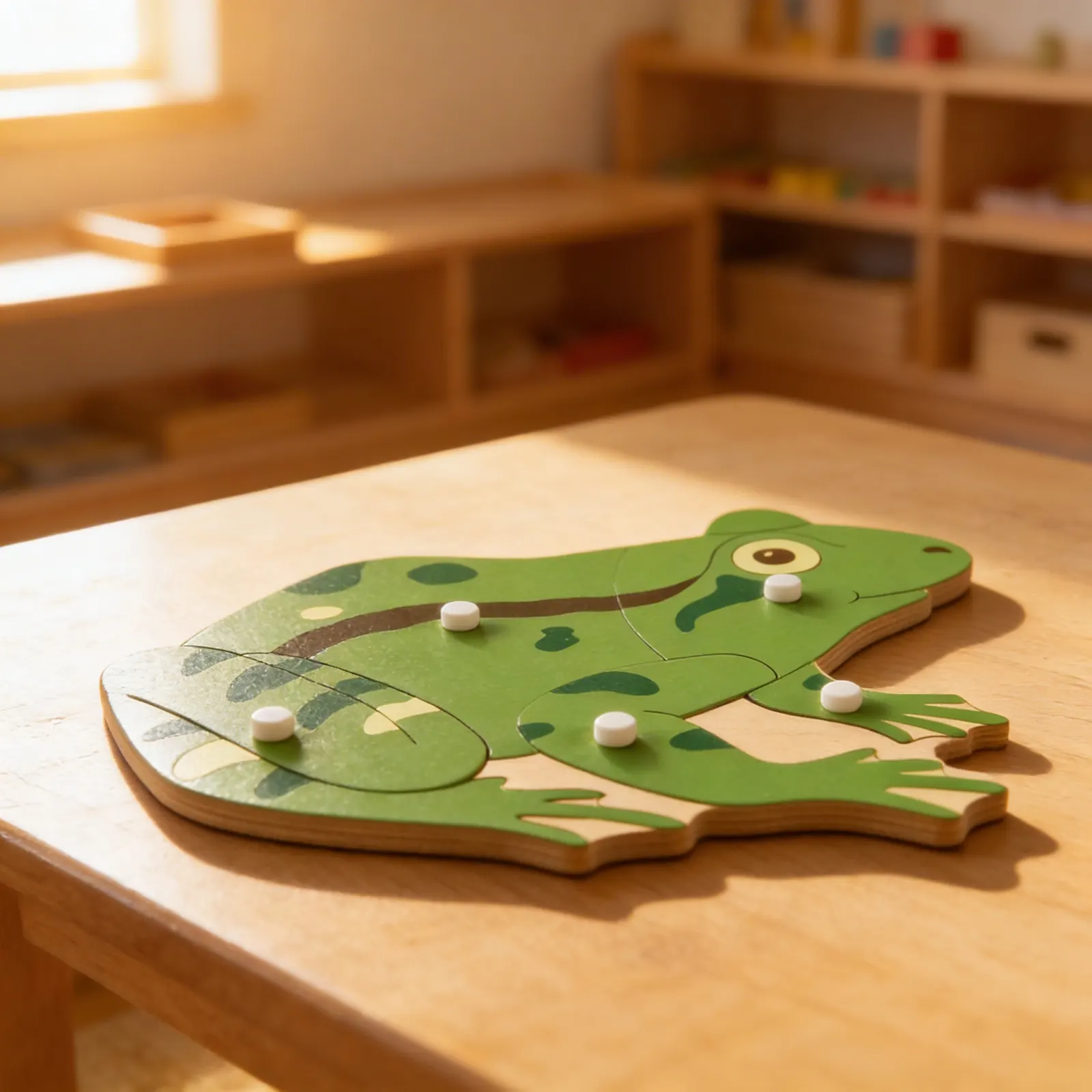
The frog puzzle from the zoology series, separating into the parts of a frog. The frog is the animal in the set that used to be a different shape entirely: it had a tail and no legs and breathed underwater, and every part on this puzzle is one it grew. Children meet frogspawn and tadpoles long before they meet the word metamorphosis, and a puzzle of the finished animal is where those two halves of the story get joined. Wood with paint, for ages 3 to 6.
Biology Knowledge
Introduces basic amphibian anatomy and the concept that living things are made of parts that work together.
Fine Motor Control
Knobbed pieces strengthen pincer grip while precise fitting develops hand-eye coordination.
Visual Discrimination
Matching puzzle pieces to their spaces refines perception of shape, size, and spatial relationships.
Concentration Building
The focused work of completing the puzzle develops sustained attention and task persistence.
How to present it
Place the frog puzzle on a tray at the child's work table. Ensure all pieces are present and knobs are secure. Have a real photograph of a frog nearby for reference.
- 1Remove each piece slowly using the knob, naming each body part as you lift it
- 2Arrange removed pieces in order on the table, creating a 'frog map'
- 3Invite the child to replace pieces, starting with the body
- 4Once complete, trace around the frog with your finger, reviewing part names
3 tips for parents
- Visit a pond or stream to observe real frogs, connecting the puzzle to living creatures
- Read factual books about frogs during quiet time, reinforcing puzzle vocabulary
- Allow repeated puzzle work even after mastery - repetition deepens understanding

If you are not sure it suits your child, we answer in person.
Norbert Kovalčín, founder of Faborino · write to him
There is no review here yet. We will ask you for one after you buy. Write the first review
What's in the Box
- Wooden puzzle frame: 20×20cm base with recessed areas
- Frog puzzle pieces: Approx. 7 pieces with knob handles
Size and material
| Packaging | 25 × 25 × 3 cm |
| Primary Material | Solid wood |
| Finish | Paint coating |
| Recommended Age | 3-6 years |
Care
Wipe with slightly damp cloth, dry immediately
Frequently Asked Questions
What parts of the frog anatomy does this puzzle teach?
This puzzle features the main body parts of a frog including the head, body, front legs, and hind legs. Each piece is designed to show how these parts connect together to form a complete amphibian, helping children understand basic frog anatomy and body structure.
Is this puzzle self-correcting for independent learning?
Yes, each puzzle piece fits only in its correct position, making it self-correcting. The easy-grip knobs allow children to manipulate pieces independently, and the precise fit provides immediate feedback when pieces are placed correctly, supporting autonomous learning.
What skills does this frog puzzle develop besides biology knowledge?
Beyond amphibian anatomy, this puzzle develops fine motor skills through knob gripping, hand-eye coordination, spatial reasoning, problem-solving abilities, and concentration. It also builds vocabulary related to animals and nature while fostering scientific observation skills.
How durable is the wooden construction for classroom use?
The puzzle is crafted from high-quality wood with smooth, splinter-free surfaces and a protective finish. The knobs are securely attached, and the base is sturdy enough to withstand daily classroom use by multiple children while maintaining its educational value.
Can this puzzle be used alongside other animal puzzles for comparative anatomy?
Absolutely! This frog puzzle works excellently with other animal puzzles to teach comparative anatomy. Children can explore differences between amphibians, mammals, birds, and insects, understanding how different animals have unique body structures adapted to their environments.
Product safety
Manufacturer: Nienhuis Montessori, Anders Celsiusstraat 15, 7442 PB Nijverdal, Netherlands
Animal Puzzle