
Animal Young 3 Part Cards
The first photo is the maker's own. The other shots are illustrative.
Inv. no. NIE-EC0605A
- Maker
- Nienhuis Montessori, since 1929
- Product size
- 9.5 × 12.7 cm
- Material
- Durable plastic
- Finish
- Pre-cut with rounded corners
- EAN
- 8719924043063
Final price incl. VAT. Delivery €5.90, €94.10 to go for free delivery.
Advice, warranty and returns are handled by us.
Animal Young 3 Part Cards in a child's hands
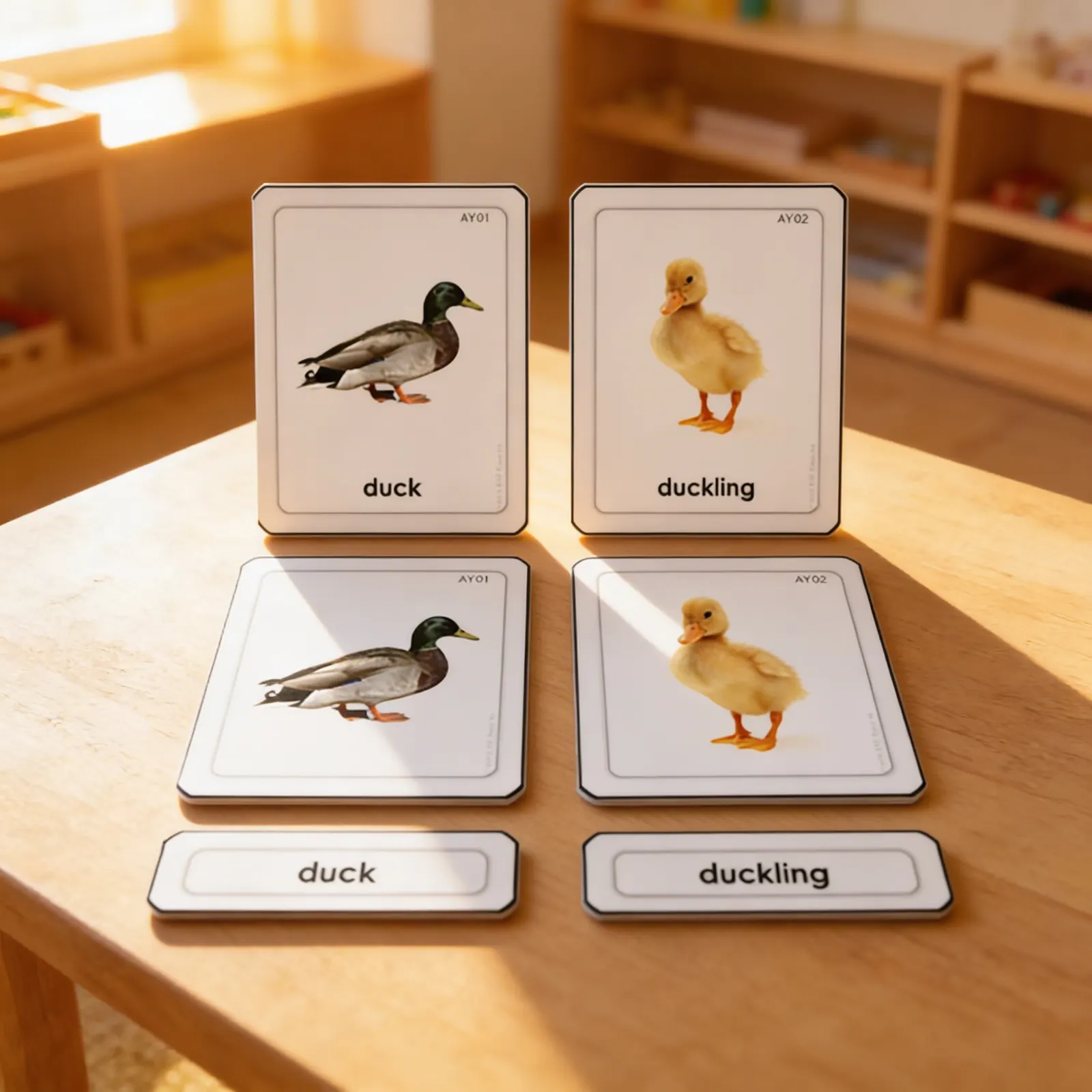
Three part cards for the young of animals, with a real photograph of each. Baby animals are the subject children already care about, and the vocabulary is genuinely hard: a young horse, a young goose and a young frog have three unrelated names, none of which can be guessed. Three part cards give the picture, the word and the pair to match them with. Durable plastic with rounded corners. In English, so the names taught are the English ones.
Vocabulary Development
Builds specific terminology for adult animals and their young through visual association and label matching.
Classification Skills
Develops understanding of relationships between mature animals and their offspring.
Visual Discrimination
Enhances ability to identify similarities and differences between related animals.
Reading Preparation
Supports early literacy through picture-to-word matching activities.
How to present it
Place the control cards (picture with label attached) in a column on the left side of the work mat. Arrange the separate picture cards randomly to the right, with label cards in a small basket.
- 1Introduce vocabulary using the control cards, pointing to each animal: 'This is a duck. This is a duckling.'
- 2Match the separate picture cards to their corresponding control cards, naming each as you place them
- 3Once pictures are matched, read each label card and place below the corresponding picture pair
- 4Use the control cards to check work by comparing label placement
3 tips for parents
- Point out parent-young animal pairs during nature walks or zoo visits to reinforce the vocabulary
- Create a photo book of pets and their babies using family photos or magazine pictures
- Read picture books featuring animal families to extend the learning beyond card work

If you are not sure it suits your child, we answer in person.
Norbert Kovalčín, founder of Faborino · write to him
There is no review here yet. We will ask you for one after you buy. Write the first review
What's in the Box
- Picture Cards: Approx. 6 photo cards
- Label Cards: Matching text nomenclature cards
Size and material
| Product size | 9.5 × 12.7 cm |
| Packaging | 15 × 15 × 2 cm |
| Material | Durable plastic |
| Finish | Pre-cut with rounded corners |
| Recommended Age | 3-6 years |
Care
Wipe with damp cloth, dry immediately
Frequently Asked Questions
What animals are included in this 3-part card set?
This set features a duck and duckling pair with clear photographs showing the adult animal and its young. The cards help children understand the relationship between parent animals and their offspring through visual matching and vocabulary work.
How do 3-part cards work in Montessori education?
The set includes picture cards, label cards, and control cards. Children match pictures to labels, building vocabulary and classification skills. They can self-check using the control cards, promoting independent learning and confidence in language development.
What age is appropriate for these animal young cards?
These cards are designed for children ages 3-6 years. Younger children can start with picture matching and vocabulary building, while older children can use them for reading practice and more complex classification activities.
Are the cards durable for classroom use?
Yes, the cards are printed on laminated cardstock, making them water-resistant and durable for repeated handling by young children. This ensures they maintain their quality through years of classroom or home use.
How do these cards support biology learning?
The cards introduce fundamental biology concepts including life cycles, animal families, and parent-offspring relationships. They help children develop scientific vocabulary and understand that all animals have young, laying groundwork for future zoology studies.
Product safety
Manufacturer: Nienhuis Montessori, Anders Celsiusstraat 15, 7442 PB Nijverdal, Netherlands
Animal Young 3 Part Cards