
Animalia Kingdom Charts
The first photo is the maker's own. The other shots are illustrative.
Inv. no. NIE-ELC4059
- Maker
- Nienhuis Montessori, since 1929
- Product size
- 132 × 30.5 cm
- Material
- Durable plastic
- Finish
- Pre-cut with rounded corners
- EAN
- 8719924044077
Final price incl. VAT. Delivery €5.90, €49.10 to go for free delivery.
Advice, warranty and returns are handled by us.
Animalia Kingdom Charts in a child's hands
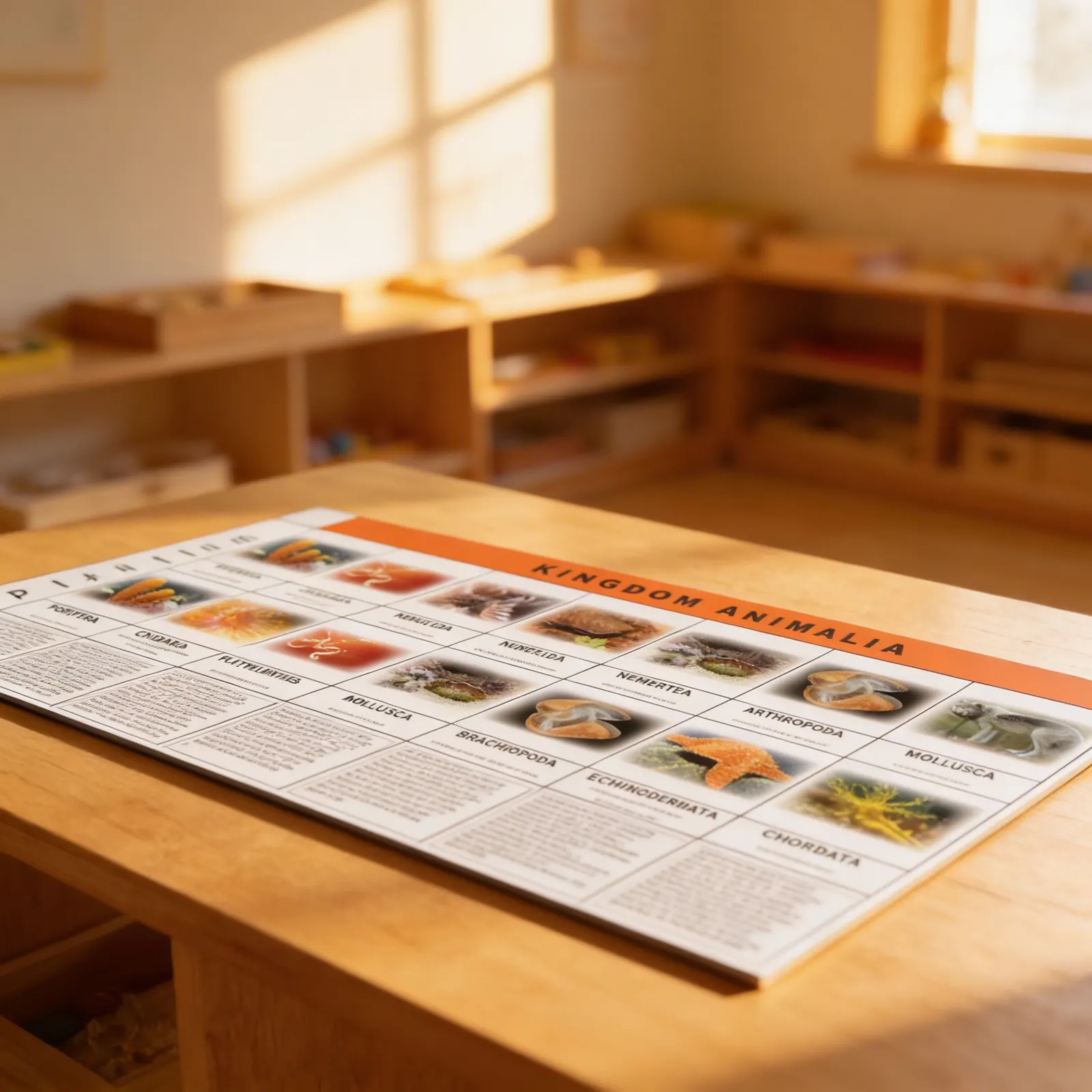
An essential classroom resource, this Animalia Kingdom Chart presents the twelve major phyla of the animal kingdom through carefully selected photographs and scientific classifications. Designed for the Montessori biology curriculum, this large-format laminated poster supports children's exploration of animal diversity through visual learning and classification work. The durable construction allows for frequent handling during lessons on animal characteristics and evolutionary relationships.
Scientific Classification
Introduces the concept of biological classification through visual organization of animal phyla.
Visual Discrimination
Develops observation skills as children compare characteristics across different animal groups.
Vocabulary Development
Builds scientific vocabulary through exposure to phylum names and animal terminology.
Nature Connection
Fosters appreciation for animal diversity and understanding of living world relationships.
How to present it
Mount the chart at child eye level in the biology area. Place a low shelf nearby with related three-part cards, animal figurines, and magnifying glasses. Ensure adequate lighting for examining details in photographs.
- 1Begin with familiar animals, pointing to photographs the child recognizes
- 2Introduce the concept of phyla by grouping animals with similar characteristics
- 3Compare two animals from different phyla, noting differences in body structure
- 4Practice pronouncing phylum names while tracing the text with a finger
- 5Match animal figurines or picture cards to their corresponding phyla on the chart
3 tips for parents
- Visit zoos or aquariums and help your child identify which phylum each animal belongs to
- Create a nature journal together, sketching animals and noting their phylum classification
- Read non-fiction books about specific animal groups to deepen understanding of individual phyla

If you are not sure it suits your child, we answer in person.
Norbert Kovalčín, founder of Faborino · write to him
There is no review here yet. We will ask you for one after you buy. Write the first review
What's in the Box
- Animalia Kingdom Chart: 90×60cm laminated poster
Size and material
| Product size | 132 × 30.5 cm |
| Packaging | 42 × 29 × 12 cm |
| Material | Durable plastic |
| Finish | Pre-cut with rounded corners |
| Recommended Age | 6-12 years |
Care
Wipe with damp cloth, dry immediately
Frequently Asked Questions
What are the dimensions of this Animalia Kingdom Chart?
This is a large-format laminated poster designed for classroom use. The exact dimensions are optimized for wall display and group lessons, allowing children to clearly see all twelve phyla representations and their classifications.
Which animal phyla are included in this chart?
The chart presents all twelve major phyla of the animal kingdom, including Porifera (sponges), Cnidaria (jellyfish), Platyhelminthes (flatworms), Nematoda (roundworms), Annelida (segmented worms), Mollusca (mollusks), Arthropoda (insects, spiders, crustaceans), Echinodermata (starfish), and Chordata (vertebrates), among others.
How does this chart support the Montessori biology curriculum?
This chart aligns with Montessori principles by providing concrete visual representations of abstract concepts. It supports classification work, encourages observation skills, and introduces scientific vocabulary naturally. Children can use it for matching activities, discussion, and as a reference during animal studies.
Is this chart appropriate for 3-year-olds given the complex scientific content?
Yes, in Montessori education, we introduce accurate scientific concepts early using age-appropriate methods. Young children focus on the visual aspects and basic characteristics, while older children (5-6) begin understanding classifications. The chart grows with the child, offering deeper learning opportunities over time.
Can this chart withstand daily classroom use?
Yes, the chart features durable laminated construction specifically designed for frequent handling in classroom environments. The lamination protects against spills, fingerprints, and general wear, making it ideal for hands-on Montessori lessons where children may touch and point to different animals.
Product safety
Manufacturer: Nienhuis Montessori, Anders Celsiusstraat 15, 7442 PB Nijverdal, Netherlands
Animalia Kingdom Charts