
AustraliaState Boundaries Map: Labeled Control
The first photo is the maker's own. The other shots are illustrative.
Inv. no. NIE-552210
- Maker
- Nienhuis Montessori, since 1929
- Approval
- AMI
- Primary Material
- Paper
- Print Type
- Black outline on white background
- EAN
- 8719924061241
Final price incl. VAT. Delivery €5.90, €125.10 to go for free delivery.
Advice, warranty and returns are handled by us.
Why it costs €23.90
Behind the price of the original are things you can check yourself.
AMI approval
The material is approved by the Association Montessori Internationale (AMI). Nienhuis has made Montessori materials since 1929.
A verifiable original
The EAN 8719924061241 is on the box. It is the maker's number, not ours.
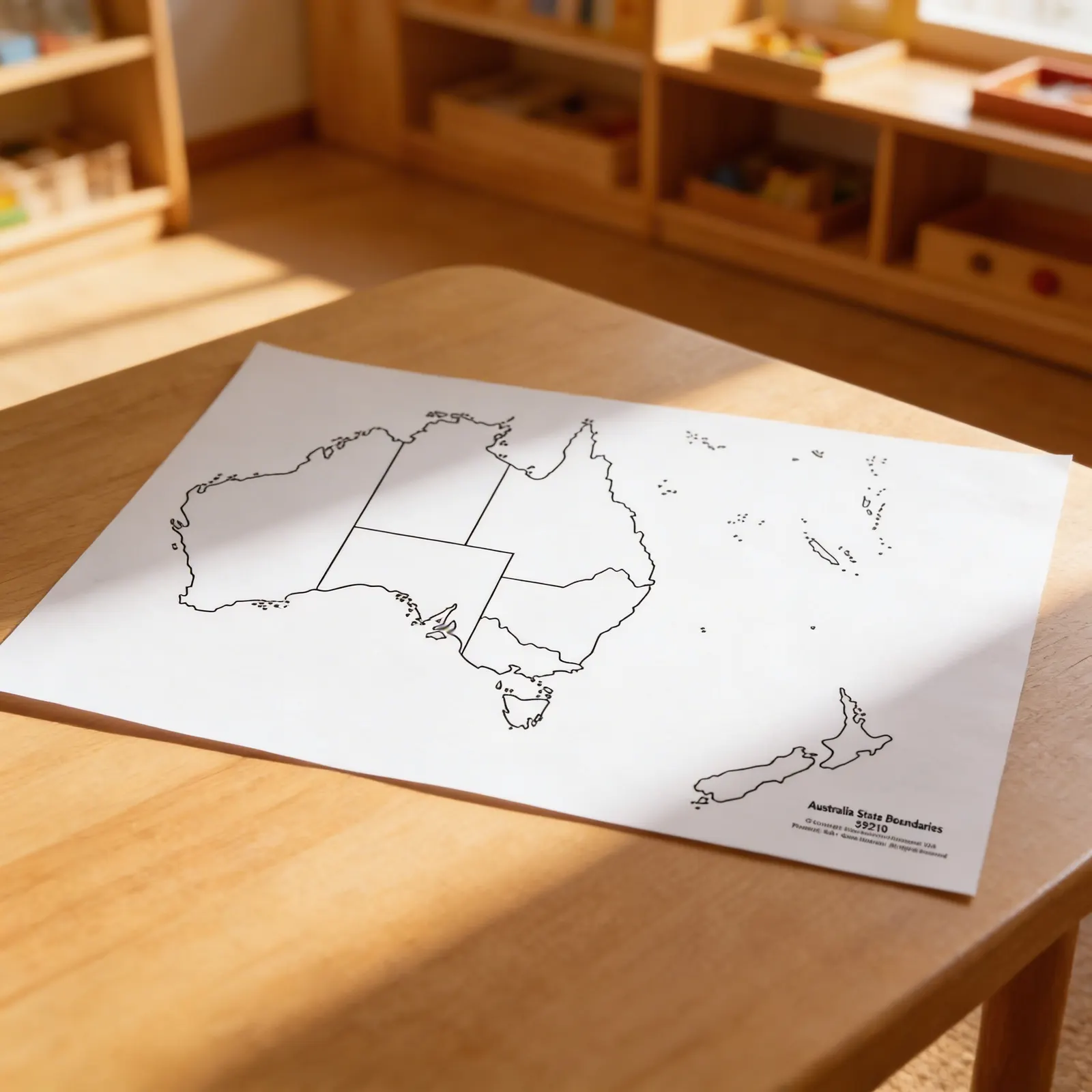
Australia in a child's hands
This detailed outline map of Australia guides discovery of the country's state boundaries and territories through independent work. The clear boundary lines and accurate coastline details support geography studies in the Montessori classroom, helping children develop spatial awareness and an understanding of political divisions. Made for pin-pricking, coloring, or labeling activities that reinforce knowledge of Australian geography.
Geographic Awareness
Develops understanding of political boundaries and spatial relationships between Australian states and territories.
Fine Motor Skills
Pin-pricking and coloring activities strengthen hand muscles and precision needed for writing.
Cultural Knowledge
Builds foundation for understanding Australia's political geography and regional differences.
Concentration
Detailed map work requires sustained focus and attention to boundaries and shapes.
How to present it
Place one outline map on a cork board or felt mat. Prepare colored pencils, labels, and push pins in a tray. Have an atlas or control map of Australia available for reference.
- 1Invite the child to trace the coastline of Australia with their finger, starting at Cape York
- 2Select one state to focus on, such as Tasmania, and trace its boundaries
- 3Use push pins to prick along the selected state's border
- 4Remove the pricked section and color it with the state's designated color
- 5Label the state and its capital city using prepared or handwritten labels
3 tips for parents
- Display your child's completed maps at home and refer to them when discussing Australian news or travel
- Support learning by looking at Australian coins and stamps showing state emblems
- Plan imaginary trips between states, calculating distances and discussing what you might see

If you are not sure it suits your child, we answer in person.
Norbert Kovalčín, founder of Faborino · write to him
There is no review here yet. We will ask you for one after you buy. Write the first review
What's in the Box
- Australia Outline Map: 50×50cm with state boundaries
Size and material
| Packaging | 4 × 3 × 0 cm |
| Primary Material | Paper |
| Print Type | Black outline on white background |
| Recommended Age | 3-6 years |
Care
Keep dry, store flat or rolled to prevent creasing
Frequently Asked Questions
What age group is this Australia state boundaries map designed for?
This map is designed for children ages 3-6 years old, aligning with the Montessori early childhood curriculum for introducing geography concepts through concrete, hands-on materials.
What activities can children do with this outline map?
Children can use this map for pin-pricking exercises to develop fine motor skills, coloring activities to reinforce state recognition, and labeling work to practice state names and locations. It's also suitable for tracing and creating their own maps.
Does this map show all Australian states and territories?
Yes, this detailed outline map displays all six Australian states (New South Wales, Victoria, Queensland, South Australia, Western Australia, and Tasmania) plus the two mainland territories (Northern Territory and Australian Capital Territory) with clear boundary lines.
What material is this map printed on?
This map is printed on high-quality paper suitable for repeated use in classroom activities. The paper weight is appropriate for pin-pricking exercises while being durable enough for coloring and handling by young children.
How does this map support Montessori geography curriculum?
This map follows Montessori principles by providing a concrete, manipulative material that allows children to explore abstract concepts like political boundaries through sensorial experience. It progresses from whole (continent) to parts (states), supporting the child's natural learning progression.
Product safety
Manufacturer: Nienhuis Montessori, Anders Celsiusstraat 15, 7442 PB Nijverdal, Netherlands
Australia