
Balls On Small Pegs
The first photo is the maker's own. The other shots are illustrative.
Inv. no. NIE-046000
- Maker
- Nienhuis Montessori, since 1929
- Approval
- AMI
- Base
- Natural plywood
- Balls & Pegs
- Solid wood
- EAN
- 8719924012816
Final price incl. VAT. Delivery €5.90, €102.10 to go for free delivery.
Advice, warranty and returns are handled by us.
Why it costs €46.90
Behind the price of the original are things you can check yourself.
AMI approval
The material is approved by the Association Montessori Internationale (AMI). Nienhuis has made Montessori materials since 1929.
A verifiable original
The EAN 8719924012816 is on the box. It is the maker's number, not ours.
Balls On Small Pegs in a child's hands
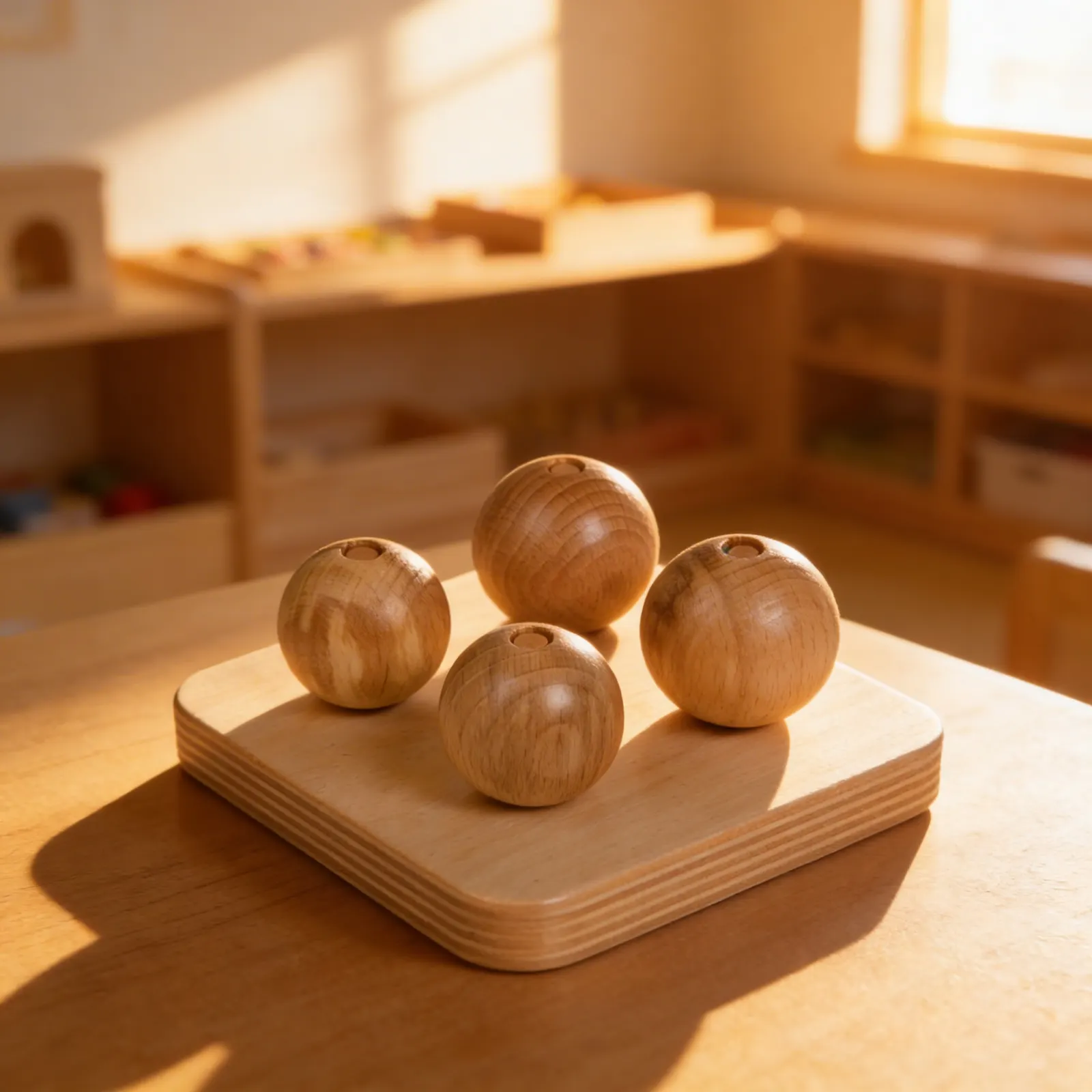
A square wooden board with four small pegs holding four balls of two different sizes. The two sizes are what makes this the step after the ellipsoids: a child who has learned that a shape swallows its peg now finds that the same thing happens at two scales, and comparing the two is a question they were not asked before. Grasping a ball also needs a different hand shape than grasping an ellipsoid. Wood and plywood, for ages 0 to 3.
Pincer Grasp Refinement
Lifting and placing the balls strengthens the thumb and index finger muscles essential for pencil holding.
Hand-Eye Coordination
Aligning the ball's hole with the peg requires precise visual-motor integration and spatial judgment.
Concentration Building
The focused nature of the activity helps children develop sustained attention and task completion skills.
Order and Sequence
Children naturally create patterns and sequences, supporting mathematical thinking and logical reasoning.
How to present it
Place the peg board on a tray at the child's work table. Arrange all balls in a small basket to the right of the board. Ensure adequate lighting and a clear workspace.
- 1Demonstrate grasping one ball with thumb and index finger, holding it directly above a peg
- 2Lower the ball straight down onto the peg, releasing when it sits securely
- 3Continue placing balls one at a time, working systematically across the board
- 4Once all balls are placed, remove them one at a time back to the basket
3 tips for parents
- Practice pincer grasp at home by picking up small foods like raisins or cereal pieces
- Avoid correcting grip immediately - allow exploration before gentle guidance
- Create similar activities using golf tees in foam and ping pong balls

If you are not sure it suits your child, we answer in person.
Norbert Kovalčín, founder of Faborino · write to him
There is no review here yet. We will ask you for one after you buy. Write the first review
What's in the Box
- Plywood base: With rounded corners
- 4 wooden balls: With center holes
- 4 vertical pegs: Attached to base
Size and material
| Packaging | 16 × 16 × 9 cm |
| Base | Natural plywood |
| Balls & Pegs | Solid wood |
| Recommended Age | 0-3 years |
Care
| Cleaning | Wipe with slightly damp cloth, dry immediately |
| Storage | Keep in dry area away from direct sunlight |
Frequently Asked Questions
What skills does this material develop?
This material primarily develops pincer grasp, hand-eye coordination, spatial awareness, and concentration. It strengthens the small muscles in the hand needed for writing, while teaching precise controlled movements and visual-motor integration.
How many balls and pegs are included?
The set typically includes 5-10 wooden balls with corresponding vertical pegs mounted on a wooden base. Each ball fits precisely onto its designated peg, providing clear visual feedback for successful placement.
What makes this different from regular stacking toys?
Unlike stacking toys, this material focuses on precise vertical placement using a refined pincer grasp. The small pegs require careful coordination and control, making it an excellent pre-writing exercise that isolates hand movements.
Can younger children use this safely?
While designed for ages 3-6, always supervise younger children. The balls should be large enough to prevent choking hazards, but the activity requires developed fine motor skills typically present around age 3.
How does this prepare children for writing?
By strengthening the pincer grasp and developing hand control, this material directly prepares the hand muscles for holding a pencil. The precise movements required mirror the control needed for forming letters and numbers.
Product safety
Manufacturer: Nienhuis Montessori, Anders Celsiusstraat 15, 7442 PB Nijverdal, Netherlands
Balls On Small Pegs