
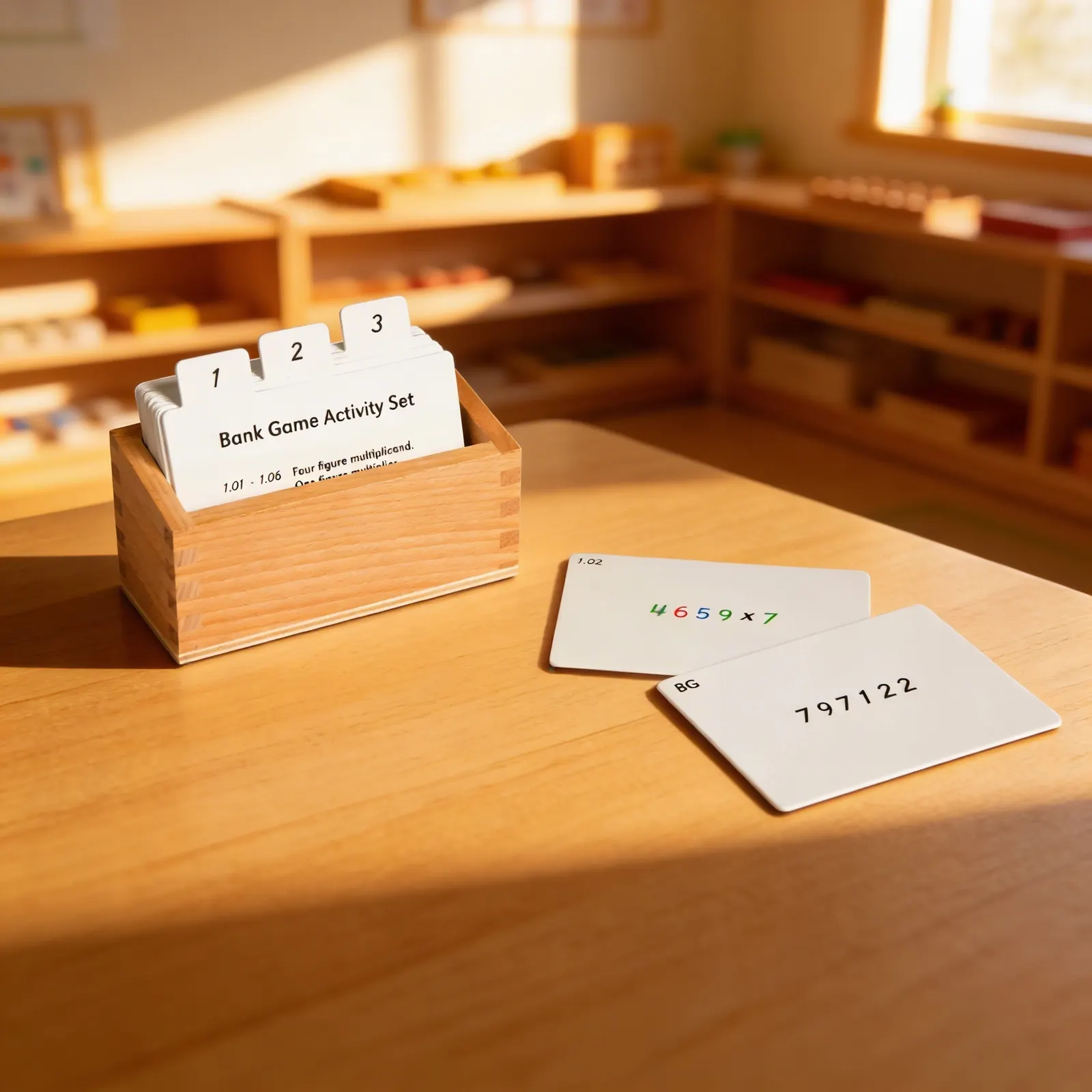
Bank Game Activity Set
The first photo is the maker's own. The other shots are illustrative.
Inv. no. NIE-060301
- Maker
- Nienhuis Montessori, since 1929
- Approval
- AMI
- Storage Container
- Natural wood with smooth finish
- Activity Cards
- Durable cardstock
- EAN
- 8719924013066
Final price incl. VAT. Delivery €5.90, €94.10 to go for free delivery.
Advice, warranty and returns are handled by us.
Why it costs €54.90
Behind the price of the original are things you can check yourself.
AMI approval
The material is approved by the Association Montessori Internationale (AMI). Nienhuis has made Montessori materials since 1929.
A verifiable original
The EAN 8719924013066 is on the box. It is the maker's number, not ours.
Bank Game Activity Set in a child's hands
Exercise cards with divider tabs in a wooden box, extending the bank game. The bank game is the one piece of decimal work that needs other people: somebody keeps the bank, somebody comes to change ten hundreds for a thousand, and the exchange has to be agreed rather than simply performed. That makes it the material most likely to stall for want of a task everyone can see, which is what these cards provide. Bank game sold separately. Wood and cardstock, for ages 6 to 12.
Mathematical Understanding
Builds concrete understanding of place value and multiplication through hands-on manipulation of physical materials.
Abstract Thinking
Bridges the gap between concrete objects and abstract numerical concepts through systematic practice.
Problem-Solving Skills
Develops logical thinking and sequential processing through structured mathematical challenges.
How to present it
3 tips for parents
- Practice skip counting at home to reinforce multiplication readiness
- Use everyday scenarios like setting the table to demonstrate equal groups
- Celebrate the process of working through problems, not just correct answers

If you are not sure it suits your child, we answer in person.
Norbert Kovalčín, founder of Faborino · write to him
There is no review here yet. We will ask you for one after you buy. Write the first review
What's in the Box
- Exercise cards: Additional exercises for the bank game
- Divider tabs: For organising the cards in the box
- Wooden box: For storing the set
Size and material
| Packaging | 14 × 11 × 7 cm |
| Storage Container | Natural wood with smooth finish |
| Activity Cards | Durable cardstock |
| Recommended Age | 6-12 years |
Care
Wipe wooden box with slightly damp cloth; keep cards dry
Frequently Asked Questions
What mathematical concepts does this Bank Game Activity Set teach?
This set teaches place value, multi-digit addition, subtraction, multiplication, and division. It helps children understand units, tens, hundreds, and thousands through concrete manipulation, making abstract mathematical concepts tangible and comprehensible for ages 6-12.
How does the Bank Game differ from other Montessori math materials?
The Bank Game bridges the gap between concrete golden bead materials and abstract written calculations. It introduces systematic recording of operations while maintaining hands-on manipulation, helping children transition from physical counting to mental math computation.
What's included in the wooden storage box?
The set includes exercise cards and divider tabs, all housed in a wooden box. The bank game is sold separately.
Can children use this independently or does it require adult guidance?
After initial presentation by an adult, children can work independently with the Bank Game. The problem cards provide self-directed learning opportunities, though adult supervision helps ensure proper technique and can introduce new concepts as children progress.
How does this support the Montessori approach to mathematics?
This material follows Montessori principles by moving from concrete to abstract, allowing repetition for mastery, and providing self-correcting elements. It respects the child's developmental readiness and builds mathematical understanding through sensorial exploration and logical sequencing.
Product safety
Manufacturer: Nienhuis Montessori, Anders Celsiusstraat 15, 7442 PB Nijverdal, Netherlands
Bank Game Activity Set