
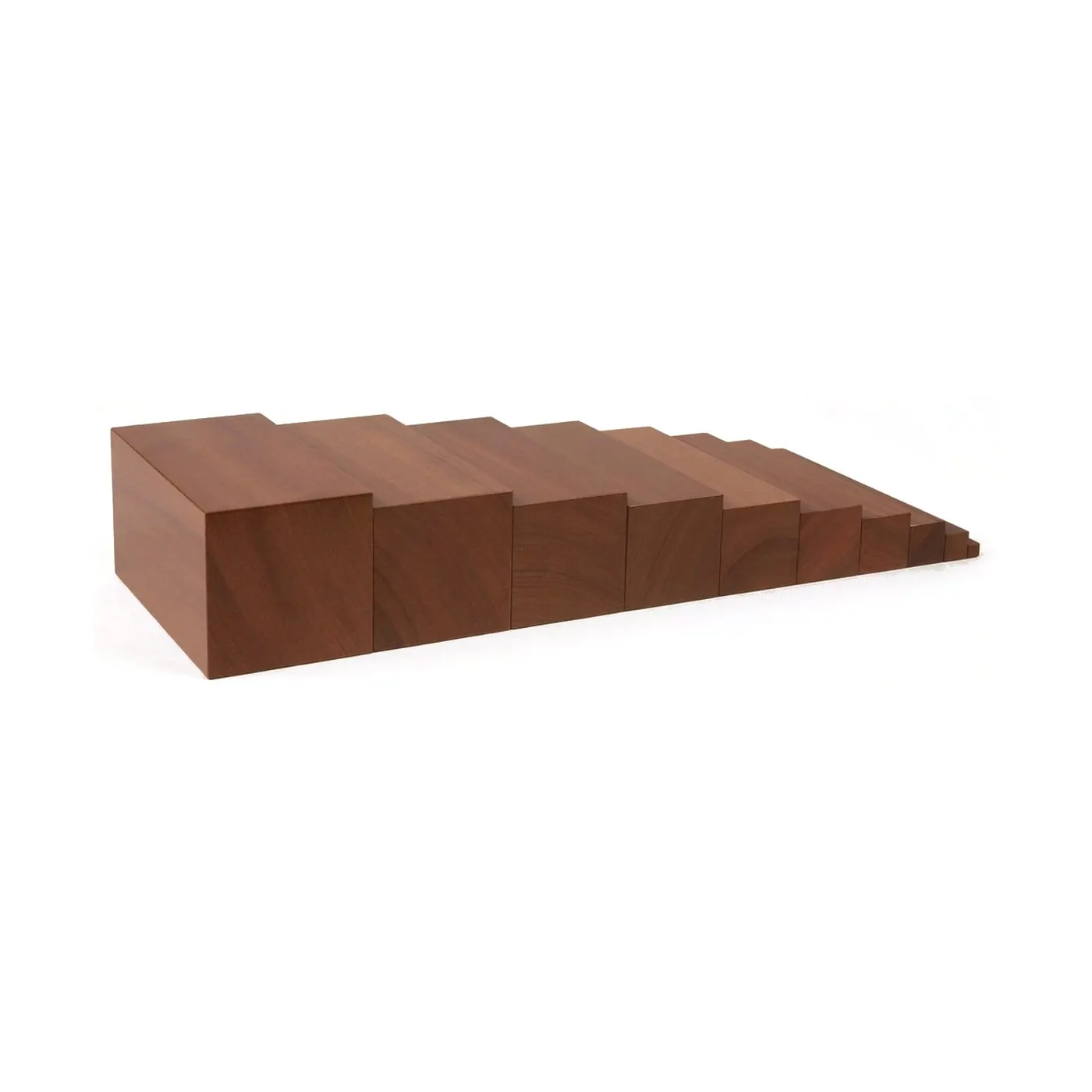
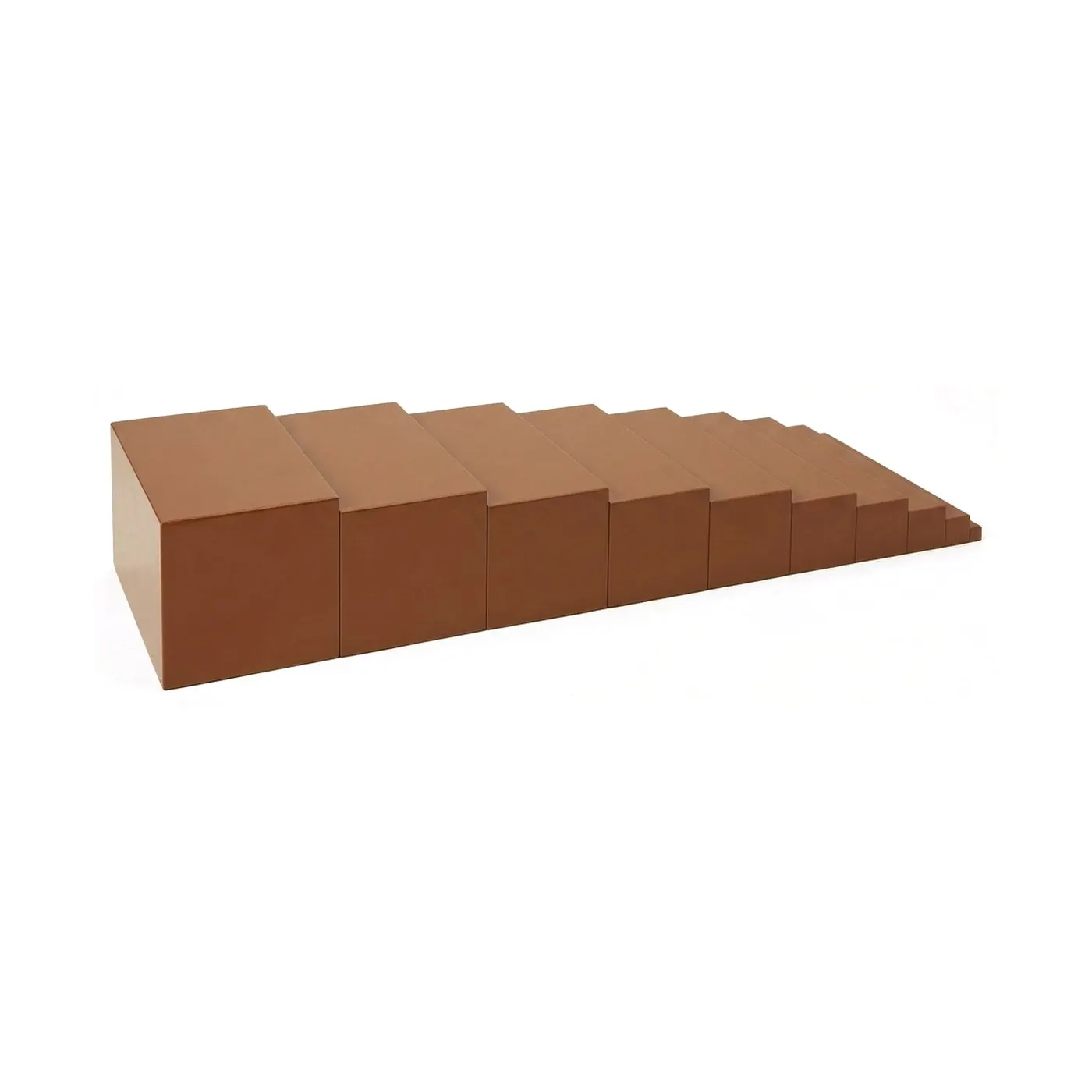
Bases For Brown Stairs
The first photo is the maker's own. The other shots are illustrative.
Inv. no. NIE-EC0302
- Maker
- Nienhuis Montessori, since 1929
- Material
- Durable plastic
- Finish
- Pre-cut with rounded corners
- EAN
- 8719924042653
Final price incl. VAT. Delivery €5.90, €117.10 to go for free delivery.
Advice, warranty and returns are handled by us.
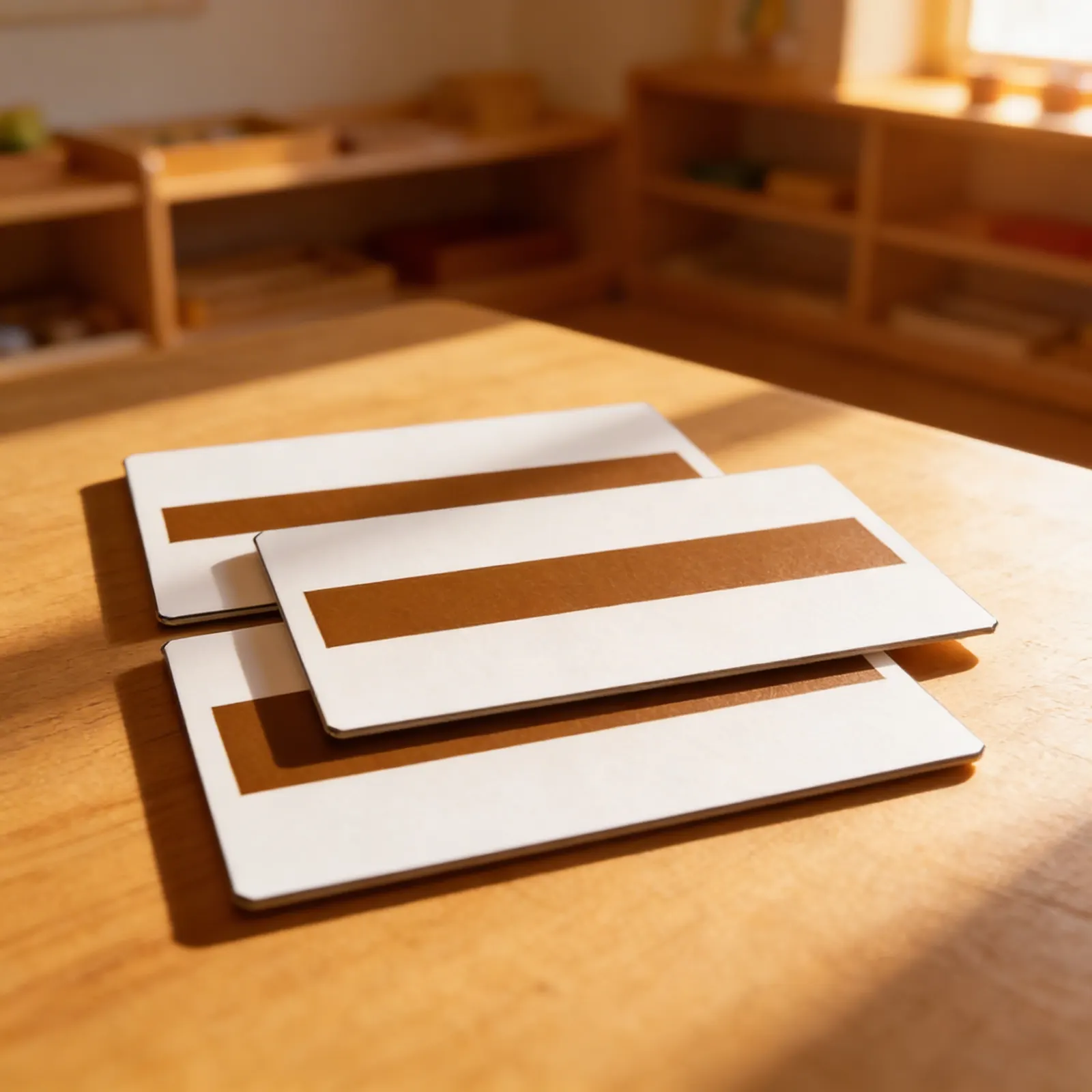
Bases For Brown Stairs in a child's hands
Sharpening perception one step at a time, these durable plastic base cards provide essential visual guides for children working with the Brown Stair material, showing three different stair configurations in precise brown outlines. Each durable card presents a unique arrangement pattern, helping children understand spatial relationships and develop systematic thinking as they match the physical prisms to the two-dimensional representations.
Visual Discrimination
Children develop keen observation skills by matching three-dimensional Brown Stair prisms to two-dimensional representations.
Spatial Reasoning
Working with base cards enhances understanding of size gradation and spatial relationships in different orientations.
Order and System
Following the card patterns reinforces systematic thinking and precise arrangement skills.
Abstract Thinking
Translating between 3D objects and 2D representations builds essential cognitive bridges for mathematical concepts.
How to present it
Place one base card on the work mat. Ensure the Brown Stair prisms are arranged randomly nearby, not in size order.
- 1Examine the card's outline pattern, tracing the edges with your finger
- 2Select the largest prism and place it on the corresponding outline
- 3Continue selecting and placing prisms according to the card's pattern
- 4Check alignment by running fingers along edges where prisms meet outlines
- 5Remove prisms and try a different configuration card
3 tips for parents
- These cards extend your child's work with the Brown Stair by adding pattern-matching challenges
- Notice how your child approaches the task - methodically or through trial and error
- Celebrate precision in placement rather than speed of completion

If you are not sure it suits your child, we answer in person.
Norbert Kovalčín, founder of Faborino · write to him
There is no review here yet. We will ask you for one after you buy. Write the first review
What's in the Box
- Base Cards: 3 configuration patterns
- Card Designs: Different stair arrangements in brown outlines
Size and material
| Packaging | 29 × 23 × 0 cm |
| Material | Durable plastic |
| Finish | Pre-cut with rounded corners |
| Recommended Age | 3-6 years |
Care
Wipe with damp cloth, dry immediately
Frequently Asked Questions
What exactly are the Bases for Brown Stairs and how are they used?
These are laminated cards featuring precise brown outlines of the Brown Stair prisms in three different configurations. Children place the actual Brown Stair blocks on top of the matching outlines, helping them develop spatial awareness, visual discrimination, and systematic thinking while providing a self-correcting guide for their work.
Do I need to already own the Brown Stair material to use these bases?
Yes, these base cards are designed as an extension activity for the Brown Stair material (sold separately). The cards show outlines where children place the actual wooden prisms, so you'll need the physical Brown Stair blocks to use these bases effectively.
What are the three different configurations shown on the cards?
The cards typically show three arrangements: the traditional linear stair formation (smallest to largest), a centered/pyramid arrangement, and a scattered pattern that challenges children to match individual prisms to their corresponding outlines. Each configuration develops different aspects of visual perception and problem-solving.
How durable are these laminated cards for classroom use?
The cards are professionally laminated for durability, making them resistant to regular handling, spills, and cleaning. They're designed to withstand daily classroom use by multiple children and can be easily wiped clean with a damp cloth, ensuring they remain in good condition for years.
At what point should I introduce these base cards to a child?
Introduce these cards after the child has mastered the basic Brown Stair work (typically around age 3.5-4). The child should be able to grade the prisms accurately and understand the concept of thick to thin before adding this extension, which provides new challenges and maintains interest in the material.
Product safety
Manufacturer: Nienhuis Montessori, Anders Celsiusstraat 15, 7442 PB Nijverdal, Netherlands
Bases For Brown Stairs