
Basket Of Balls
The first photos are the maker's own. The other shots are illustrative.
Inv. no. NIE-047900
- Maker
- Nienhuis Montessori, since 1929
- Basket
- Woven rope/cotton
- Balls
- Wood, rubber, silicone, textured plastic, knitted fabric
- EAN
- 8719924063054
Final price incl. VAT. Delivery €5.90, €124.10 to go for free delivery.
Advice, warranty and returns are handled by us.
Basket Of Balls in a child's hands
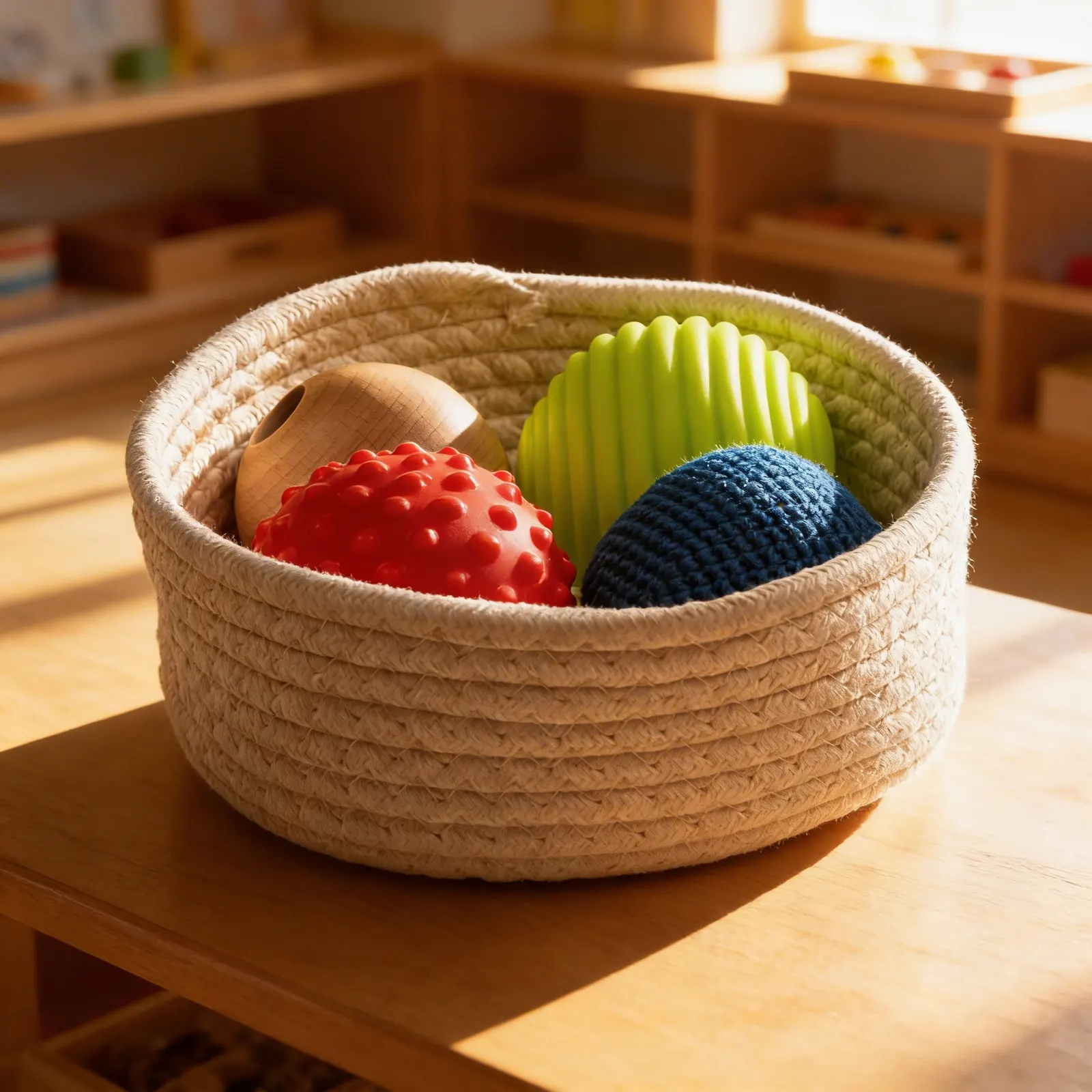
A small basket holding a set of balls of varying types, for an infant to work out that not everything that rolls is the same. Size, weight and texture all change from ball to ball, and none of it has to be explained: a heavy one behaves differently in the hand from a light one, and a child finds that out by picking both up. A basket rather than a box means the whole set is visible and reachable from the floor. Assorted materials, for ages 0 to 3.
Tactile Discrimination
Exploring varied textures develops the infant's ability to distinguish between different surfaces, laying the foundation for refined sensory perception.
Fine Motor Development
Grasping, transferring, and manipulating different sized and textured balls strengthens hand muscles and develops pincer grasp.
Visual-Motor Coordination
Reaching for and grasping specific balls enhances hand-eye coordination and spatial awareness during critical early development.
Cognitive Development
Comparing and contrasting different textures supports early classification skills and sensory memory formation.
How to present it
Place the basket on a low shelf at infant's eye level when sitting. Ensure all balls are clean and inside the basket. Create a defined workspace with a small mat or rug.
- 1Sit with the infant and slowly remove one ball from the basket
- 2Explore the ball using both hands, allowing the infant to observe your movements
- 3Offer the ball to the infant, allowing independent exploration
- 4When interest wanes, return the first ball and present another texture
- 5Model returning balls to the basket when finished
3 tips for parents
- Create a dedicated exploration time without distractions - no background TV or music
- Describe what your child is experiencing without directing: 'You found the bumpy ball!'
- Place the basket consistently in the same location to build routine and independence

If you are not sure it suits your child, we answer in person.
Norbert Kovalčín, founder of Faborino · write to him
There is no review here yet. We will ask you for one after you buy. Write the first review
What's in the Box
- Woven storage basket: Natural rope construction
- Smooth wooden ball: Natural finish
- Bumpy textured ball: Rubber or silicone
- Ridged sensory ball: Textured plastic
- Soft knitted ball: Fabric surface
Size and material
| Packaging | 21 × 21 × 9 cm |
| Basket | Woven rope/cotton |
| Balls | Wood, rubber, silicone, textured plastic, knitted fabric |
| Recommended Age | 0-3 years |
Care
Wipe balls with damp cloth; spot clean basket as needed
Frequently Asked Questions
What materials are the balls made from and are they safe for mouthing?
The set includes balls made from natural wood, food-grade silicone or rubber, and soft knitted fabric. All materials are non-toxic and safe for infants who explore through mouthing, meeting European safety standards for toys under 3 years.
What size are the balls and basket included in this set?
Each ball is approximately 5-6cm in diameter, perfectly sized for infant grasping. The handwoven basket measures approximately 15cm in diameter and 8cm high, making it easy for young children to access the balls independently.
How does this material support Montessori principles for infant development?
This material aligns with Montessori's emphasis on sensory exploration and tactile discrimination. It allows infants to discover different textures, weights, and temperatures naturally, supporting their absorbent mind during the sensitive period for sensory development.
At what age should I introduce this basket of balls to my child?
You can introduce this material as early as 3-4 months when babies begin grasping objects. Start with supervised exploration and gradually allow independent play as your child develops. The material remains engaging through age 3 as children refine their sensory discrimination skills.
How should I present this material to my infant following Montessori principles?
Place the basket on a low shelf or mat where your child can access it independently. Initially, you might demonstrate slowly taking one ball out, exploring it, and returning it to the basket. Allow your child to explore at their own pace without directing their play.
Product safety
Manufacturer: Nienhuis Montessori, Anders Celsiusstraat 15, 7442 PB Nijverdal, Netherlands
Basket Of Balls