
Beechwood Rod With 9 Holes
The first photo is the maker's own. The other shots are illustrative.
Inv. no. NIE-02520001
- Maker
- Nienhuis Montessori, since 1929
- Approval
- AMI
- Primary Material
- Solid beechwood
- Finish
- Natural
- EAN
- 8719924011932
Final price incl. VAT. Delivery €5.90, €143.50 to go for free delivery.
Advice, warranty and returns are handled by us.
Why it costs €5.50
Behind the price of the original are things you can check yourself.
AMI approval
The material is approved by the Association Montessori Internationale (AMI). Nienhuis has made Montessori materials since 1929.
A verifiable original
The EAN 8719924011932 is on the box. It is the maker's number, not ours.
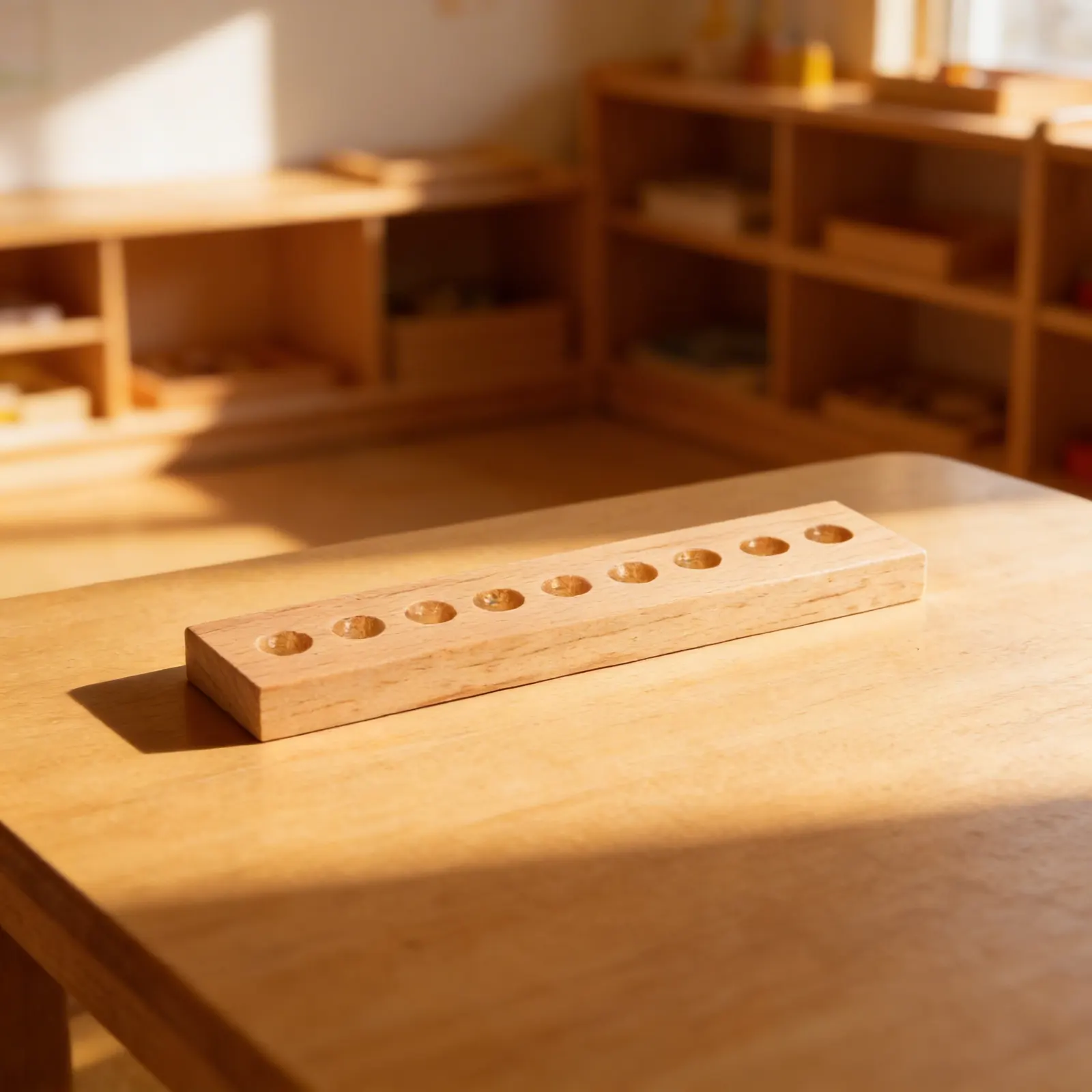
Beechwood Rod With 9 Holes in a child's hands
A beechwood rod with nine holes, a spare part from the mathematics materials. Nine is not an accidental number here. In the decimal system a child never holds ten of one hierarchy loose, because ten is the moment of exchange, so nine is the largest count that stays in place and holders in these materials are built to that limit. Beech, unfinished, and made to match a rod you already have. Check it against yours before ordering.
Fine Motor Control
Placing pegs in the holes develops pincer grip and hand-eye coordination essential for writing preparation.
Mathematical Concepts
The nine holes introduce counting, one-to-one correspondence, and spatial relationships through concrete manipulation.
Concentration Development
Sequential peg placement activities build focus and attention span through purposeful, repetitive movements.
Order and Sequence
Working systematically from left to right reinforces directional concepts and prepares for reading patterns.
How to present it
Place the beechwood rod horizontally on a tray with a small basket containing exactly 9 pegs to the right side
- 1Demonstrate slow, deliberate placement of one peg into the leftmost hole
- 2Continue placing pegs left to right, counting aloud with each insertion
- 3After filling all holes, remove pegs in reverse order (right to left)
- 4Invite the child to repeat the process independently
3 tips for parents
- Practice peg placement during calm moments, not when rushing to build skills
- Count everyday objects in groups of nine to reinforce this quantity at home
- Let your child fill and empty the rod completely before suggesting variations

If you are not sure it suits your child, we answer in person.
Norbert Kovalčín, founder of Faborino · write to him
There is no review here yet. We will ask you for one after you buy. Write the first review
What's in the Box
- Beechwood Rod: 30cm board with 9 holes
Size and material
| Packaging | 13 × 9 × 1 cm |
| Primary Material | Solid beechwood |
| Finish | Natural |
| Recommended Age | 3-6 years |
Care
Wipe with slightly damp cloth, dry immediately
Frequently Asked Questions
What size pegs work with this beechwood rod?
This rod is designed for standard Montessori pegs with a diameter of 6-8mm. The holes are precisely sized to provide a snug fit while still allowing children to easily insert and remove pegs for repeated practice.
How can this rod be used for mathematical learning?
Children can use the 9 holes to practice counting 1-9, explore odd/even concepts, create patterns, learn addition/subtraction by adding or removing pegs, and understand quantity relationships through hands-on manipulation.
Is the beechwood rod safe for 3-year-olds?
Yes, the rod is crafted from solid beechwood with smooth, splinter-free surfaces and rounded edges. However, adult supervision is recommended when used with pegs to prevent choking hazards for children who still put objects in their mouths.
What activities can children do with just the rod alone?
Without pegs, children can practice finger placement in holes for pincer grip development, trace the holes for counting practice, use it as a ruler for measuring, or incorporate it into sensory bins for texture exploration.
How do I clean and maintain the beechwood rod?
Wipe with a slightly damp cloth and dry immediately. Avoid soaking in water or using harsh chemicals. Occasionally treat with food-safe mineral oil to maintain the wood's natural luster and prevent drying or cracking.
Product safety
Manufacturer: Nienhuis Montessori, Anders Celsiusstraat 15, 7442 PB Nijverdal, Netherlands
Beechwood Rod With 9 Holes