
Bells Keyboards (Nienhuis)
The first photo is the maker's own. The other shots are illustrative.
Inv. no. NIE-0063B0
- Maker
- Nienhuis Montessori, since 1929
- Approval
- AMI
- Construction
- Laminated board
- Surface
- Printed paper with protective coating
- EAN
- 8719924004149
Final price incl. VAT. Delivery €5.90, €85.10 to go for free delivery.
Advice, warranty and returns are handled by us.
Why it costs €63.90
Behind the price of the original are things you can check yourself.
AMI approval
The material is approved by the Association Montessori Internationale (AMI). Nienhuis has made Montessori materials since 1929.
A verifiable original
The EAN 8719924004149 is on the box. It is the maker's number, not ours.
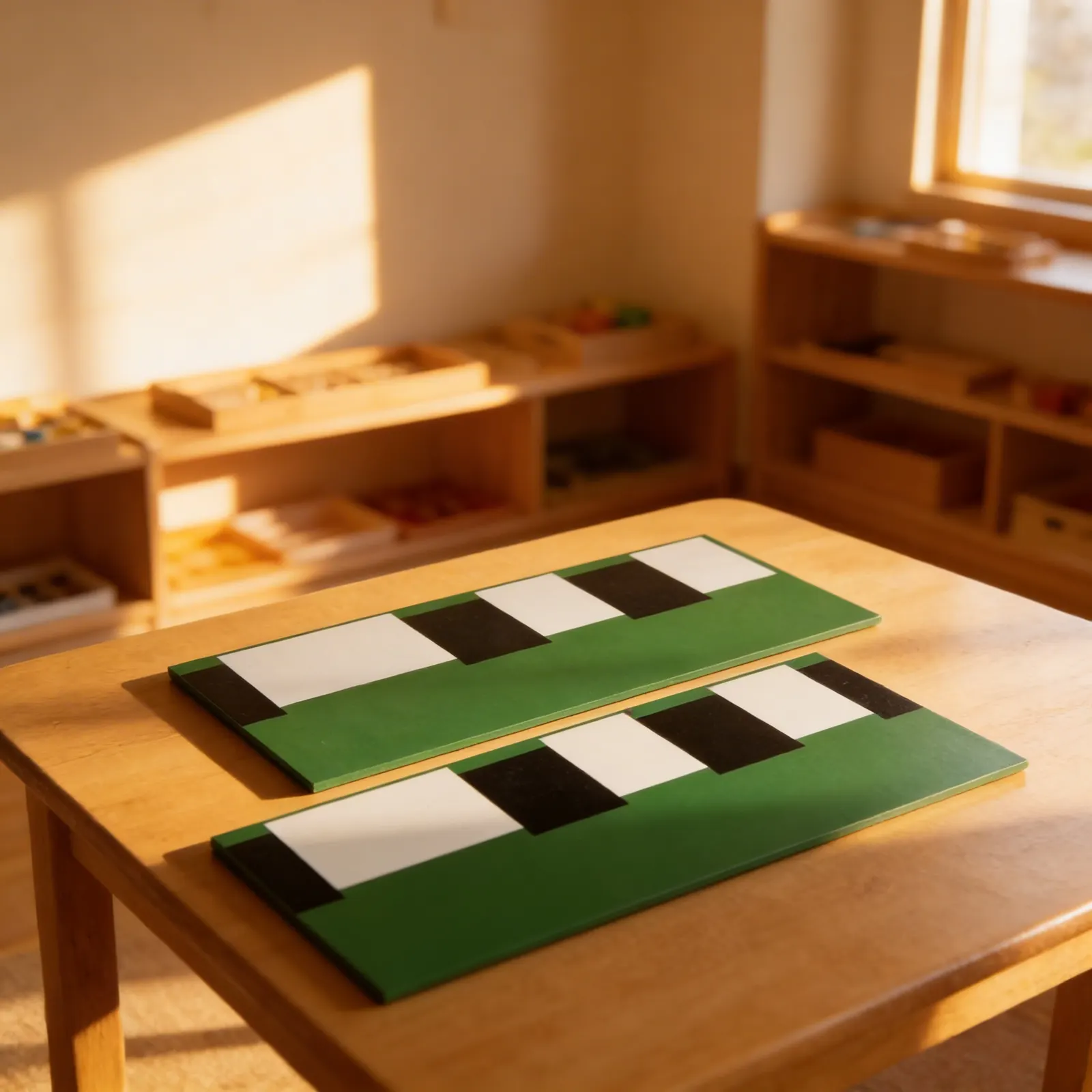
Bells Keyboards (Nienhuis) in a child's hands
Two colour coded keyboards on which to lay the bells out in chromatic order. Two are needed because the bells work in pairs: one set stays in order on the first board as the reference, and the second set is what a child moves, sorts and mismatches on the other. Without somewhere to put the ordered set down, that comparison has to be held in memory, which is exactly the thing a three year old cannot yet do. Bells sold separately. Laminated board with printed paper, for ages 3 to 12.
Musical Understanding
Helps children visualize the relationship between bells and piano keys, supporting pitch recognition and music theory comprehension.
Visual-Auditory Connection
Bridges the gap between hearing tones and understanding their position on a keyboard, enhancing musical literacy.
Pattern Recognition
The alternating black and white key pattern develops visual discrimination and understanding of musical patterns.
Preparation for Music Education
Provides foundational knowledge for future piano or keyboard instruction through familiar Montessori materials.
How to present it
Place the Bells Keyboards on a work mat alongside the Montessori bells. Ensure the green background is clearly visible and the keyboard pattern corresponds to the bell set being used.
- 1Invite the child to match each bell to its corresponding key on the keyboard board
- 2Show how to trace the keyboard pattern from left to right while singing the scale
- 3Demonstrate placing bells directly on or beside their matching keys on the board
- 4Introduce the pattern of black keys in groups of two and three
3 tips for parents
- Point out piano keyboards in everyday environments to reinforce the pattern recognition
- Sing simple scales while your child traces the keys on the board at home
- Support musical interest by noting how the keyboard pattern repeats in octaves

If you are not sure it suits your child, we answer in person.
Norbert Kovalčín, founder of Faborino · write to him
There is no review here yet. We will ask you for one after you buy. Write the first review
What's in the Box
- Keyboard Reference Boards: 2 laminated boards with piano key pattern
Size and material
| Packaging | 54 × 22 × 2 cm |
| Construction | Laminated board |
| Surface | Printed paper with protective coating |
| Recommended Age | 3-6 years |
Care
Wipe with damp cloth; avoid excessive moisture
Frequently Asked Questions
How do the Bells Keyboards connect to Montessori bell activities?
These laminated boards display piano key patterns that correspond directly to Montessori bells, helping children visualize the relationship between the physical bells and traditional keyboard layout while learning pitch and note recognition.
What makes these keyboards suitable for ages 3-6?
The clear visual design with green background and contrasting black/white keys provides an age-appropriate reference that young children can easily understand, supporting their developing musical comprehension without overwhelming detail.
Are these actual playable keyboards or visual aids?
These are visual reference boards, not playable instruments. They serve as laminated educational materials that help children understand keyboard patterns while working with actual Montessori bells.
How durable are these laminated boards for classroom use?
The boards feature sturdy lamination that protects against daily handling, spills, and repeated use in classroom environments, making them ideal for young children who are still developing fine motor control.
Can these keyboards be used without Montessori bells?
While designed to complement Montessori bells, these visual aids can independently teach keyboard layout, note patterns, and basic music theory concepts, making them versatile educational tools for early musical education.
Product safety
Manufacturer: Nienhuis Montessori, Anders Celsiusstraat 15, 7442 PB Nijverdal, Netherlands
Bells Keyboards (Nienhuis)