
Bells Music Signs And Notes (Nienhuis)
The first photo is the maker's own. The other shots are illustrative.
Inv. no. NIE-0063E1
- Maker
- Nienhuis Montessori, since 1929
- Approval
- AMI
- Storage Box
- Natural wood with compartments
- Notation Pieces
- Durable plastic
- EAN
- 8719924004170
Final price incl. VAT. Free delivery.
Advice, warranty and returns are handled by us.
Why it costs €196.90
Behind the price of the original are things you can check yourself.
AMI approval
The material is approved by the Association Montessori Internationale (AMI). Nienhuis has made Montessori materials since 1929.
A verifiable original
The EAN 8719924004170 is on the box. It is the maker's number, not ours.
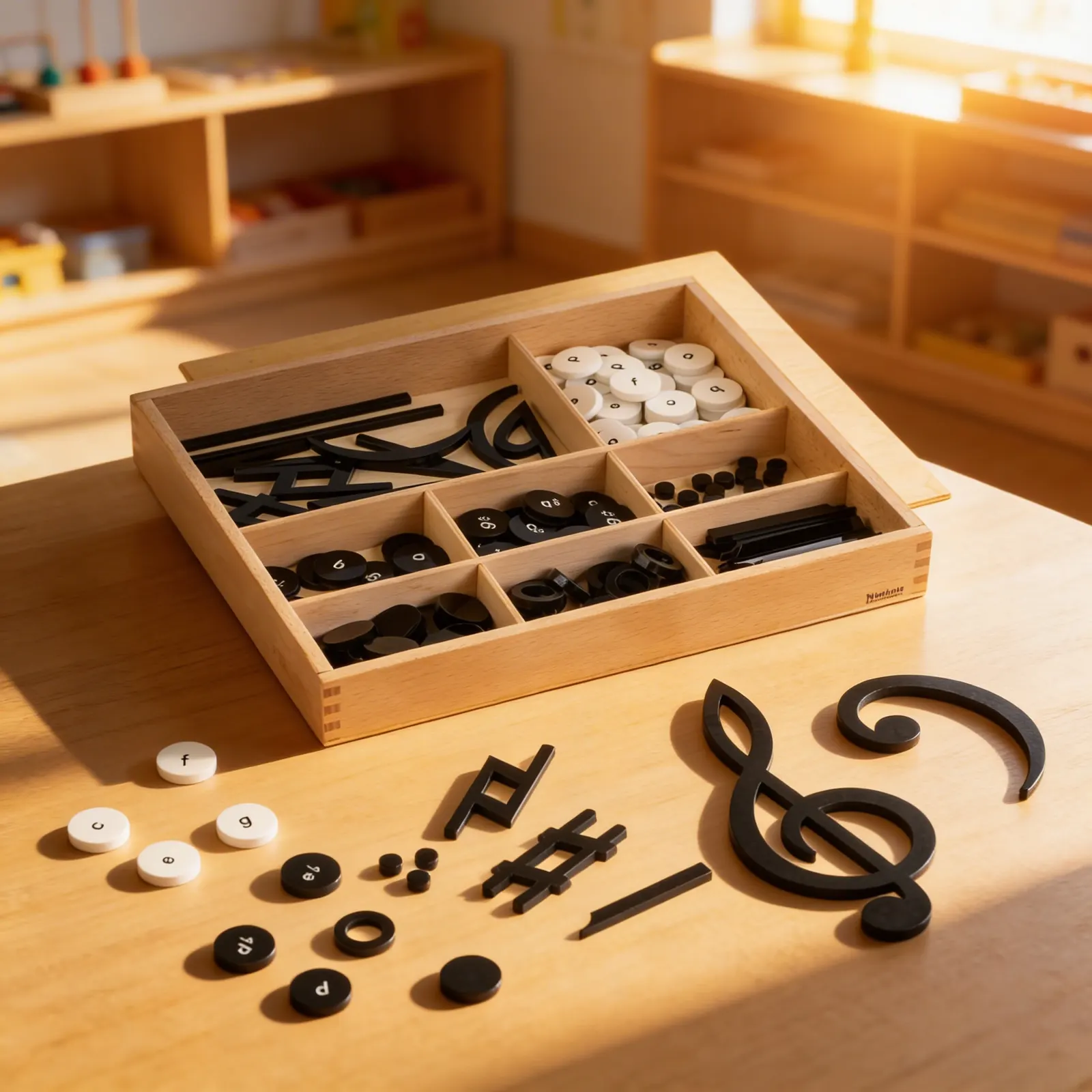
Bells Music Signs And Notes (Nienhuis) in a child's hands
The notation half of the bells work: signs and notes in wooden boxes, used to write down what has been played and to play what has been written. Until this arrives, a child working with the bells is composing in sound only and nothing survives the session. With it, a melody found on Tuesday can be laid out, kept and returned to on Thursday, which is the point at which music starts behaving like language. Belongs with the bells rather than alone. Wooden boxes with the signs and notes, for ages 3 to 6.
Musical Literacy
Introduces fundamental concepts of written music through concrete manipulation before abstract understanding.
Symbol Recognition
Develops visual discrimination skills as children match and identify different note values and musical symbols.
Mathematical Concepts
Note values teach fractions and duration relationships, connecting music to mathematical thinking.
Fine Motor Control
Handling small notation pieces refines pincer grip and hand movements needed for writing.
How to present it
Place the wooden storage box on a low shelf at child's eye level. Ensure bells or other instruments are accessible nearby. Prepare a work mat or table with sufficient space for arranging pieces.
- 1Begin with note value discs only, introducing whole notes and half notes
- 2Add quarter notes, creating simple rhythm patterns on the mat
- 3Introduce the staff components, placing notes at different heights
- 4Combine rhythm and pitch, creating simple melodies
- 5Add rests and other symbols gradually
3 tips for parents
- Clap simple rhythms during daily routines and ask child to find matching note patterns
- Point out musical notation in books or public spaces to reinforce symbol recognition
- Encourage child to 'write' favorite songs using the wooden pieces before attempting paper notation

If you are not sure it suits your child, we answer in person.
Norbert Kovalčín, founder of Faborino · write to him
There is no review here yet. We will ask you for one after you buy. Write the first review
What's in the Box
- Wooden Storage Box: With multiple compartments
- Note Value Discs: Various durations in black and white
- Musical Symbols: Including treble clef and sharps
- Notation Components: Approx. 50 pieces total
Size and material
| Packaging | 37 × 31 × 8 cm |
| Storage Box | Natural wood with compartments |
| Notation Pieces | Durable plastic |
| Recommended Age | 3-6 years |
Care
Wipe wooden box with damp cloth, clean plastic pieces with mild soap and water
Frequently Asked Questions
What age is this musical notation kit most suitable for?
This kit is designed for children ages 3-6 who are beginning to explore music concepts. The tactile materials allow young children to physically manipulate musical symbols before they're ready for abstract notation, making it ideal for early childhood music education.
Do children need prior music knowledge to use this material?
No prior music knowledge is required. The material is designed to introduce musical concepts from the beginning, allowing children to explore note values, rhythm patterns, and basic notation through hands-on manipulation and sensorial learning.
How does this material teach music reading without instruments?
Children learn to recognize and understand musical symbols, note values, and staff positions through physical manipulation of the pieces. They can arrange notes on the staff, compare different note durations, and create rhythm patterns, building a concrete understanding of music notation before applying it to an instrument.
What specific musical concepts does this kit cover?
The kit covers fundamental music literacy including note values (whole, half, quarter notes), rest symbols, staff lines and spaces, basic rhythm patterns, and pitch placement. Children learn to identify, sort, and arrange these elements to understand how written music represents sound.
Can this be used alongside Montessori bells or other instruments?
Yes, this material perfectly complements Montessori bells and other musical instruments. Children can create notation for melodies they play, match written notes to sounds they hear, and develop a complete understanding of how music is both heard and written.
Product safety
Manufacturer: Nienhuis Montessori, Anders Celsiusstraat 15, 7442 PB Nijverdal, Netherlands
Bells Music Signs And Notes (Nienhuis)