
Black And White Bead Stairs - Individual Beads Glass1 Set
The first photo is the maker's own. The other shots are illustrative.
Inv. no. NIE-0091AG
- Maker
- Nienhuis Montessori, since 1929
- Approval
- AMI
- Beads
- Glass
- Wire Structure
- Metal with loop connectors
- EAN
- 8719924005412
Final price incl. VAT. Delivery €5.90, €135.70 to go for free delivery.
Advice, warranty and returns are handled by us.
Why it costs €13.30
Behind the price of the original are things you can check yourself.
AMI approval
The material is approved by the Association Montessori Internationale (AMI). Nienhuis has made Montessori materials since 1929.
A verifiable original
The EAN 8719924005412 is on the box. It is the maker's number, not ours.
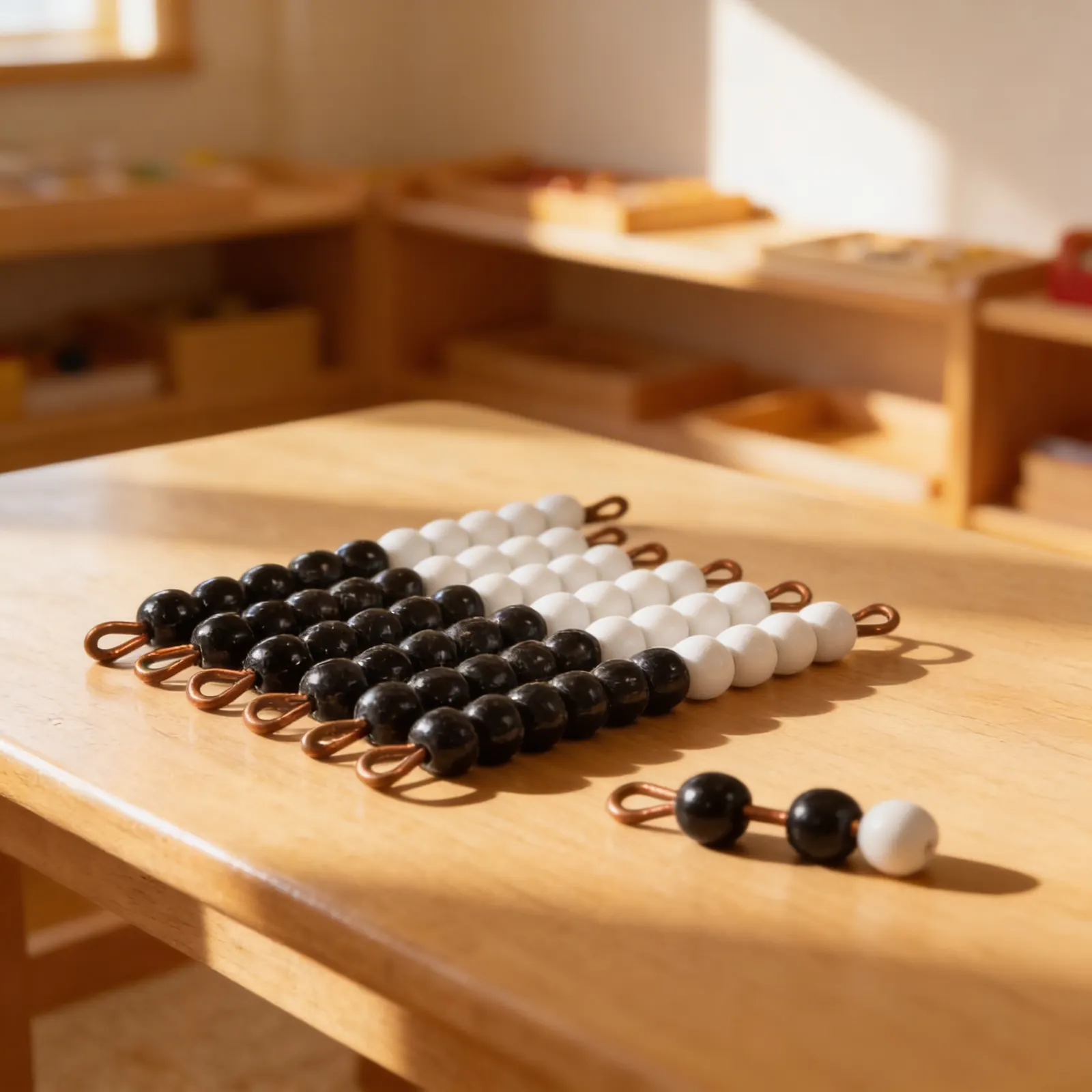
Black And White Bead Stairs - Individual Beads Glass in a child's hands
Part of the Bead Materials collection, this traditional Montessori Black and White Bead Stairs set features alternating glass beads strung on durable metal wire, creating a tactile mathematical material for exploring numerical relationships from 1 to 9. Each bead bar is carefully constructed with loop connectors at both ends, so children can physically manipulate and compare quantities while developing their understanding of the decimal system and mathematical patterns.
Number Concept Formation
Physical manipulation of bead quantities builds concrete understanding of numbers 1-9 and their relationships.
Visual Discrimination
Alternating black and white pattern enhances counting accuracy and supports visual tracking skills.
Mathematical Foundations
Prepares for skip counting, addition, and understanding of the decimal system through hands-on exploration.
Fine Motor Precision
Handling individual bead bars develops pincer grasp and controlled movements essential for later writing.
How to present it
Place the Black and White Bead Stairs on a mat in random order. Have a separate mat or tray ready for the child's work.
- 1Invite the child to build the stair pattern by finding the one-bead, then the two-bead bar, continuing sequentially
- 2Once arranged, count each bar together, touching each glass bead as you count
- 3Compare different bars by placing them side by side, observing which is longer
- 4Connect two smaller bars using the loops to match a longer bar's length
3 tips for parents
- Create simple counting games at home using the bead bars during everyday activities
- Allow your child to arrange the beads in different patterns beyond the traditional stair formation
- Resist the urge to correct immediately - let your child self-discover through manipulation

If you are not sure it suits your child, we answer in person.
Norbert Kovalčín, founder of Faborino · write to him
There is no review here yet. We will ask you for one after you buy. Write the first review
What's in the Box
- Black and White Bead Bars: 9 bars representing numbers 1-9
- Storage Arrangement: Triangular presentation layout
Size and material
| Packaging | 8 × 4 × 2 cm |
| Beads | Glass |
| Wire Structure | Metal with loop connectors |
| Recommended Age | 3-6 years |
Care
Wipe glass beads with damp cloth, dry metal thoroughly to prevent rust
Frequently Asked Questions
What is included in this Black and White Bead Stairs set?
This set includes 9 bead bars representing quantities 1-9, with each bar containing alternating black and white glass beads strung on metal wire with loop connectors at both ends.
How do children use the Black and White Bead Stairs for learning?
Children physically manipulate the bead bars to compare quantities, build number sequences, explore skip counting patterns, and prepare for multiplication concepts by seeing visual patterns in the alternating colors.
What is the difference between colored bead stairs and black/white bead stairs?
While colored bead stairs use different colors for each quantity, black and white bead stairs use alternating beads to emphasize numerical patterns and groupings, making it easier to visualize even/odd numbers and multiplication concepts.
Are the glass beads safe for young children?
Yes, the glass beads are securely strung on durable metal wire with loop connectors, preventing beads from coming loose. However, adult supervision is recommended for children ages 3-6 as specified.
What mathematical concepts can be taught with this material?
This material supports learning counting 1-9, quantity comparison, number sequencing, even/odd number recognition, skip counting, early multiplication patterns, and preparation for the decimal system.
Product safety
Manufacturer: Nienhuis Montessori, Anders Celsiusstraat 15, 7442 PB Nijverdal, Netherlands
Black And White Bead Stairs - Individual Beads Glass