
Bolts and PegsFine Motor Activity
The first photo is the maker's own. The other shots are illustrative.
Inv. no. NIE-041000
- Maker
- Nienhuis Montessori, since 1929
- Approval
- AMI
- Product size
- 24 × 16 × 5.5 cm
- Base
- Birch plywood
- Pegs & Bolts
- Solid wood, paint
- EAN
- 8719924058401
Final price incl. VAT. Delivery €5.90, €93.10 to go for free delivery.
Advice, warranty and returns are handled by us.
Why it costs €55.90
Behind the price of the original are things you can check yourself.
AMI approval
The material is approved by the Association Montessori Internationale (AMI). Nienhuis has made Montessori materials since 1929.
A verifiable original
The EAN 8719924058401 is on the box. It is the maker's number, not ours.
Bolts and Pegs in a child's hands
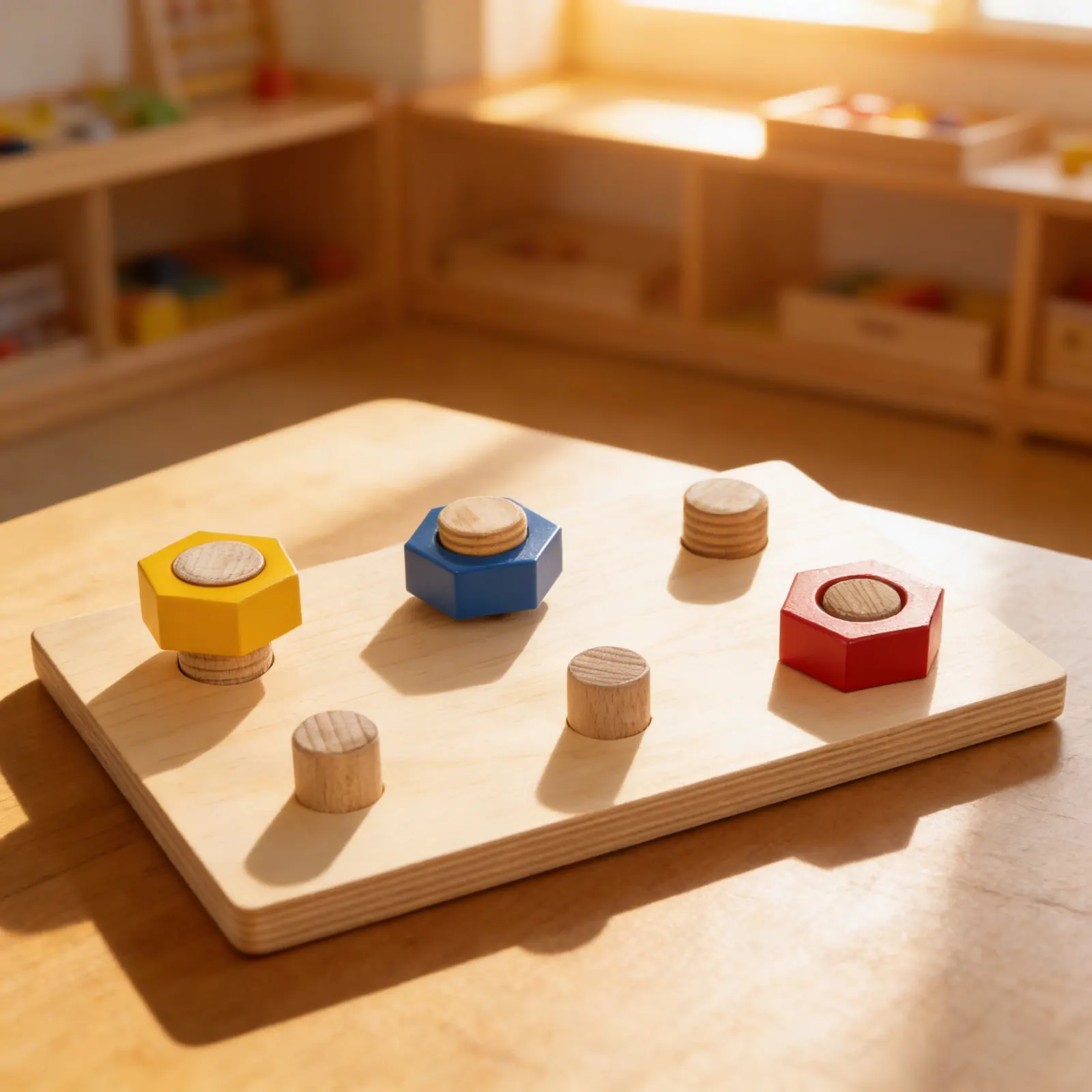
Bolts and pegs on a board of 24 by 16 by 5.5 cm, worked by turning each bolt between finger and thumb. That grip, the pincer grasp, is the one a pencil needs, and this is one of the few materials that trains it without a pencil being anywhere near: the bolt has to be turned, which means the fingers must both grip and rotate at once. The hand muscles built here are the ones that later make writing possible for longer than five minutes. Birch plywood and solid wood, for ages 0 to 3.
Fine Motor Control
Grasping and placing pegs and bolts strengthens the pincer grasp essential for writing preparation.
Shape Discrimination
Distinguishing between cylindrical and hexagonal forms develops visual perception and problem-solving skills.
Hand-Eye Coordination
Aligning pieces with their corresponding posts refines coordination between visual input and hand movements.
Concentration Development
The focused nature of the activity builds attention span and task completion skills.
How to present it
Place the birch plywood board on a low table or mat at child's working height. Arrange the three pegs and three bolts in a small basket to the right of the board.
- 1Demonstrate slowly picking up one cylindrical peg with thumb and two fingers
- 2Place the peg onto its matching hole with deliberate, controlled movement
- 3Pick up one hexagonal bolt and show how to position fingers around its edges
- 4Demonstrate the wrist rotation needed to fit the bolt into its space
- 5Invite the child to try, starting with the cylindrical pegs first
3 tips for parents
- Practice with household items like jar lids and containers to reinforce the twisting motion learned with the hexagonal bolts
- Notice if your child favors one hand, encourage use of both hands alternately with this material
- Create simple shape-sorting games during daily routines using the cylinder/hexagon concept

If you are not sure it suits your child, we answer in person.
Norbert Kovalčín, founder of Faborino · write to him
There is no review here yet. We will ask you for one after you buy. Write the first review
What's in the Box
- Plywood Base Board: 30 × 20 cm with 6 posts
- Cylindrical Peg Pieces: 3 natural wood pieces
- Hexagonal Bolt Pieces: 3 painted pieces
Size and material
| Product size | 24 × 16 × 5.5 cm |
| Packaging | 25 × 17 × 7 cm |
| Base | Birch plywood |
| Pegs & Bolts | Solid wood, paint |
| Recommended Age | 12-36 months |
Care
Wipe with damp cloth, dry immediately
Frequently Asked Questions
What age is the Bolts and Pegs board suitable for?
This material is designed for children ages 12 months to 3 years. Younger toddlers enjoy the simple placement activities, while older children refine their precision and explore the different shapes and textures.
How does this differ from a regular peg board?
Unlike traditional peg boards, this features two distinct elements - cylindrical pegs and hexagonal bolts - providing varied gripping positions and movements. This contrast helps children develop shape discrimination while practicing different fine motor patterns.
What skills does the Bolts and Pegs board develop?
This material develops hand-eye coordination, pincer grasp, shape recognition, and concentration. The different shapes require varied hand positions, strengthening fingers and preparing the hand for writing and other precise movements.
Is supervision required during use?
While the pieces are designed to be safe for toddlers, adult supervision is recommended for children under 2 years. Always ensure pieces are larger than the child's mouth opening and check regularly for any damage or wear.
How should I present this material to my child?
Start by slowly demonstrating placing one peg, then one bolt, using deliberate movements. Allow your child to explore at their own pace. Store at child's height on a low shelf so they can choose the work independently.
Product safety
Manufacturer: Nienhuis Montessori, Anders Celsiusstraat 15, 7442 PB Nijverdal, Netherlands
Bolts and Pegs