
Botany Puzzle Activity Set
The first photos are the maker's own. The other shots are illustrative.
Inv. no. NIE-020201
- Maker
- Nienhuis Montessori, since 1929
- Approval
- AMI
- Storage Box
- Natural wood with compartment dividers
- Puzzle Materials
- Laminated paper or cardboard
- EAN
- 8719924010911
Final price incl. VAT. Delivery €5.90, €67.10 to go for free delivery.
Advice, warranty and returns are handled by us.
Why it costs €81.90
Behind the price of the original are things you can check yourself.
AMI approval
The material is approved by the Association Montessori Internationale (AMI). Nienhuis has made Montessori materials since 1929.
A verifiable original
The EAN 8719924010911 is on the box. It is the maker's number, not ours.
Botany Puzzle Activity Set in a child's hands
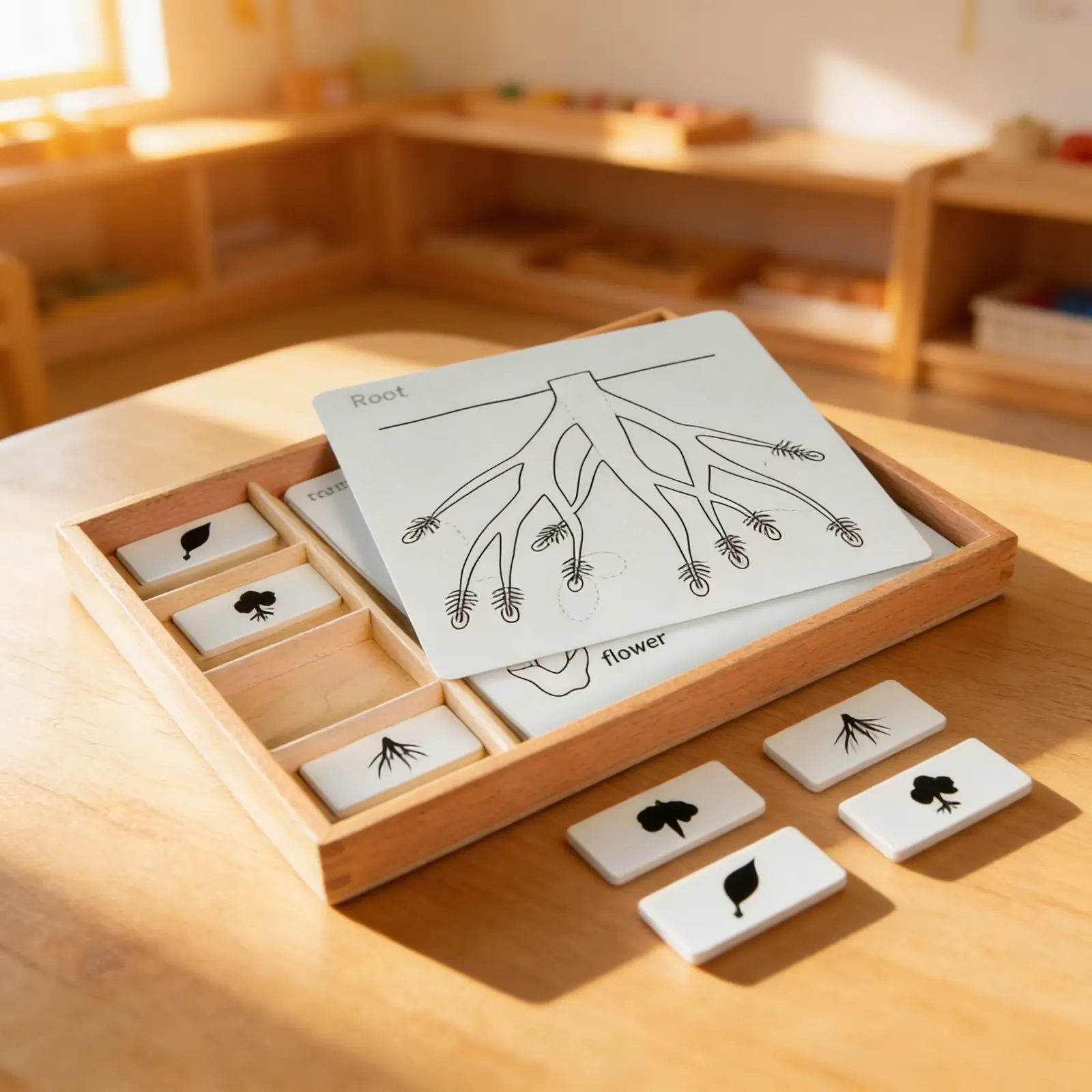
Great for independent study, this Botany Puzzle Activity Set brings children face-to-face with plant anatomy through direct experience. The wooden storage box contains multiple botanical puzzles featuring root systems and flower structures, complete with removable labels for nomenclature work. Each puzzle piece is precisely cut to isolate specific plant parts, supporting the Montessori approach to scientific classification and vocabulary development.
Scientific Classification
Children learn to identify and name plant parts, building a foundation for biological sciences and systematic thinking.
Language Development
Matching labels to puzzle pieces enriches vocabulary with precise botanical terminology appropriate for the sensitive period for language.
Visual Discrimination
Assembling detailed anatomical puzzles refines visual perception and attention to botanical structures.
How to present it
Place the wooden storage box on a work mat. Select one botanical puzzle (start with the flower puzzle). Arrange the puzzle frame on the left side of the mat with pieces removed and placed randomly to the right.
- 1Invite the child to examine each puzzle piece, noting its unique shape and features
- 2Demonstrate removing one piece at a time from right to left, examining it closely before placing it in the correct position
- 3Once the puzzle is complete, introduce the nomenclature cards one at a time, reading each label clearly
- 4Remove all labels and invite the child to match them independently to the puzzle pieces
3 tips for parents
- Support learning at home by identifying plant parts during nature walks or while preparing vegetables
- Create a small garden or window box where your child can observe real plant growth and structures
- Encourage your child to teach you the botanical vocabulary they've learned through puzzle work

If you are not sure it suits your child, we answer in person.
Norbert Kovalčín, founder of Faborino · write to him
There is no review here yet. We will ask you for one after you buy. Write the first review
What's in the Box
- Wooden Storage Box: With multiple compartments
- Root System Puzzle: With removable anatomical pieces
- Flower Anatomy Puzzle: With labeled parts
- Nomenclature Labels: Approx. 10 matching labels
Size and material
| Packaging | 33 × 25 × 5 cm |
| Storage Box | Natural wood with compartment dividers |
| Puzzle Materials | Laminated paper or cardboard |
| Construction | Precision-cut puzzle pieces |
| Recommended Age | 3-6 years |
Care
Wipe wooden box with damp cloth, keep puzzle pieces dry
Frequently Asked Questions
What puzzles are included in this Botany Activity Set?
The set includes multiple wooden botanical puzzles featuring detailed root systems and flower structures. Each puzzle focuses on different plant anatomy components with precisely cut pieces that isolate specific parts like stems, leaves, petals, stamens, and roots for focused learning.
How do the removable labels support language development?
The removable nomenclature labels allow children to match botanical terms with corresponding puzzle pieces, supporting vocabulary development and reading skills. This three-part card approach helps children learn scientific terminology through visual association and repetition.
What makes this suitable for ages 3-6?
The puzzles feature large, easy-to-grasp wooden pieces perfect for developing fine motor skills. The concepts progress from simple plant parts identification to more complex understanding of plant structures, allowing children to grow with the material throughout the early childhood years.
How does the wooden storage box help with organization?
The included wooden storage box keeps all puzzles and labels organized in designated compartments, teaching children proper care of materials. This promotes independence as children can easily access, use, and return materials to their proper places without adult assistance.
Can this set be used for group lessons?
Yes, the multiple puzzles allow several children to work simultaneously on different plant concepts. Teachers can present lessons on plant anatomy to small groups, then children can practice independently or in pairs, making it ideal for classroom environments.
Product safety
Manufacturer: Nienhuis Montessori, Anders Celsiusstraat 15, 7442 PB Nijverdal, Netherlands
Botany Puzzle Activity Set