
Botany PuzzleCopy Masters
The first photo is the maker's own. The other shots are illustrative.
Inv. no. NIE-020500
- Maker
- Nienhuis Montessori, since 1929
- Approval
- AMI
- Primary Material
- Cardstock paper
- Print Type
- Black line drawings
- EAN
- 8719924010973
Final price incl. VAT. Delivery €5.90, €138.60 to go for free delivery.
Advice, warranty and returns are handled by us.
Why it costs €10.40
Behind the price of the original are things you can check yourself.
AMI approval
The material is approved by the Association Montessori Internationale (AMI). Nienhuis has made Montessori materials since 1929.
A verifiable original
The EAN 8719924010973 is on the box. It is the maker's number, not ours.
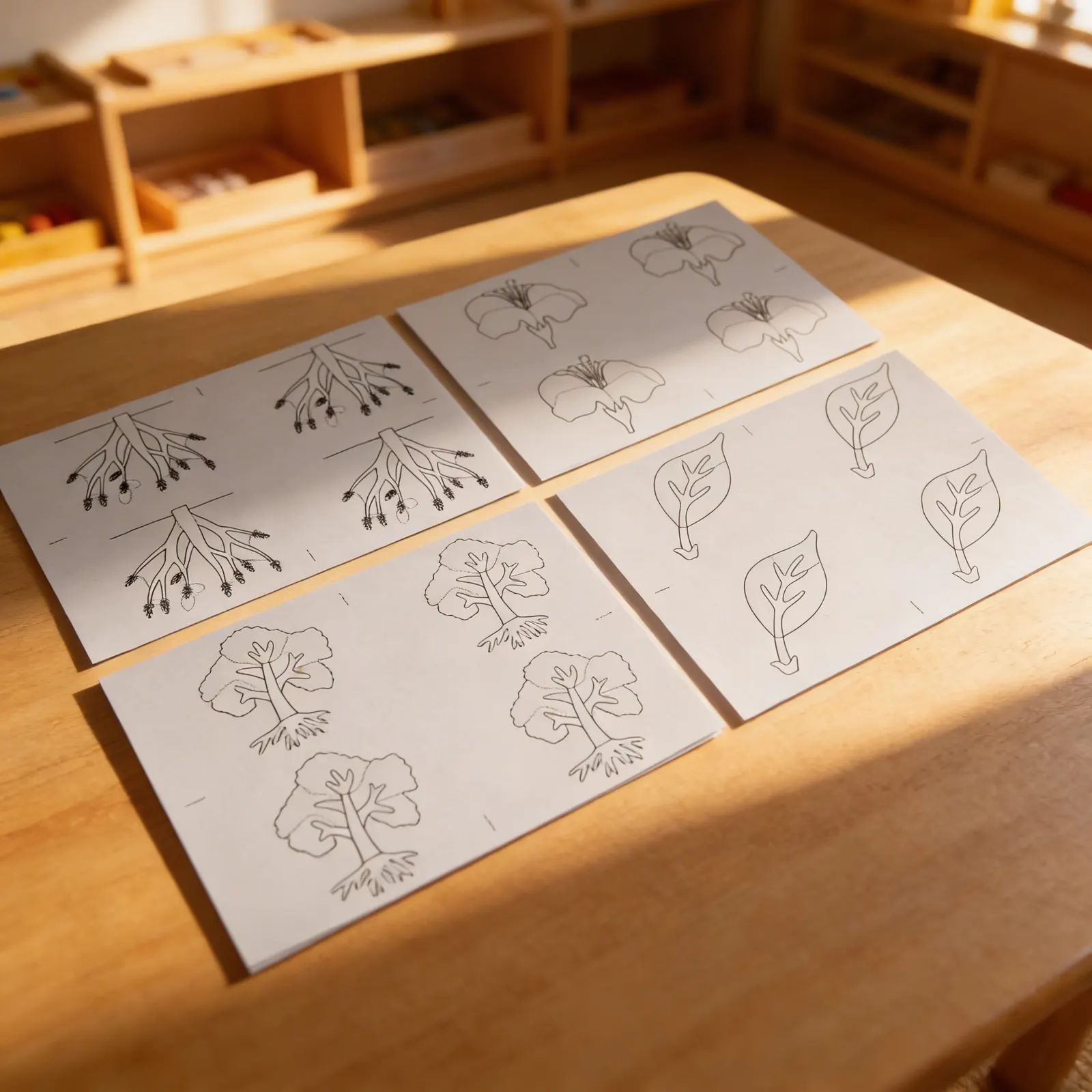
Botany Puzzle in a child's hands
Four plastic cards carrying the botany puzzle illustrations, for copying. The puzzles give the child the leaf shapes to handle, and these cards are what happens next: the outline is traced onto paper and coloured in, so a shape that was in the hands becomes a drawing that can be kept, labelled and taken home. Plastic rather than card because a pencil pressed along an edge all year would destroy paper. The botany puzzles themselves are separate items.
Fine Motor Control
Tracing botanical outlines develops pencil grip and hand control essential for later writing skills.
Botanical Knowledge
Repeated tracing reinforces understanding of plant parts and their distinctive shapes.
Concentration Development
Following precise lines requires sustained focus and attention to detail.
Visual Discrimination
Distinguishing between different plant structures enhances observational skills.
How to present it
Place Copy Masters on a tray with colored pencils and plain paper. Position at the biology shelf near botany puzzles and nomenclature cards.
- 1Select one botanical sheet and place on work surface
- 2Place tracing paper over the Copy Master and secure corners
- 3Trace the outline slowly with a pencil, following each curve
- 4Remove tracing and compare with original Copy Master
- 5Color the traced drawing using realistic botanical colors
3 tips for parents
- Create nature journals combining pressed leaves with traced drawings from Copy Masters
- Use tracings as templates for seasonal art projects or greeting cards
- Practice botanical vocabulary during nature walks by finding plants matching traced forms

If you are not sure it suits your child, we answer in person.
Norbert Kovalčín, founder of Faborino · write to him
There is no review here yet. We will ask you for one after you buy. Write the first review
What's in the Box
- Botanical tracing sheets: 4 cardstock sheets with multiple designs
- Flower outlines: Various flower structures for tracing
- Leaf patterns: Different leaf shapes and venation patterns
- Tree designs: Branch and tree structure outlines
Size and material
| Packaging | 30 × 25 × 0 cm |
| Primary Material | Cardstock paper |
| Print Type | Black line drawings |
| Recommended Age | 3-6 years |
Care
| Cleaning | Wipe with dry cloth if needed |
| Storage | Keep flat in a dry location |
Frequently Asked Questions
What exactly are Botany Puzzle Copy Masters?
These are cardstock tracing templates featuring precise line drawings of plant parts including flowers, leaves, and tree structures. They're designed to complement botany puzzles by providing traceable outlines that children can use repeatedly to practice identifying and drawing plant components.
How do these copy masters support Montessori learning?
They follow Montessori principles by isolating botanical concepts, allowing repetitive practice for mastery, and combining sensorial learning (tracing) with vocabulary development. The materials support the child's natural tendency to refine movements while building concrete understanding of plant morphology.
What age group benefits most from these materials?
While designed for ages 3-6, they're most effective when children have developed basic pencil grip and can follow simple lines. Typically, 4-5 year olds gain the most benefit as they're refining fine motor skills while actively exploring botanical concepts in their environment.
Can these be used without owning the actual botany puzzles?
Yes, these copy masters function independently as botanical drawing exercises. However, they're most effective when used alongside physical botany puzzles, as children can trace after manipulating the concrete materials, reinforcing their understanding through multiple sensory experiences.
How durable are these copy masters for classroom use?
Printed on sturdy cardstock, they're designed for repeated classroom use. For extended durability, many teachers laminate them or place them in clear protective sleeves, allowing children to trace with dry-erase markers for unlimited practice opportunities.
Product safety
Manufacturer: Nienhuis Montessori, Anders Celsiusstraat 15, 7442 PB Nijverdal, Netherlands
Botany Puzzle