
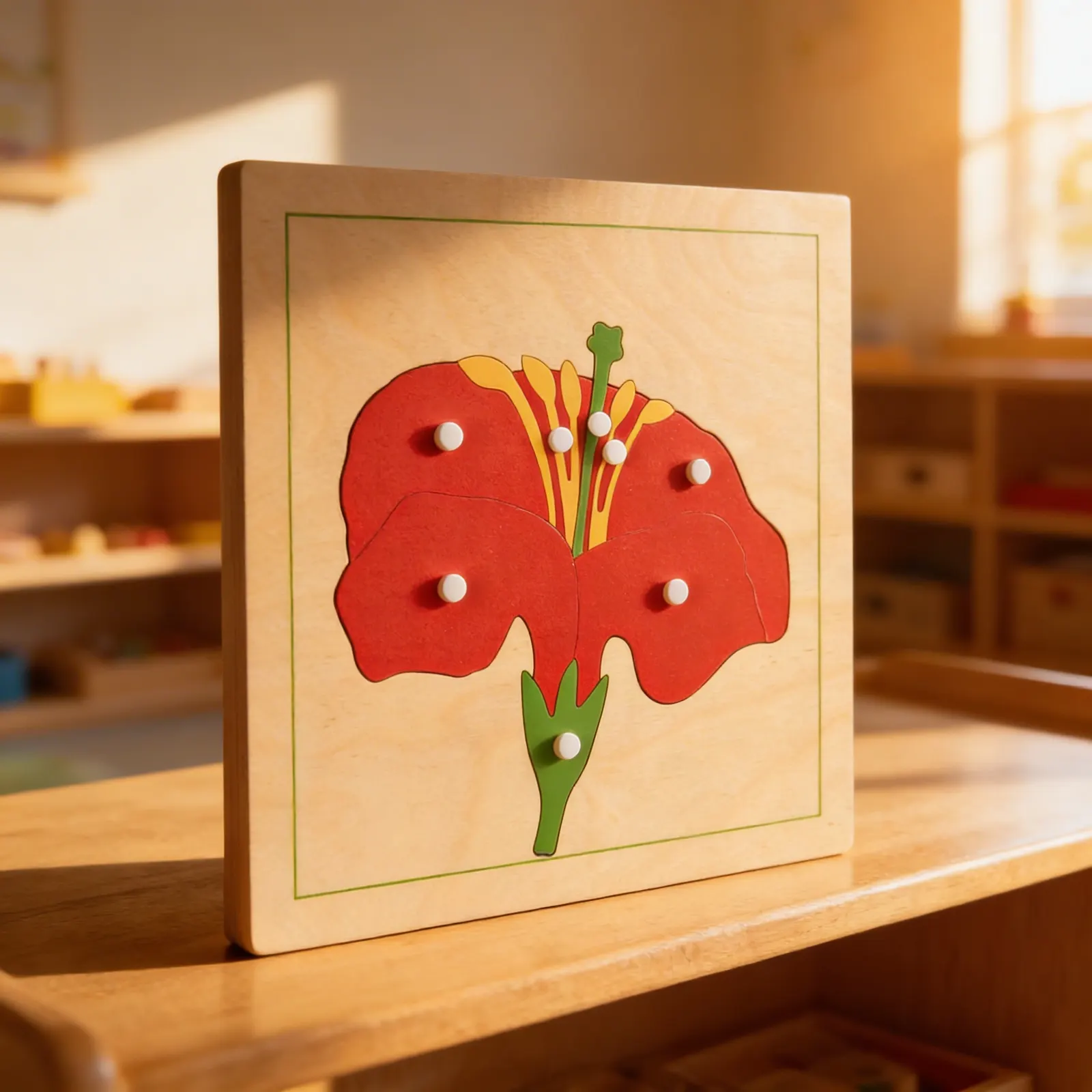
Botany PuzzleFlower
The first photo is the maker's own. The other shots are illustrative.
Inv. no. NIE-0198B0
- Maker
- Nienhuis Montessori, since 1929
- Approval
- AMI
- Base & Pieces
- Solid wood construction
- Surface Finish
- Paint or laminate
- EAN
- 8719924010713
Final price incl. VAT. Delivery €5.90, €109.10 to go for free delivery.
Advice, warranty and returns are handled by us.
Why it costs €39.90
Behind the price of the original are things you can check yourself.
AMI approval
The material is approved by the Association Montessori Internationale (AMI). Nienhuis has made Montessori materials since 1929.
A verifiable original
The EAN 8719924010713 is on the box. It is the maker's number, not ours.
Botany Puzzle in a child's hands
The flower puzzle from the botany series, separating into the parts a flower is made of. A flower is the plant part children handle most and understand least: it gets picked, pulled apart and thrown away long before anyone explains that the whole structure exists to make seeds. Taking it apart deliberately, with each piece named and put back, is a different act from pulling petals off, and that difference is worth teaching. Wood, for ages 3 to 12.
Botanical Knowledge
Children learn flower anatomy through concrete manipulation, building vocabulary for petals, stamens, and other plant parts.
Fine Motor Refinement
Knob handles isolate finger movements, preparing the hand for writing while developing pincer grip strength.
Visual Discrimination
Matching puzzle pieces to their spaces develops spatial reasoning and attention to botanical details.
Science Foundation
Concrete exploration of flower structure creates sensorial memories that support later abstract botanical studies.
How to present it
Place the Botany Puzzle on a tray with the frame on the left and pieces arranged in order on the right. Include a small pitcher of water and cloth for cleaning knobs if needed.
- 1Remove all pieces starting with the top layer, naming each part as you lift it by its knob
- 2Point to each empty space in the frame and name the flower part that belongs there
- 3Replace pieces starting with the bottom layer, building the flower from inside out
- 4Run your finger around each completed part, reinforcing its name and position
3 tips for parents
- Collect flowers from garden or walks to examine parts matching the puzzle
- Press flowers between paper to create botanical collection linking to puzzle work
- Use puzzle vocabulary during everyday flower encounters: 'Look at those bright petals!'

If you are not sure it suits your child, we answer in person.
Norbert Kovalčín, founder of Faborino · write to him
There is no review here yet. We will ask you for one after you buy. Write the first review
What's in the Box
- Wooden Base Board: With green border frame
- Flower Puzzle Pieces: Approx. 6 pieces with knob handles
Size and material
| Packaging | 25 × 25 × 3 cm |
| Base & Pieces | Solid wood construction |
| Surface Finish | Paint or laminate |
| Handles | Wooden knobs |
| Recommended Age | 3-6 years |
Care
Wipe with slightly damp cloth, dry immediately
Frequently Asked Questions
What parts of the flower does this puzzle teach?
This Botany Puzzle includes all major flower parts such as petals, sepals, stamens, pistil, and stem. Each piece is clearly defined and removable, allowing children to learn botanical terminology through hands-on exploration and repetition.
How does the layered design work for learning?
The puzzle features multiple layers that reveal the flower's internal structure. Children first remove outer parts like petals, then discover inner components like stamens and pistil underneath, providing a realistic understanding of how flowers are constructed in nature.
What makes this puzzle suitable for ages 3-6?
Each puzzle piece features appropriately-sized knob handles designed for developing fine motor skills. The pieces are large enough to prevent choking hazards while being perfectly proportioned for small hands to grasp, manipulate, and place accurately.
How can parents support learning with this puzzle?
Parents can introduce botanical vocabulary as children work, name each part as it's removed or replaced, and connect the puzzle to real flowers in nature. Extension activities include flower dissection, nature walks, and creating botanical drawings.
Is this puzzle self-correcting like other Montessori materials?
Yes, each puzzle piece fits only in its designated space, providing immediate feedback to the child. This self-correcting feature allows independent learning and helps children develop problem-solving skills while building confidence through successful completion.
Product safety
Manufacturer: Nienhuis Montessori, Anders Celsiusstraat 15, 7442 PB Nijverdal, Netherlands
Botany Puzzle