
Botany PuzzleLeaf
The first photo is the maker's own. The other shots are illustrative.
Inv. no. NIE-0198C0
- Maker
- Nienhuis Montessori, since 1929
- Approval
- AMI
- Frame
- Solid wood with natural finish
- Puzzle Piece
- Painted wood with finish
- EAN
- 8719924010720
Final price incl. VAT. Delivery €5.90, €109.10 to go for free delivery.
Advice, warranty and returns are handled by us.
Why it costs €39.90
Behind the price of the original are things you can check yourself.
AMI approval
The material is approved by the Association Montessori Internationale (AMI). Nienhuis has made Montessori materials since 1929.
A verifiable original
The EAN 8719924010720 is on the box. It is the maker's number, not ours.
Botany Puzzle in a child's hands
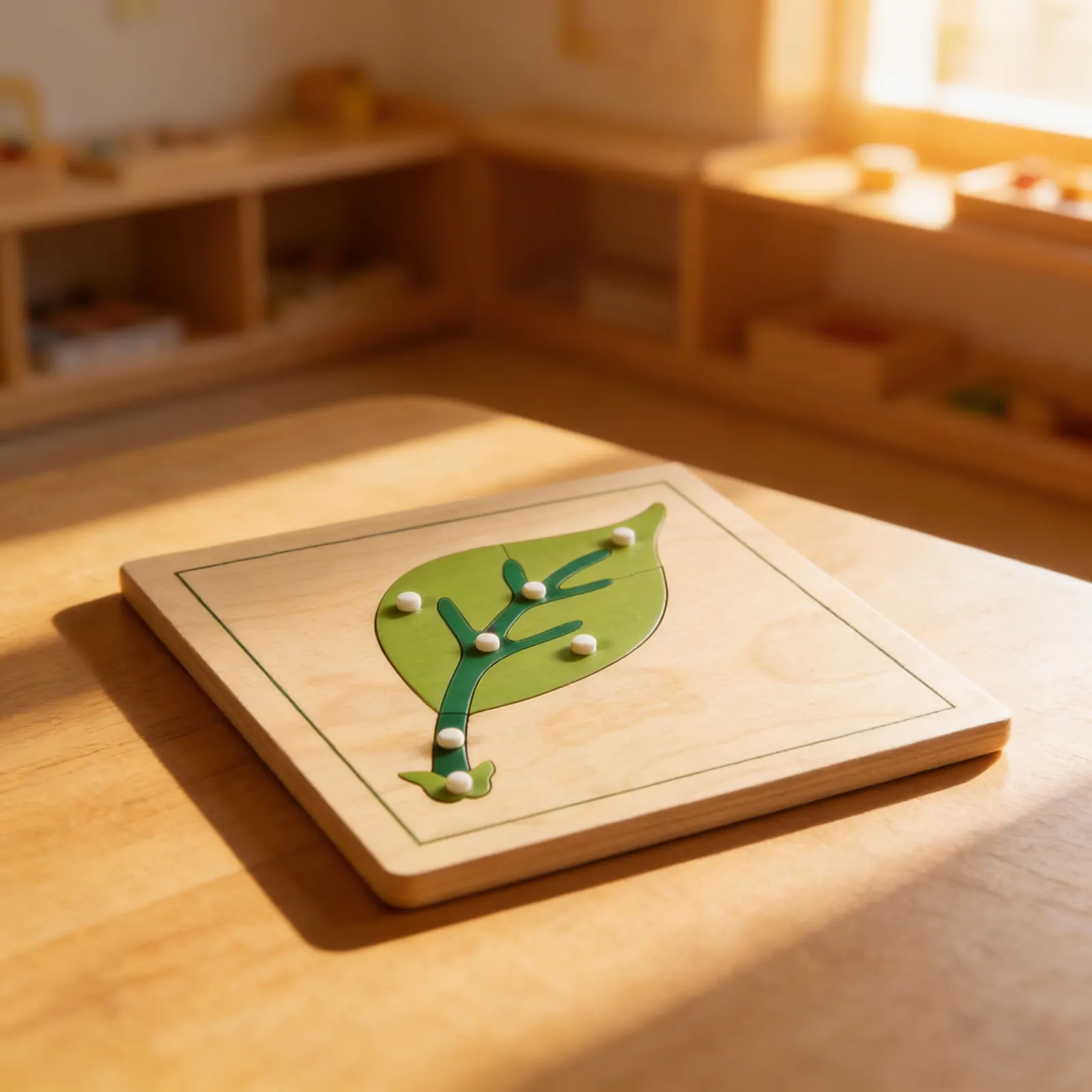
Connecting children to the living world, this Montessori Botany Puzzle introduces young learners to leaf anatomy through real-world practice. The puzzle features a detailed leaf shape with visible veining patterns, fitted with white grasping knobs that support the development of the pincer grip. Set within a wooden frame with a distinctive green border, this material isolates the study of leaf structure while building fine motor skills and botanical vocabulary.
Botanical Knowledge
Introduces leaf structure and vocabulary through concrete manipulation, preparing for advanced botany studies.
Fine Motor Refinement
Grasping knobs strengthen pincer grip while precise placement develops hand-eye coordination.
Visual Discrimination
Matching puzzle shape to frame opening enhances perception of form and spatial relationships.
Concentration Building
Single-focus activity supports attention span development through purposeful, repetitive work.
How to present it
Place the puzzle on a tray at the child's workspace. Have a real leaf specimen nearby for comparison. Ensure the work surface is at appropriate height for the child.
- 1Invite the child to carry the tray to their table using both hands
- 2Remove puzzle pieces one at a time using the pincer grip on the knobs
- 3Place removed pieces to the right of the frame in the order removed
- 4Trace the empty leaf outline with your index finger
- 5Replace pieces starting with the first removed, fitting each carefully
- 6Compare the completed puzzle to the real leaf specimen
3 tips for parents
- Collect different leaf types during walks to compare with the puzzle's leaf shape at home
- Avoid correcting puzzle placement, children learn more from discovering the right fit themselves
- Display completed leaf drawings or pressings near the puzzle work area to extend interest

If you are not sure it suits your child, we answer in person.
Norbert Kovalčín, founder of Faborino · write to him
There is no review here yet. We will ask you for one after you buy. Write the first review
What's in the Box
- Wooden puzzle board: 24×24cm with green border
- Leaf puzzle piece: With white grasping knobs
- Presentation guide: Basic usage instructions
Size and material
| Packaging | 25 × 25 × 3 cm |
| Frame | Solid wood with natural finish |
| Puzzle Piece | Painted wood with finish |
| Knobs | White painted wood |
| Recommended Age | 3-6 years |
Care
Wipe with slightly damp cloth, dry immediately
Frequently Asked Questions
What age is the Botany Puzzle: Leaf suitable for?
This puzzle is designed for children ages 3-6 years old, aligning with the Montessori early childhood curriculum for botanical studies and fine motor development.
What skills does this leaf puzzle help develop?
The puzzle develops fine motor skills, particularly the pincer grip through the white grasping knobs, while introducing botanical concepts like leaf structure, veining patterns, and scientific vocabulary.
How is this puzzle used in Montessori education?
Children trace the puzzle piece, match it to the frame, and learn leaf anatomy vocabulary. It's often paired with real leaves for comparison and used alongside other botany materials in the cultural studies area.
What are the dimensions and materials of this puzzle?
The puzzle features a wooden frame with a green border and includes a detailed leaf-shaped piece with visible veining patterns. Each piece has white grasping knobs sized appropriately for small hands.
Can this puzzle be used with other Montessori botany materials?
Yes, it integrates perfectly with the complete botany puzzle series (flower, tree, etc.), botany nomenclature cards, and leaf classification activities to create a comprehensive botanical curriculum.
Product safety
Manufacturer: Nienhuis Montessori, Anders Celsiusstraat 15, 7442 PB Nijverdal, Netherlands
Botany Puzzle