
Botany PuzzleRoot
The first photo is the maker's own. The other shots are illustrative.
Inv. no. NIE-0198D0
- Maker
- Nienhuis Montessori, since 1929
- Approval
- AMI
- Primary Material
- Plywood with wood veneer
- Frame
- Natural wood with recessed border
- EAN
- 8719924010737
Final price incl. VAT. Delivery €5.90, €109.10 to go for free delivery.
Advice, warranty and returns are handled by us.
Why it costs €39.90
Behind the price of the original are things you can check yourself.
AMI approval
The material is approved by the Association Montessori Internationale (AMI). Nienhuis has made Montessori materials since 1929.
A verifiable original
The EAN 8719924010737 is on the box. It is the maker's number, not ours.
Botany Puzzle in a child's hands
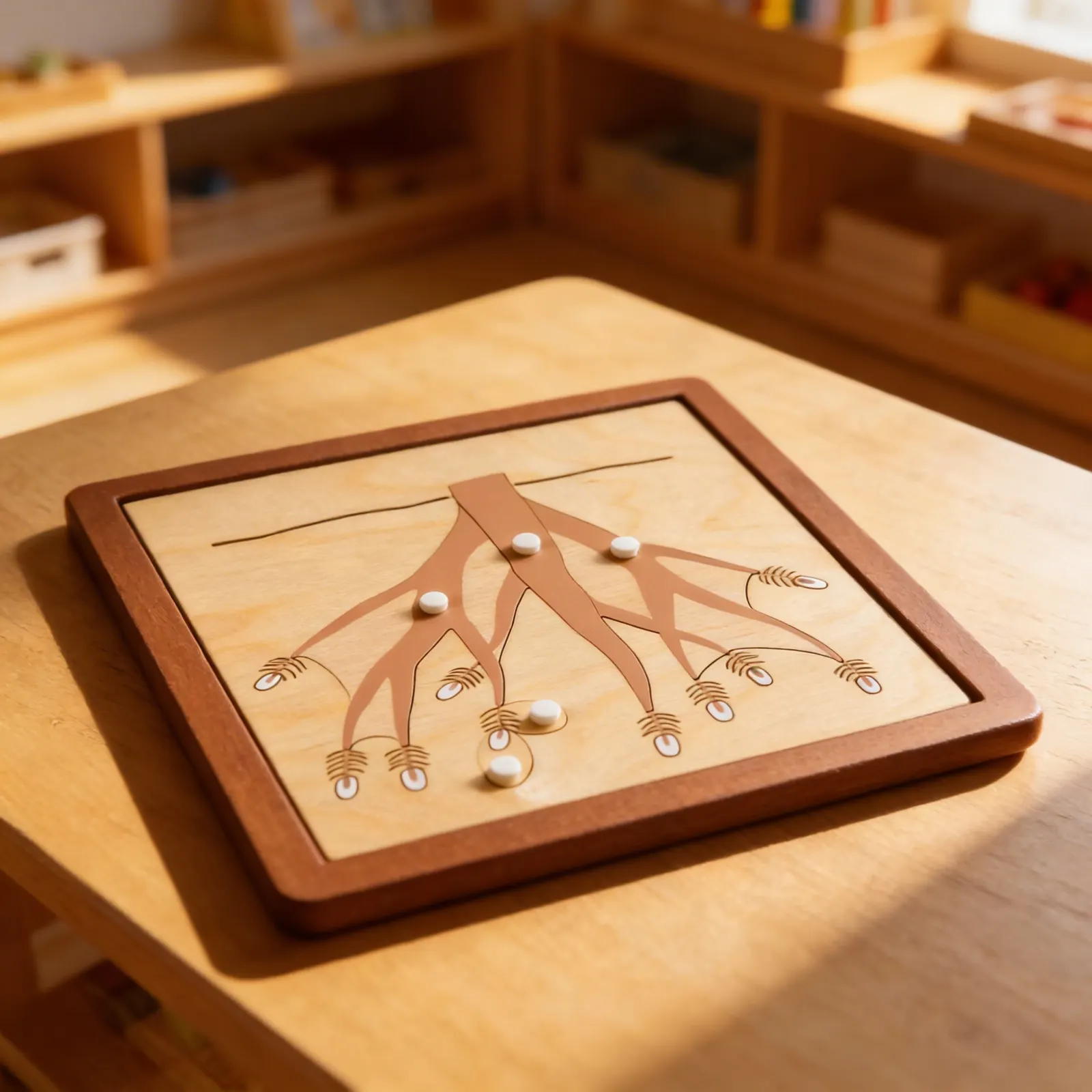
The Botany Puzzle: Root lays the groundwork for understanding plant anatomy through physical engagement of root structure. This finely made wooden puzzle features a taproot system with lateral branches and root hair details, so that children trace, remove, and replace pieces while building botanical vocabulary. The recessed frame and knobbed pieces support independent work as children discover how roots anchor plants and absorb nutrients.
Botanical Knowledge
Children learn root anatomy including taproot, lateral roots, and root hairs through concrete manipulation.
Scientific Vocabulary
Introduces precise botanical terms while children trace and handle each root component.
Fine Motor Refinement
Removing and replacing puzzle pieces develops pincer grasp and hand-eye coordination.
Nature Connection
Understanding root systems deepens children's appreciation for how plants grow and survive.
How to present it
Place the root puzzle on a tray at the child's workspace. Ensure all pieces are properly seated in the frame. Have a real plant with visible roots nearby if possible.
- 1Demonstrate removing the main taproot piece first, using a pincer grasp on the knob
- 2Trace the outline of the taproot in the frame before replacing it
- 3Remove lateral root pieces one at a time, naming each part
- 4Invite the child to remove and replace pieces, starting with the largest
3 tips for parents
- Look for roots during gardening activities and compare them to the puzzle pieces
- Start a bean or avocado pit in water to observe real root growth over time
- Use correct botanical terms at home to reinforce classroom vocabulary

If you are not sure it suits your child, we answer in person.
Norbert Kovalčín, founder of Faborino · write to him
There is no review here yet. We will ask you for one after you buy. Write the first review
What's in the Box
- Root System Puzzle: Approx. 6 removable pieces
- Wooden Frame: With recessed border for piece placement
Size and material
| Packaging | 25 × 25 × 3 cm |
| Primary Material | Plywood with wood veneer |
| Frame | Natural wood with recessed border |
| Recommended Age | 3-6 years |
Care
Wipe with slightly damp cloth, dry immediately
Frequently Asked Questions
What age is the Botany Root Puzzle suitable for?
This puzzle is designed for children ages 3-6 years. The knobbed pieces and recessed frame make it accessible for 3-year-olds developing their pincer grasp, while the botanical concepts engage children through age 6 as they explore plant science.
What does the Root Puzzle teach children?
Children learn about root anatomy including the taproot, lateral roots, and root hairs. They discover how roots anchor plants in soil and absorb water and nutrients. The puzzle builds botanical vocabulary and understanding of plant life cycles through hands-on exploration.
How many pieces does the puzzle contain?
The puzzle features multiple wooden pieces representing different parts of the root system - typically including the main taproot, several lateral branch roots, and detailed root hair sections. Each piece has a knob for easy grasping and precise placement.
What materials is the Botany Root Puzzle made from?
The puzzle is crafted from high-quality, smooth-finished wood with a durable recessed wooden frame. The pieces are precisely cut to show accurate root anatomy details, with child-safe, non-toxic finishes that meet European safety standards.
How does this puzzle support Montessori learning?
This puzzle follows Montessori principles by isolating one concept (root structure), providing concrete sensorial experience before abstract learning, and enabling self-correction through the control of error built into the puzzle design. It supports the Montessori botany curriculum for primary classrooms.
Product safety
Manufacturer: Nienhuis Montessori, Anders Celsiusstraat 15, 7442 PB Nijverdal, Netherlands
Botany Puzzle