
The Brown Stair
Made by Nienhuis Montessori · shipped by Heutink International (Netherlands) About the maker
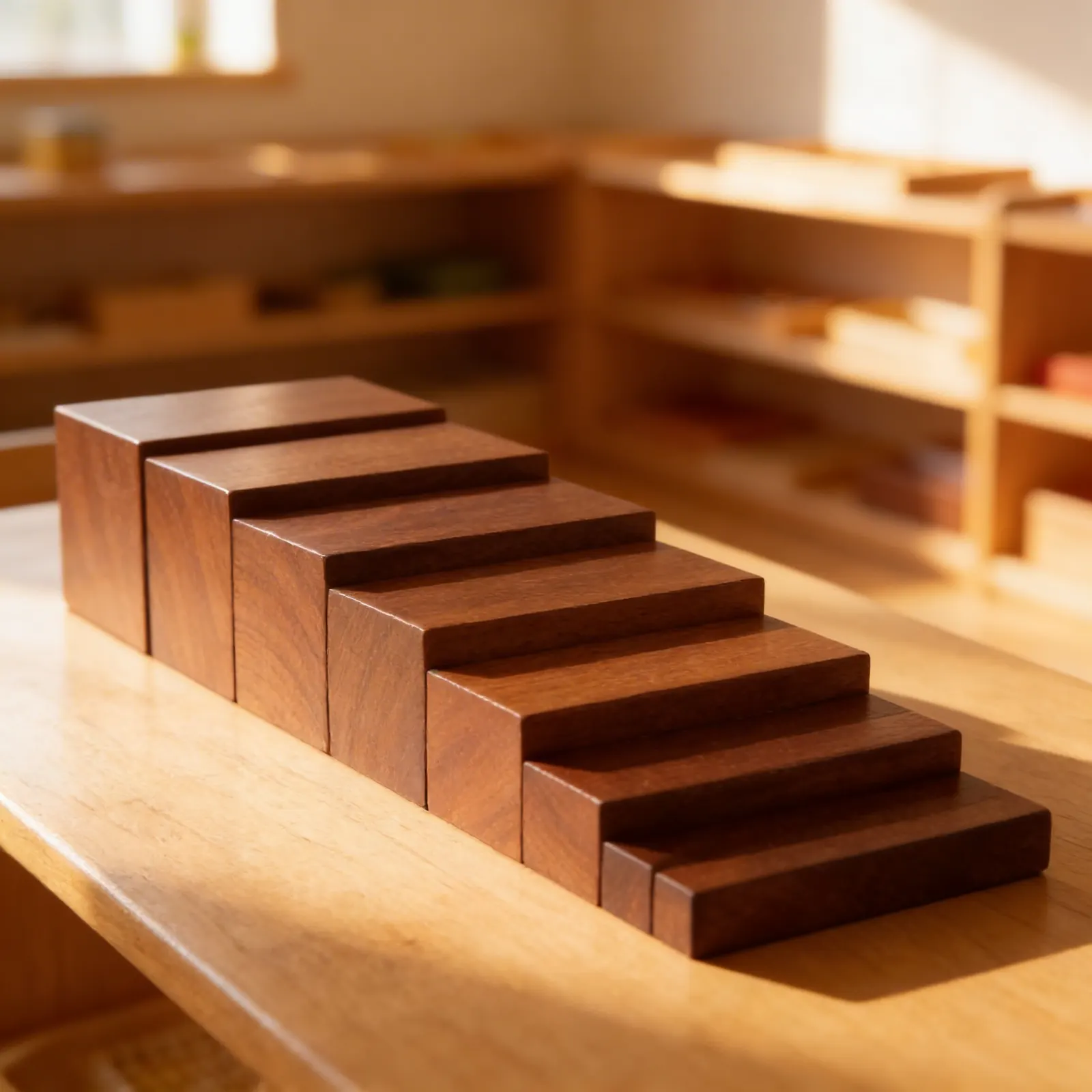
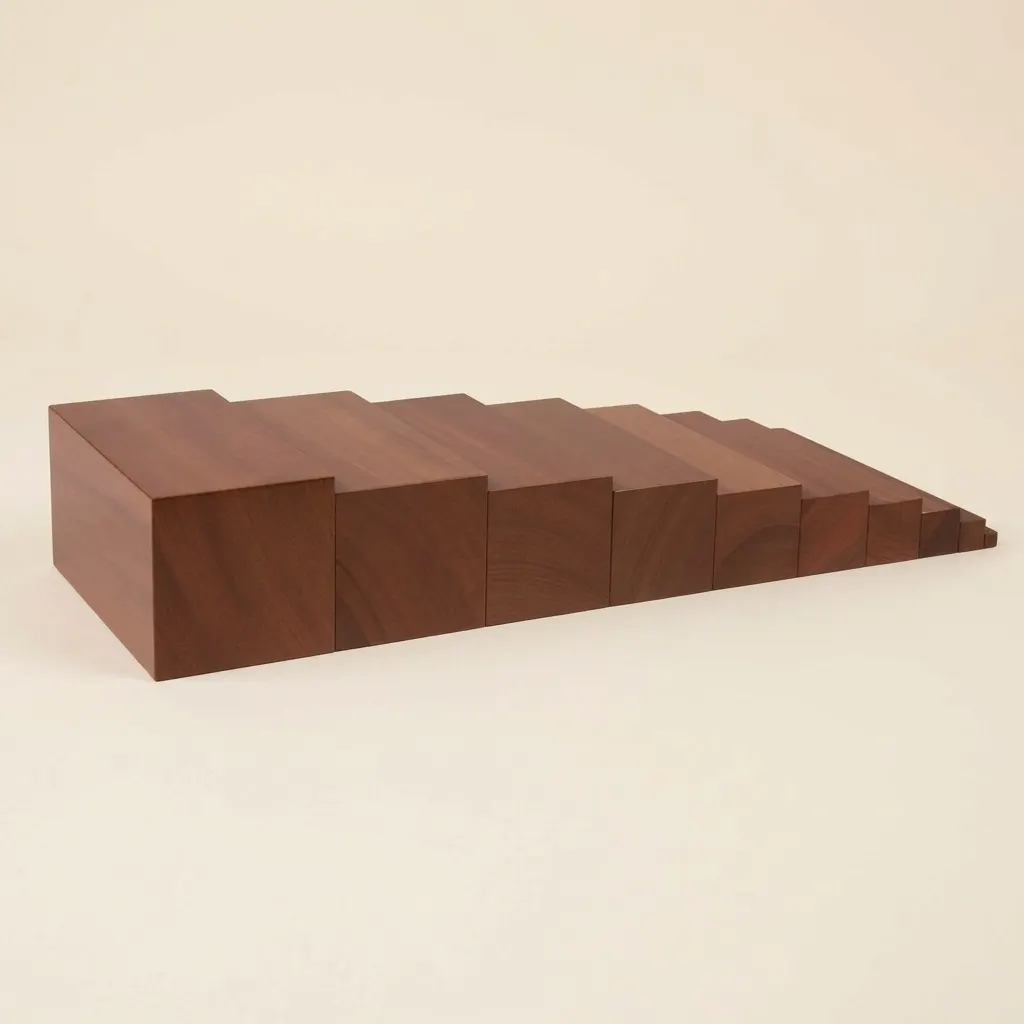
Ten prisms that change in width while the length stays constant, running in exact steps from 1 x 1 x 20 cm to 10 x 10 x 20 cm. Only one dimension moves, which is what separates this from the Pink Tower and what lets a child feel breadth on its own. Built as a stair, the constant length reads as a straight edge along the top while the thickness steps down beneath it, and that contrast is the lesson. Groundwork for plane geometry, area and volume, met years before those words. Hardwood, for ages 3 to 6.
“Education is a natural process spontaneously carried out by the human individual, and is acquired not by listening to words but by experiences upon the environment.”
The Brown Stair introduces children to systematic variations in dimension through ten precisely graduated wooden prisms. Each prism increases by one centimeter in width and height while maintaining a constant twenty-centimeter length, creating a material that isolates the concept of thickness. The Brown Stair's wooden construction provides substantial weight differences that children experience kinesthetically as they carry each prism individually to their work mat.
- Visual discrimination of dimensions in three-dimensional objects
- Development of vocabulary: thick/thin, thicker/thinner, thickest/thinnest
- Preparation for mathematical concepts of volume and the decimal system
- Refinement of voluntary movement through careful handling of graduated weights
Read More
This deliberate one-piece-at-a-time movement develops muscular memory of dimensional relationships. The Brown Stair prepares the mathematical mind by offering concrete experiences with the base-ten system through its ten distinct prisms. Children build the stair horizontally or vertically, discovering relationships between sizes through trial and error. The material's self-correcting nature becomes apparent when an incorrectly placed prism creates visual disharmony in the graduated sequence. These wooden blocks serve as indirect preparation for geometry, volume calculation, and the decimal system, while their precise dimensions establish a sensorial foundation for understanding mathematical relationships.
How to present it
Follow the Montessori method of presentation for optimal child development.
Invite the child to work with the Brown Stair. Have them lay out a work mat. Show how to carry one prism at a time using both hands, starting with the largest. Place prisms randomly on the mat.
- 1
Begin building by selecting the thickest prism as the base
Let the child visually compare prisms rather than telling them which is largest - 2
Continue selecting the next thickest prism, placing it precisely on top or beside the previous one
If building vertically, ensure each prism is centered for stability - 3
Complete the stair with all ten prisms in order
The visual harmony of the completed stair provides immediate feedback - 4
Invite the child to observe the stair from different angles
Looking from the side reveals the regular gradation clearly - 5
Dismantle by removing one prism at a time, returning each to the shelf
Maintain the same careful movements used during construction
Every Child Is a Little Creator

Heritage
Since 1929

In classrooms
Around the world

European brands
Nienhuis, GAM, Educo

AMI approved
To the association standard
The Brown Stair
