
Building Atoms With The Atom Board
The first photos are the maker's own. The other shots are illustrative.
Inv. no. NIE-ELC4051
- Maker
- Nienhuis Montessori, since 1929
- Product size
- 48 × 48 cm
- Primary Material
- Durable plastic
- Processing
- Pre-cut with rounded corners
- EAN
- 8719924044015
Final price incl. VAT.
This material is no longer made
The manufacturer has withdrawn it, so we cannot order it in. The page stays here because the material itself is still worth knowing about.
Would you buy it if we could source it or make it ourselves? Enough people saying yes is what makes the attempt worth it.
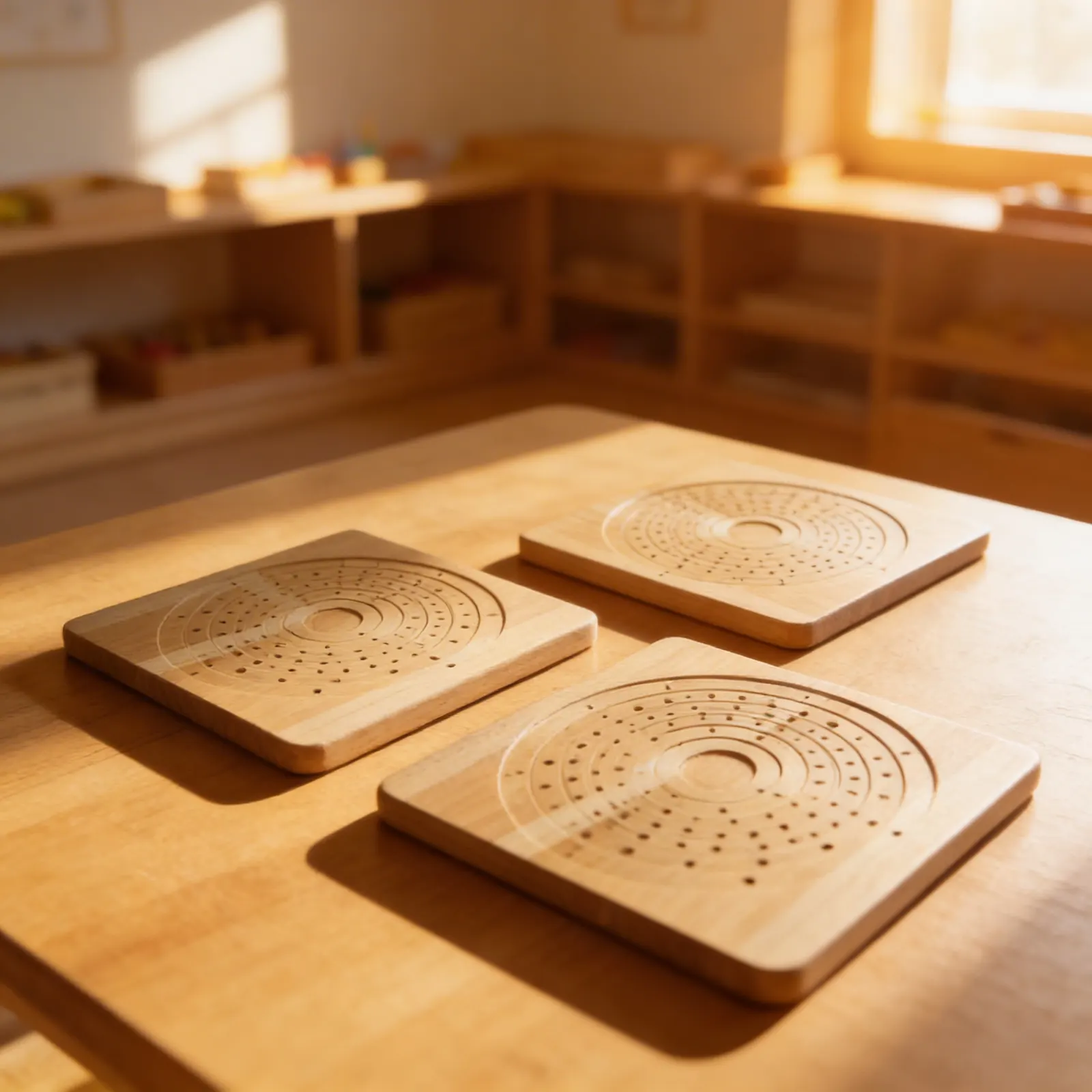
Building Atoms With The Atom Board in a child's hands
The atom board, built to the Bohr model, for building atomic models element by element. Durable plastic, pre-cut with rounded corners.
Abstract Concept Visualization
Transforms invisible atomic structures into tangible, manipulable models that children can construct and understand.
Scientific Method Introduction
Encourages systematic thinking through step-by-step atom construction following natural laws.
Mathematical Relationships
Reveals patterns in electron shells and atomic numbers through hands-on exploration.
Fine Motor Precision
Develops careful hand movements while building the atomic model.
How to present it
Place the atom board on a work mat. Have element cards ready showing atomic numbers.
- 1Begin with hydrogen, build a model with one proton in the nucleus
- 2Add one electron in the first shell
- 3Progress to helium, two protons and two neutrons in the nucleus
- 4Place two electrons in the first shell
- 5Build increasingly complex atoms, filling electron shells according to rules
3 tips for parents
- Look for everyday connections, 'The iron in your cereal has atoms we can build'
- Support pattern recognition by asking 'What do you notice about electron numbers?'
- Create a periodic table poster to reference during atom building sessions

If you are not sure it suits your child, we answer in person.
Norbert Kovalčín, founder of Faborino · write to him
There is no review here yet. We will ask you for one after you buy. Write the first review
Size and material
| Product size | 48 × 48 cm |
| Packaging | 48 × 48 × 4 cm |
| Primary Material | Durable plastic |
| Processing | Pre-cut with rounded corners |
| Recommended Age | 6-12 years |
Care
Wipe with slightly damp cloth
Frequently Asked Questions
What age is this atom board designed for?
The Atom Board is designed for children aged 6 to 12, that is, elementary school. It introduces atomic concepts through concrete experiences rather than abstract ideas. Children build atomic models, making the learning age-appropriate and engaging.
What is the Atom Board made of?
Durable plastic, pre-cut with rounded corners.
How does this material align with Montessori elementary curriculum?
The Atom Board perfectly complements the Montessori cosmic education curriculum, bridging sensorial learning with elementary science concepts. It follows the progression from concrete to abstract thinking, allowing children to physically construct atomic models before understanding theoretical chemistry, supporting the natural development of scientific reasoning.
What atoms can children build with this board?
Children can build models of simple atoms starting with hydrogen and progressing through the first several elements of the periodic table. As each new element is added, the number of electrons in the proper shells grows, allowing exploration of atomic structure patterns and introducing concepts like atomic number and electron configuration.
Do children need prior knowledge to use this material effectively?
No prior knowledge is required. Teachers typically present a simple lesson demonstrating hydrogen, then children explore independently. The concrete nature of the material allows discovery-based learning appropriate for the developmental stage.
Product safety
Manufacturer: Nienhuis Montessori, Anders Celsiusstraat 15, 7442 PB Nijverdal, Netherlands
Building Atoms With The Atom Board