
Cards Of The World Parts
The first photo is the maker's own. The other shots are illustrative.
Inv. no. NIE-023501
- Maker
- Nienhuis Montessori, since 1929
- Approval
- AMI
- Card Material
- Heavy-duty cardboard
- Storage Container
- Clear plastic
- EAN
- 8719924011208
Final price incl. VAT.
This material is no longer made
The manufacturer has withdrawn it, so we cannot order it in. The page stays here because the material itself is still worth knowing about.
Would you buy it if we could source it or make it ourselves? Enough people saying yes is what makes the attempt worth it.
Cards Of The World Parts in a child's hands
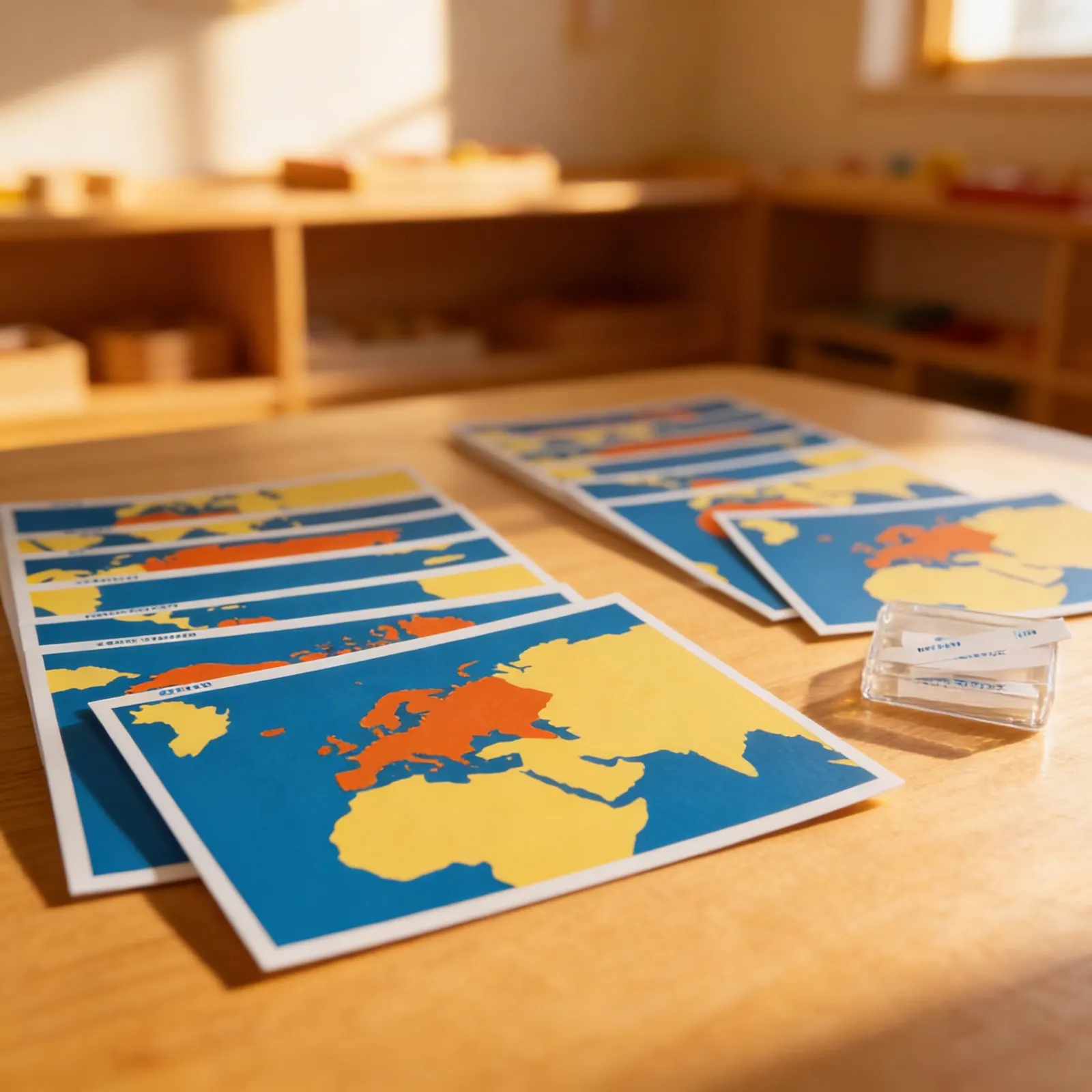
Fourteen heavy plastic silk screened cards in two sets, made to move a child from the continents as objects to the continents as an idea. The puzzle map gives shapes to hold; these cards give the same shapes with nothing to hold, which is the step towards abstraction and the one most materials skip. Two sets means the child can match one against the other. Silk screened plastic. In English.
Geographic Awareness
Introduces fundamental concepts of continents and world geography through visual learning.
Visual Discrimination
Color-coding helps children distinguish between different continental regions and develop classification skills.
Cultural Understanding
Lays foundation for understanding global diversity and different parts of our world.
Language Development
Builds geographical vocabulary as children learn to name and identify continents.
How to present it
Place the cards face-up on a mat, arranging them in a horizontal line. Ensure adequate space between cards for clear viewing.
- 1Introduce three continent cards using the three-period lesson, pointing to each colored shape while naming it clearly
- 2Invite the child to match each card with corresponding objects like continent puzzle pieces or globe references
- 3Play identification games where the child finds specific continents when named
- 4Encourage the child to arrange the cards in different patterns while discussing their observations
3 tips for parents
- Point out continents mentioned in books, news, or conversations using the same names from the cards
- Create a world map at home using the same color scheme for consistency
- Share family heritage by identifying which continents family members come from

If you are not sure it suits your child, we answer in person.
Norbert Kovalčín, founder of Faborino · write to him
There is no review here yet. We will ask you for one after you buy. Write the first review
What's in the Box
- Geography Cards: Approx. 8 cards showing world continents
- Storage Container: Clear plastic box for organized storage
Size and material
| Packaging | 18 × 13 × 2 cm |
| Card Material | Heavy-duty cardboard |
| Storage Container | Clear plastic |
| Recommended Age | 3-6 years |
Care
Wipe cards with slightly damp cloth; ensure fully dry before storing
Frequently Asked Questions
What age group are these World Parts cards designed for?
These cards are specifically designed for children ages 3-6 years old, aligning with the Montessori early childhood curriculum for introducing geography concepts to young learners.
How many continents are included in this card set?
The set includes all seven continents (Africa, Antarctica, Asia, Australia/Oceania, Europe, North America, and South America), each represented with clear continental outlines in a color-coded format.
What is the horizontal strip format and why is it used?
The horizontal strip format presents each continent card in an elongated rectangular shape, making it easier for young children to handle, arrange, and compare the different continents while developing their visual discrimination skills.
How do these cards support the Montessori approach to learning?
These cards provide concrete, hands-on materials that allow children to physically manipulate and explore geographical concepts, moving from concrete to abstract understanding as emphasized in Montessori education.
Can these cards be used with other Montessori geography materials?
Yes, these cards complement other Montessori geography materials such as the continent puzzle maps, globe, and colored continent folders, creating a comprehensive geography learning experience.
Product safety
Manufacturer: Nienhuis Montessori, Anders Celsiusstraat 15, 7442 PB Nijverdal, Netherlands
Cards Of The World Parts