
Checker BoardMultiplication Material
The first photos are the maker's own. The other shots are illustrative.
Inv. no. NIE-013701
- Maker
- Nienhuis Montessori, since 1929
- Approval
- AMI
- Board
- Solid wood construction
- Playing Surface
- Fabric or felt squares
- EAN
- 8719924007348
Final price incl. VAT. Free delivery.
Advice, warranty and returns are handled by us.
Why it costs €158.90
Behind the price of the original are things you can check yourself.
AMI approval
The material is approved by the Association Montessori Internationale (AMI). Nienhuis has made Montessori materials since 1929.
A verifiable original
The EAN 8719924007348 is on the box. It is the maker's number, not ours.
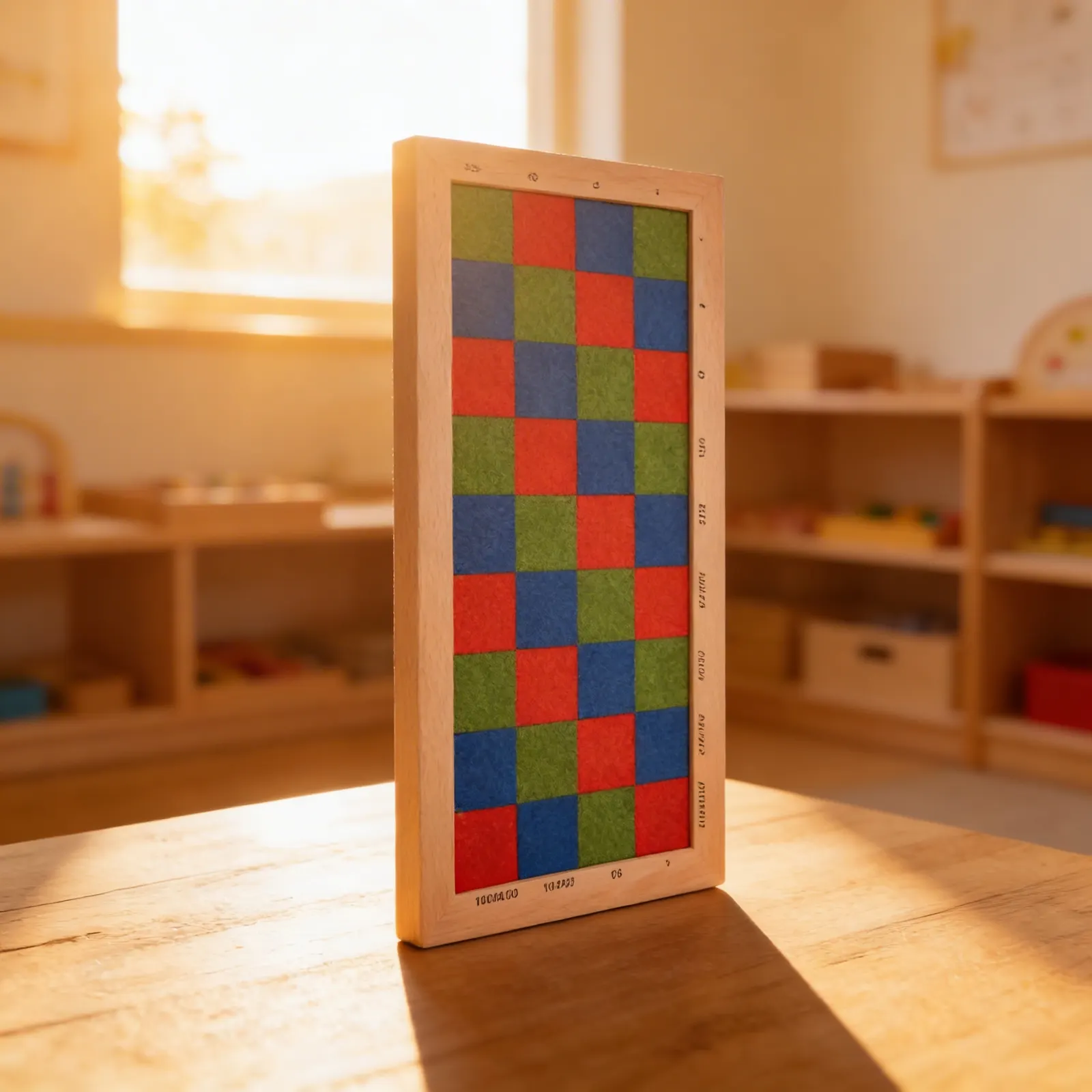
Checker Board in a child's hands
A board for short and long multiplication across the decimal hierarchies, reaching up to a hundred million. Each square stands for a place value, so a child multiplying a four digit number by a three digit one places beads square by square and reads the answer off the board rather than carrying columns in their head. The wood is covered with a printed carpet, which stops the beads drifting when a hand brushes past, and that small detail is what lets a long calculation survive to the end. Wood, for ages 6 to 12.
Abstract Reasoning
Bridges concrete manipulation to abstract mathematical thinking through systematic exploration of multiplication patterns.
Place Value Mastery
Reinforces understanding of powers of ten and their relationships in large number operations.
Concentration Development
Complex multi-step problems build sustained focus and methodical work habits.
Mathematical Confidence
Success with large numbers builds self-assurance in tackling advanced mathematical concepts.
How to present it
Place the Checker Board on a work mat with the powers of ten labels clearly visible. Arrange colored number tiles (1-9) in separate containers. Have paper strips ready for writing multiplicand and multiplier.
- 1Write the multiplicand across the top edge and multiplier down the right side
- 2Begin with the units digit of the multiplier, placing corresponding tiles on each square horizontally
- 3Continue with tens, hundreds, etc., moving down one row for each digit of the multiplier
- 4Count tiles diagonally, starting from bottom right, exchanging 10 tiles for 1 of the next place value
- 5Record the final answer by reading the remaining tiles from left to right
3 tips for parents
- Practice skip counting and multiplication facts at home to support board work at school
- Ask your child to explain the color pattern and what each square represents
- Celebrate the process of working through problems rather than focusing solely on correct answers

If you are not sure it suits your child, we answer in person.
Norbert Kovalčín, founder of Faborino · write to him
There is no review here yet. We will ask you for one after you buy. Write the first review
What's in the Box
- Checker Board: Wooden board with 30 colored squares and numerical labels
Size and material
| Packaging | 85 × 49 × 5 cm |
| Board | Solid wood construction |
| Playing Surface | Fabric or felt squares |
| Recommended Age | 6-12 years |
Care
Dust with soft cloth; spot clean fabric with damp cloth
Frequently Asked Questions
What mathematical concepts does the Checker Board teach?
The Checker Board teaches multiplication of large numbers, place value understanding, and the distributive property of multiplication. Children learn to multiply multi-digit numbers by breaking them down into units, tens, hundreds, and thousands, making abstract concepts concrete through visual and tactile manipulation.
How does the Checker Board differ from traditional multiplication methods?
Unlike paper-and-pencil methods, the Checker Board provides a visual, hands-on approach where children physically place beads on colored squares representing different place values. This concrete method helps children understand why multiplication algorithms work rather than just memorizing procedures.
What materials are included with the Checker Board?
The Checker Board includes a precision-crafted wooden board with a 6x5 grid of alternating colored squares, numbered along the edges with powers of ten. Additional materials needed but often sold separately include colored bead bars and number cards for complete multiplication exercises.
What prerequisite skills should children have before using the Checker Board?
Children should be comfortable with basic multiplication facts, understand place value concepts, and have experience with other Montessori multiplication materials like the Multiplication Bead Board or Golden Beads. Typically, children are ready for this material around age 7-8.
How does the Checker Board prepare children for advanced mathematics?
The Checker Board builds a strong foundation for algebra by demonstrating the distributive property visually. It prepares children for polynomial multiplication, develops logical thinking skills, and creates a deep understanding of how numbers interact in multiplication, supporting future abstract mathematical thinking.
Product safety
Manufacturer: Nienhuis Montessori, Anders Celsiusstraat 15, 7442 PB Nijverdal, Netherlands
Checker Board