
Checker Board BeadsIndividual Beads Glass
The first photo is the maker's own. The other shots are illustrative.
Inv. no. NIE-0138G0
- Maker
- Nienhuis Montessori, since 1929
- Approval
- AMI
- Tray
- Natural wood
- Beads
- Glass
- EAN
- 8719924007362
Final price incl. VAT. Free delivery.
Advice, warranty and returns are handled by us.
Why it costs €193.90
Behind the price of the original are things you can check yourself.
AMI approval
The material is approved by the Association Montessori Internationale (AMI). Nienhuis has made Montessori materials since 1929.
A verifiable original
The EAN 8719924007362 is on the box. It is the maker's number, not ours.
Checker Board Beads in a child's hands
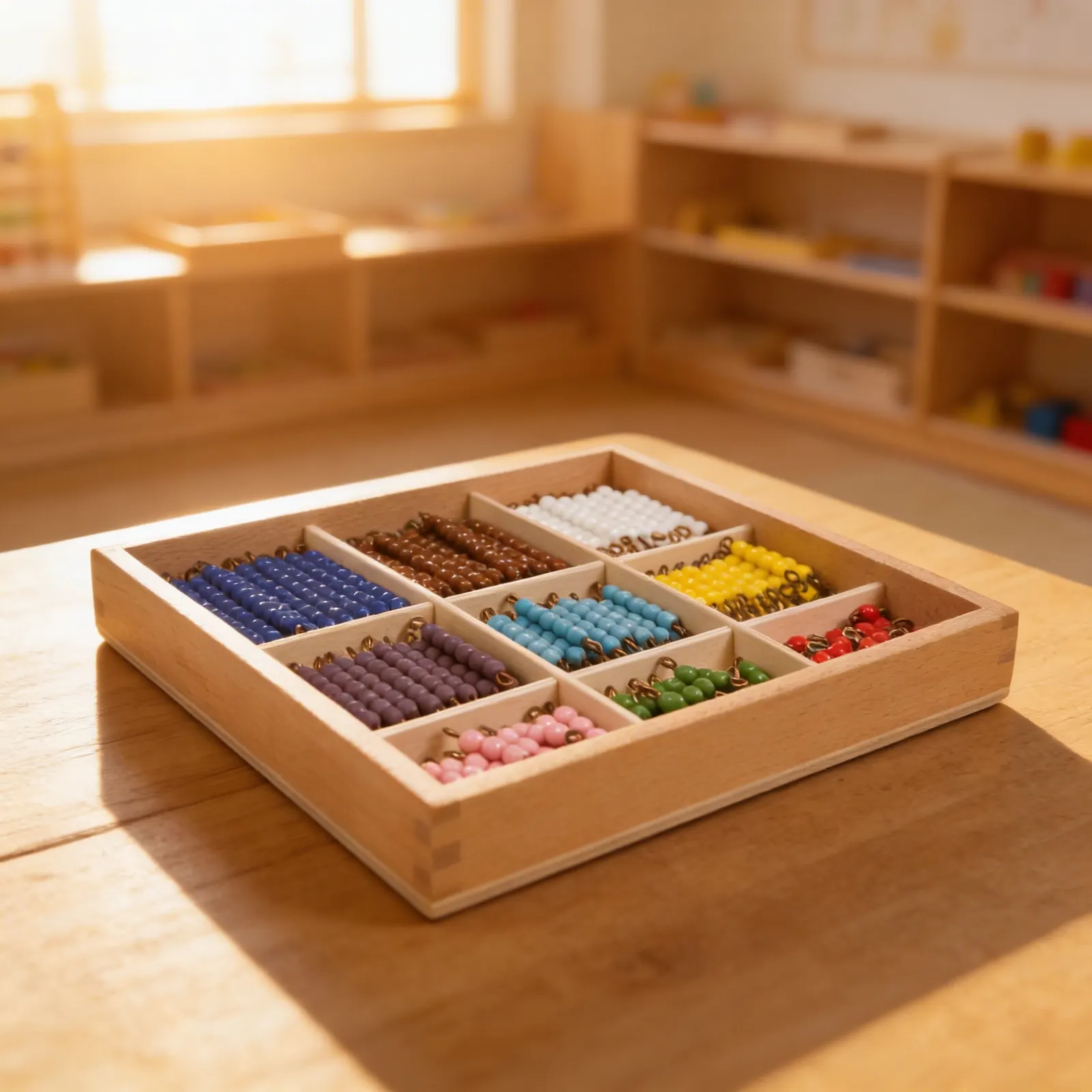
For hands-on mathematics, this Montessori Checker Board Beads set features individual glass beads arranged in a compartmentalized wooden tray, designed for advanced multiplication work with the checker board material. The color-coded beads on metal wires correspond to place values from units through millions, letting young learners build concrete representations of large multiplication problems and develop a deep understanding of mathematical hierarchies.
Abstract Thinking
Bridges concrete manipulation to abstract multiplication concepts through systematic bead work with large numbers.
Mathematical Reasoning
Develops understanding of place value, regrouping, and the hierarchical nature of the decimal system.
Concentration
Extended multiplication work with beads builds focus and attention to detail in mathematical processes.
Order and Precision
Systematic arrangement of beads cultivates organizational skills and mathematical accuracy.
How to present it
Place the wooden tray of glass beads to the right of the checker board. Arrange beads on metal wires by color: green (units/millions), blue (tens/ten thousands), red (hundreds/hundred thousands). Ensure each wire has sufficient beads for the planned multiplication problem.
- 1Write the multiplicand across the top of the checker board and the multiplier down the right side
- 2Begin with the units digit of the multiplier, placing corresponding beads on the board for each partial product
- 3Continue with tens digit of multiplier, placing beads one row up on the diagonal
- 4After placing all partial products, exchange beads horizontally: ten units become one ten, ten tens become one hundred
- 5Read the final answer from bottom to top, counting the remaining beads in each category
3 tips for parents
- Practice skip counting at home (2s, 5s, 10s) to strengthen the multiplication foundation needed for checker board work
- When your child brings home multiplication problems, ask them to explain how they would solve it using the glass beads
- Create simple multiplication stories using real scenarios: 'If 23 children each bring 14 marbles to school...'

If you are not sure it suits your child, we answer in person.
Norbert Kovalčín, founder of Faborino · write to him
There is no review here yet. We will ask you for one after you buy. Write the first review
What's in the Box
- Wooden storage tray: With 9 compartments
- Glass bead sets: Color-coded by place value
- Metal wires: For holding bead arrangements
Size and material
| Packaging | 38 × 3 × 5 cm |
| Tray | Natural wood |
| Beads | Glass |
| Wire | Metal |
| Recommended Age | 6-12 years |
Care
Wipe wooden tray with damp cloth; handle glass beads carefully
Frequently Asked Questions
What age group is the Checker Board Beads set appropriate for?
The Checker Board Beads are designed for children ages 6-12 who have mastered basic multiplication concepts and are ready for advanced multiplication work with larger numbers up to millions.
How do the glass beads work with the checker board material?
The individual glass beads on metal wires represent different place values through color coding. Children place these beads on the checker board to build concrete representations of multiplication problems, making abstract concepts visible and manipulable.
What mathematical concepts does this material teach?
This material teaches advanced multiplication, place value understanding from units to millions, mathematical hierarchies, and the relationship between different powers of ten. It bridges concrete manipulation to abstract mathematical thinking.
Why are the beads made of glass instead of plastic?
Glass beads provide a premium sensorial experience with better weight and texture, enhancing the child's concentration and respect for the material. The quality of glass also ensures durability for classroom use over many years.
What's included in the compartmentalized wooden tray?
The wooden tray contains color-coded glass beads on metal wires organized by place value: green for units, blue for tens, red for hundreds, and continuing through the color hierarchy up to millions, following standard Montessori color coding.
Product safety
Manufacturer: Nienhuis Montessori, Anders Celsiusstraat 15, 7442 PB Nijverdal, Netherlands
Checker Board Beads