
Checker Board BeadsIndividual Beads Nylon
The first photo is the maker's own. The other shots are illustrative.
Inv. no. NIE-0138M0
- Maker
- Nienhuis Montessori, since 1929
- Approval
- AMI
- Beads
- Nylon
- Storage Box
- Wood
- EAN
- 8719924007379
Final price incl. VAT. Delivery €5.90, €10.10 to go for free delivery.
Advice, warranty and returns are handled by us.
Why it costs €138.90
Behind the price of the original are things you can check yourself.
AMI approval
The material is approved by the Association Montessori Internationale (AMI). Nienhuis has made Montessori materials since 1929.
A verifiable original
The EAN 8719924007379 is on the box. It is the maker's number, not ours.
Checker Board Beads in a child's hands
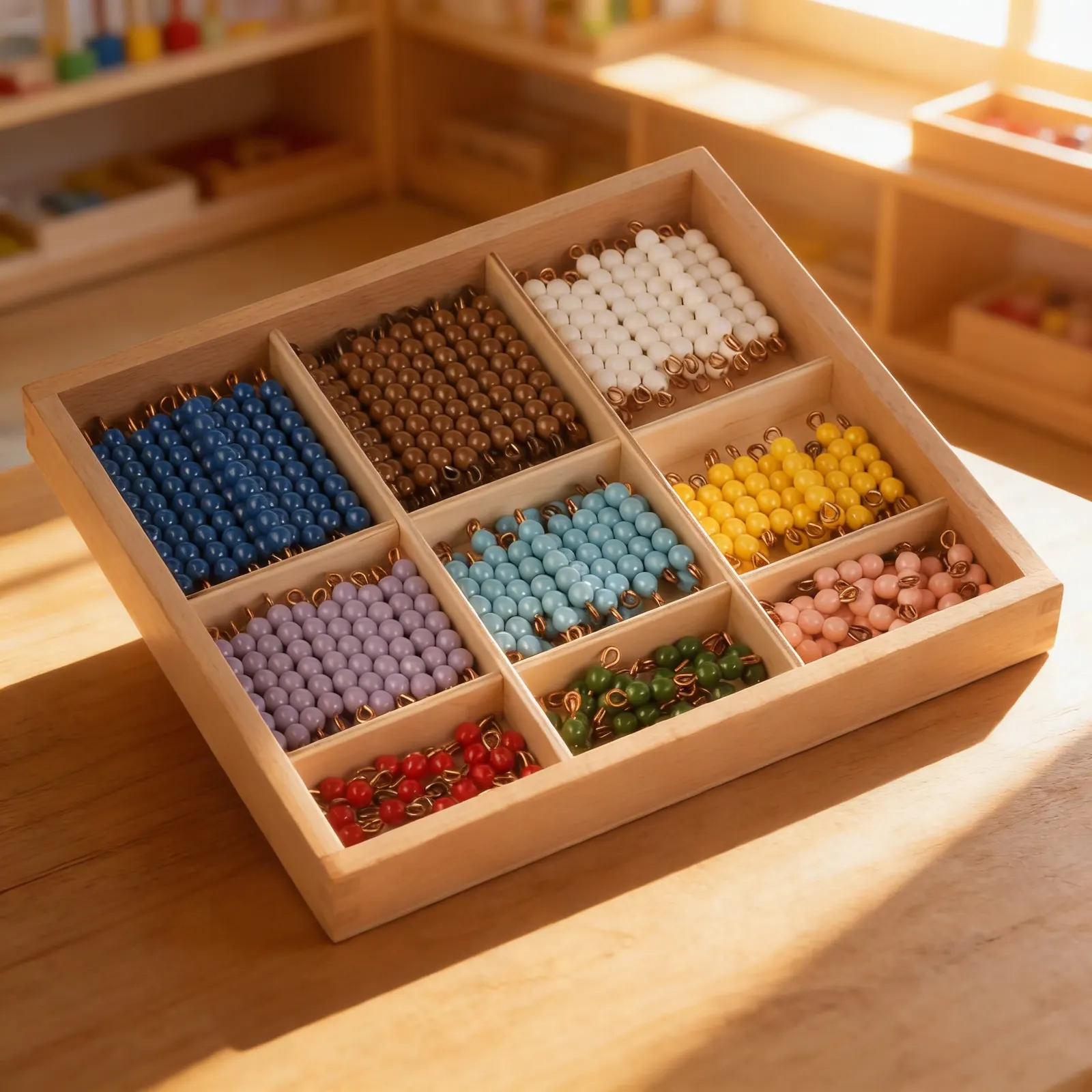
Twenty of each coloured bead bar from one to nine, in a wooden box with a lid, supplying the beads the Checker Board runs on. Twenty of each is what a long multiplication actually consumes: a four digit number across several hierarchies eats bars faster than anyone expects, and running out mid-calculation ends the work. These are one component; the board and the tile material are separate products. Nylon beads on wire in a wooden box, for ages 6 to 12.
Abstract Thought Development
Bridges concrete bead manipulation with abstract multiplication concepts through systematic place value work
Mathematical Reasoning
Supports understanding of multi-digit multiplication through visual and tactile exploration of the decimal system
Executive Function
Develops planning and organizational skills through complex, multi-step mathematical operations
Concentration
Extended work with the Checker Board and beads builds sustained focus and attention to detail
How to present it
Place the bead box to the right of the Checker Board. Make sure there are enough bead bars from 1 to 9 to hand. Have multiplication problem cards ready.
- 1Write the multiplicand across the top of the Checker Board and the multiplier down the right side
- 2Begin with the units digit of the multiplier, placing corresponding beads in each square
- 3Continue with tens, hundreds, etc., placing beads diagonally across the board
- 4Exchange beads when any square contains ten or more, moving one bead to the next hierarchy
- 5Count the final arrangement of beads to determine the product
3 tips for parents
- Practice skip counting by 10s, 100s, and 1000s at home to reinforce exchange concepts
- Use everyday items (pennies, dimes) to show similar exchange principles
- Celebrate process over product - focus on their systematic approach rather than speed

If you are not sure it suits your child, we answer in person.
Norbert Kovalčín, founder of Faborino · write to him
There is no review here yet. We will ask you for one after you buy. Write the first review
What's in the Box
- Wooden box with lid: For storing the bead bars
- Coloured bead bars 1 to 9: 20 of each, strung on metal wire
Size and material
| Packaging | 24 × 24 × 5 cm |
| Beads | Nylon |
| Storage Box | Wood |
| Stringing | Metal wire |
| Recommended Age | 6-12 years |
Care
Wipe beads and box with damp cloth; ensure beads are dry before storage
Frequently Asked Questions
What is included in the Checker Board Beads set?
The set includes 20 of each coloured bead bar from 1 to 9, made of nylon beads strung on metal wire, in a wooden box with a lid. It supplies the beads needed for multiplication work with the Montessori Checker Board.
Do I need the Checker Board separately or is it included?
The Checker Board must be purchased separately. This bead set is specifically designed as the essential companion material to work with the Montessori Checker Board for multiplication exercises.
What multiplication problems can children solve with these beads?
Children can solve complex multi-digit multiplication problems. The beads allow for concrete manipulation of large numbers, making abstract multiplication concepts visible and tangible for ages 6-12.
Product safety
Manufacturer: Nienhuis Montessori, Anders Celsiusstraat 15, 7442 PB Nijverdal, Netherlands
Checker Board Beads