
Colour Box32 Pairs of Tablets for Advanced Colour Discrimination
The first photo is the maker's own. The other shots are illustrative.
Inv. no. NIE-0053A0
- Maker
- Nienhuis Montessori, since 1929
- Approval
- AMI
- Box Construction
- Natural wood
- Tablets
- Painted wood
- EAN
- 8719924003159
Final price incl. VAT. Free delivery.
Advice, warranty and returns are handled by us.
Why it costs €162.90
Behind the price of the original are things you can check yourself.
AMI approval
The material is approved by the Association Montessori Internationale (AMI). Nienhuis has made Montessori materials since 1929.
A verifiable original
The EAN 8719924003159 is on the box. It is the maker's number, not ours.
Colour Box in a child's hands
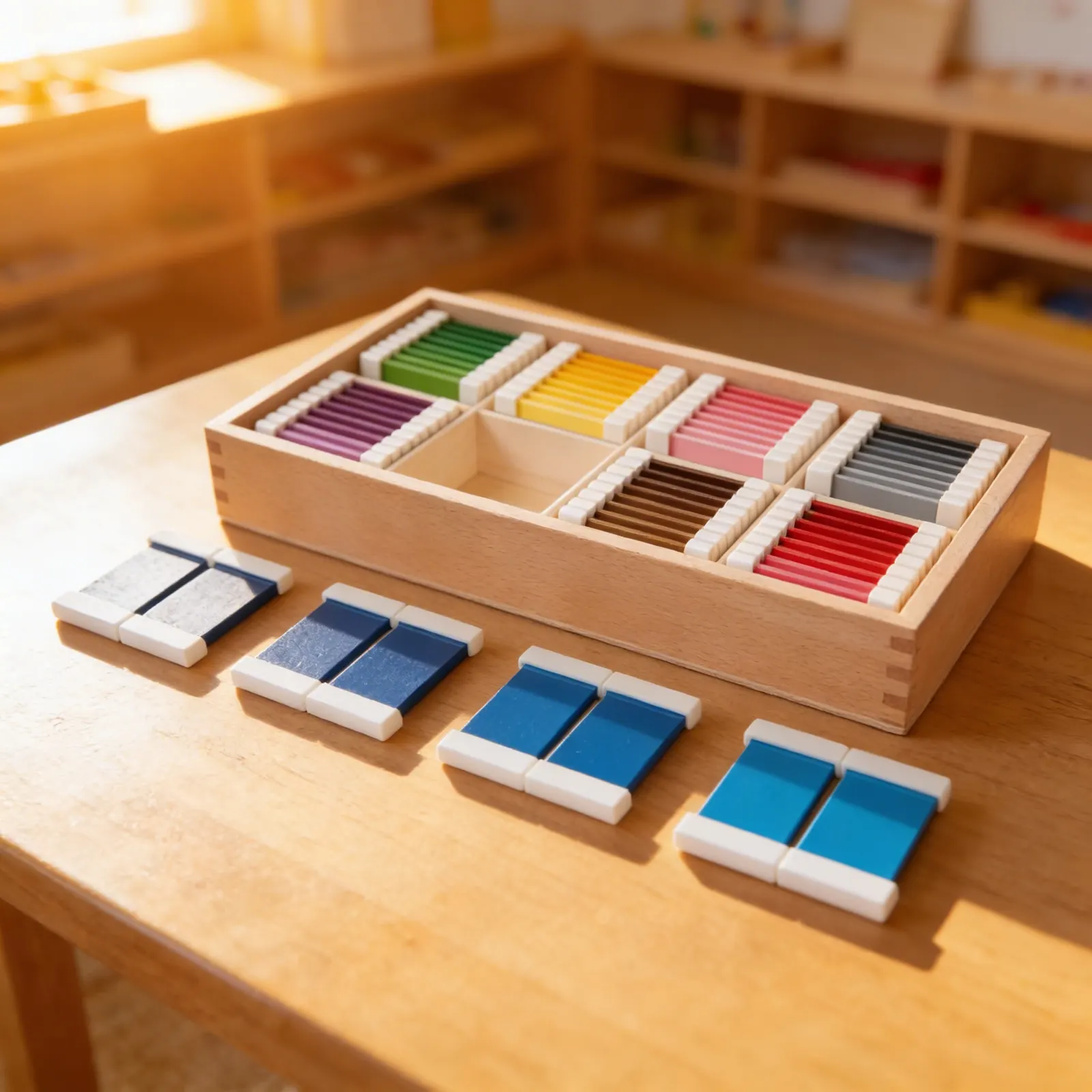
A supplementary colour box holding four matching shades of each of eight colours: red, blue, yellow, purple, green, brown, pink and grey. Pairing was the earlier work; here it is grading, laying the four shades of one colour from lightest to darkest. That is a genuinely hard discrimination, and it is where a child stops seeing red as one thing and starts seeing that red has a range. Sorting shades also gives the vocabulary a reason to exist, because now there is something to name. Wooden box with tablets, for ages 3 to 6.
Visual Discrimination
Refines ability to perceive subtle differences in hue, preparing for art appreciation and scientific observation.
Language Development
Introduces vocabulary for color shades and gradations, enriching descriptive language skills.
Cognitive Organization
Develops classification and seriation skills through sorting and grading color sequences.
How to present it
Place the Color Box on a neutral-colored mat. Ensure good natural lighting. Begin with one compartment containing 4-6 color pairs the child can already name.
- 1Invite the child, showing how to carefully carry the box with two hands
- 2Remove tablets one at a time, placing them randomly on the mat
- 3Select one tablet and systematically compare it to others to find its match
- 4When a match is found, place the pair together at the top of the mat
- 5Continue until all tablets are paired
- 6Invite the child to mix and match independently
3 tips for parents
- Support color awareness at home by noticing and naming specific shades in nature, clothing, and everyday objects
- Avoid quizzing or testing - instead, make observations like 'I notice that flower is the same coral as your shirt'
- Provide quality art materials at home that allow for color mixing and exploration

If you are not sure it suits your child, we answer in person.
Norbert Kovalčín, founder of Faborino · write to him
There is no review here yet. We will ask you for one after you buy. Write the first review
What's in the Box
- Wooden storage box: 8 compartments
- 64 color tablets: 32 matched pairs in varied hues
Size and material
| Packaging | 35 × 17 × 5 cm |
| Box Construction | Natural wood |
| Tablets | Painted wood |
| Recommended Age | 3-6 years |
Care
Wipe tablets with dry cloth; clean box with slightly damp cloth
Frequently Asked Questions
What is included in the Color Box of 32 Pairs?
The Color Box contains 32 pairs (64 tablets total) of color tablets featuring precisely graded hues, all organized in a wooden compartmented box. Each pair consists of two identical color tablets that children use for matching and grading exercises.
How does this differ from the basic color tablets?
This advanced set extends beyond primary and secondary colors to include subtle gradations and intermediate hues. It offers more complex discrimination work, allowing children to explore nuanced color relationships and develop refined visual perception skills.
What activities can children do with this material?
Children can perform matching exercises, create color gradations from light to dark, arrange colors by temperature (warm/cool), explore complementary colors, and learn precise color vocabulary. They can also create patterns and designs with the tablets.
Why is this material important for academic readiness?
Developing chromatic discrimination supports reading readiness (distinguishing letter shapes), mathematical concepts (sorting and classifying), artistic expression, and scientific observation skills. The visual perception refinement transfers to many academic areas.
How should the Color Box be presented to children?
Start with simple matching exercises using a few pairs, gradually increasing complexity. Introduce language for colors and shades. Progress to grading exercises and creative arrangements. Always demonstrate careful handling and proper storage in the compartmented box.
Product safety
Manufacturer: Nienhuis Montessori, Anders Celsiusstraat 15, 7442 PB Nijverdal, Netherlands
Colour Box