
Coloured Bead Stairs10 Complete Sets with Individual Nylon Beads
The first photos are the maker's own. The other shots are illustrative.
Inv. no. NIE-0090AM
- Maker
- Nienhuis Montessori, since 1929
- Approval
- AMI
- Beads
- Nylon
- Wire
- Metal with loop endings
- EAN
- 8719924005221
Final price incl. VAT. Delivery €5.90, €80.10 to go for free delivery.
Advice, warranty and returns are handled by us.
Why it costs €68.90
Behind the price of the original are things you can check yourself.
AMI approval
The material is approved by the Association Montessori Internationale (AMI). Nienhuis has made Montessori materials since 1929.
A verifiable original
The EAN 8719924005221 is on the box. It is the maker's number, not ours.
Coloured Bead Stairs in a child's hands
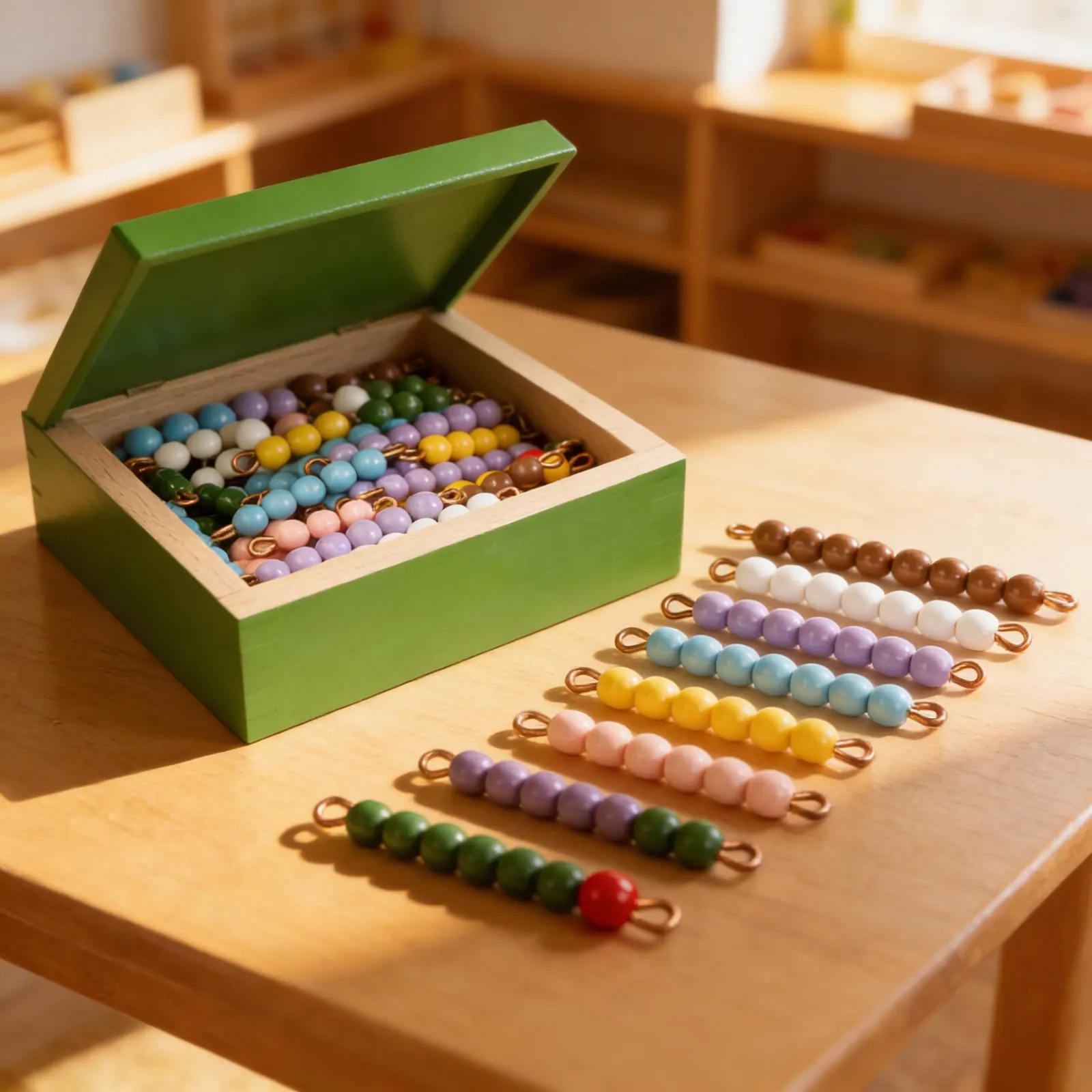
This complete Colored Bead Stairs set features 10 individual bead bars representing quantities 1-10, each in distinct colors following the traditional Montessori color coding. The nylon beads are strung on durable wire with loop endings, housed in a green-painted hinged wooden storage box. Essential for introducing mathematical concepts through sensorial exploration, supporting the child's concrete understanding of quantity and numerical relationships.
Mathematical Foundation
Provides concrete representation of quantities 1-10, preparing for abstract number concepts and skip counting.
Visual Discrimination
Distinct colors help children identify and memorize quantity associations through sensorial memory.
Sequential Thinking
Arranging bars in order develops understanding of numerical sequence and relationships between quantities.
How to present it
Place the bead box on a mat at the child's dominant side. Open the box gently, revealing the organized bead bars. Ensure adequate workspace on the mat for arranging the beads.
- 1Remove the red single bead and place it at the top left of the mat
- 2Continue removing bars in sequence (green-2, pink-3, etc.), creating a stair formation
- 3Count each bar by touching individual beads with your index finger
- 4Invite the child to build the stair independently
- 5Introduce three-period lesson for quantities using the bars
3 tips for parents
- Resist the urge to 'teach' counting - allow your child to explore the relationships between quantities through their own manipulation
- If your child brings bead work home, provide a designated workspace with a plain placemat to define their work area
- Connect bead quantities to daily life: 'You're 5 years old - that's like the light blue bead bar!'

If you are not sure it suits your child, we answer in person.
Norbert Kovalčín, founder of Faborino · write to him
There is no review here yet. We will ask you for one after you buy. Write the first review
What's in the Box
- Colored bead bars: 10 bars (1 red, 2 green, 3 pink, 4 yellow, 5 light blue, 6 violet, 7 white, 8 brown, 9 dark blue, 10 golden)
- Wooden storage box: Green painted exterior with hinged lid
Size and material
| Packaging | 10 × 10 × 4 cm |
| Beads | Nylon |
| Wire | Metal with loop endings |
| Storage Box | Painted wood with hinged lid |
| Recommended Age | 3-6 years |
Care
Wipe beads and box with damp cloth; ensure completely dry before storage
Frequently Asked Questions
What are the specific colors for each bead bar in this Montessori set?
The traditional Montessori color coding is: 1-red, 2-green, 3-pink, 4-yellow, 5-light blue, 6-violet, 7-white, 8-brown, 9-dark blue, and 10-golden. Each color consistently represents its quantity throughout all Montessori materials.
How do children use the Colored Bead Stairs for learning?
Children initially explore the material sensorially by arranging the bead bars from shortest to longest, creating a stair-like formation. They count beads, match quantities, and later use them for addition, subtraction, skip counting, and understanding number relationships through hands-on manipulation.
What's the difference between nylon and glass bead stairs?
Nylon beads are lighter, more durable, and safer for younger children, making them ideal for frequent classroom use. Glass beads offer a more premium sensorial experience with weight and texture but require more careful handling. Both versions maintain the same educational value.
Can these bead stairs be used with other Montessori math materials?
Yes, the Colored Bead Stairs integrate seamlessly with the Seguin Boards, Teen Boards, Hundred Board, and Snake Game. They serve as a foundational material that children reference throughout their mathematical journey, from concrete counting to abstract operations.
What skills do children develop using the Colored Bead Stairs?
Children develop one-to-one correspondence, number recognition, quantity comparison, visual discrimination of length, fine motor control, and concentration. The material also prepares them for understanding the decimal system, basic operations, and builds a concrete foundation for abstract mathematical thinking.
Product safety
Manufacturer: Nienhuis Montessori, Anders Celsiusstraat 15, 7442 PB Nijverdal, Netherlands
Coloured Bead Stairs