
Colour Box IVisual Discrimination with Photo Cards (Spanish Edition)
The first photo is the maker's own. The other shots are illustrative.
Inv. no. NIE-ECSP0615
- Maker
- Nienhuis Montessori, since 1929
- Card Construction
- Laminated cardboard
- Image Type
- High-quality photographic prints
- EAN
- 8719924043698
Final price incl. VAT.
This material is no longer made
The manufacturer has withdrawn it, so we cannot order it in. The page stays here because the material itself is still worth knowing about.
Would you buy it if we could source it or make it ourselves? Enough people saying yes is what makes the attempt worth it.
Colour Box I in a child's hands
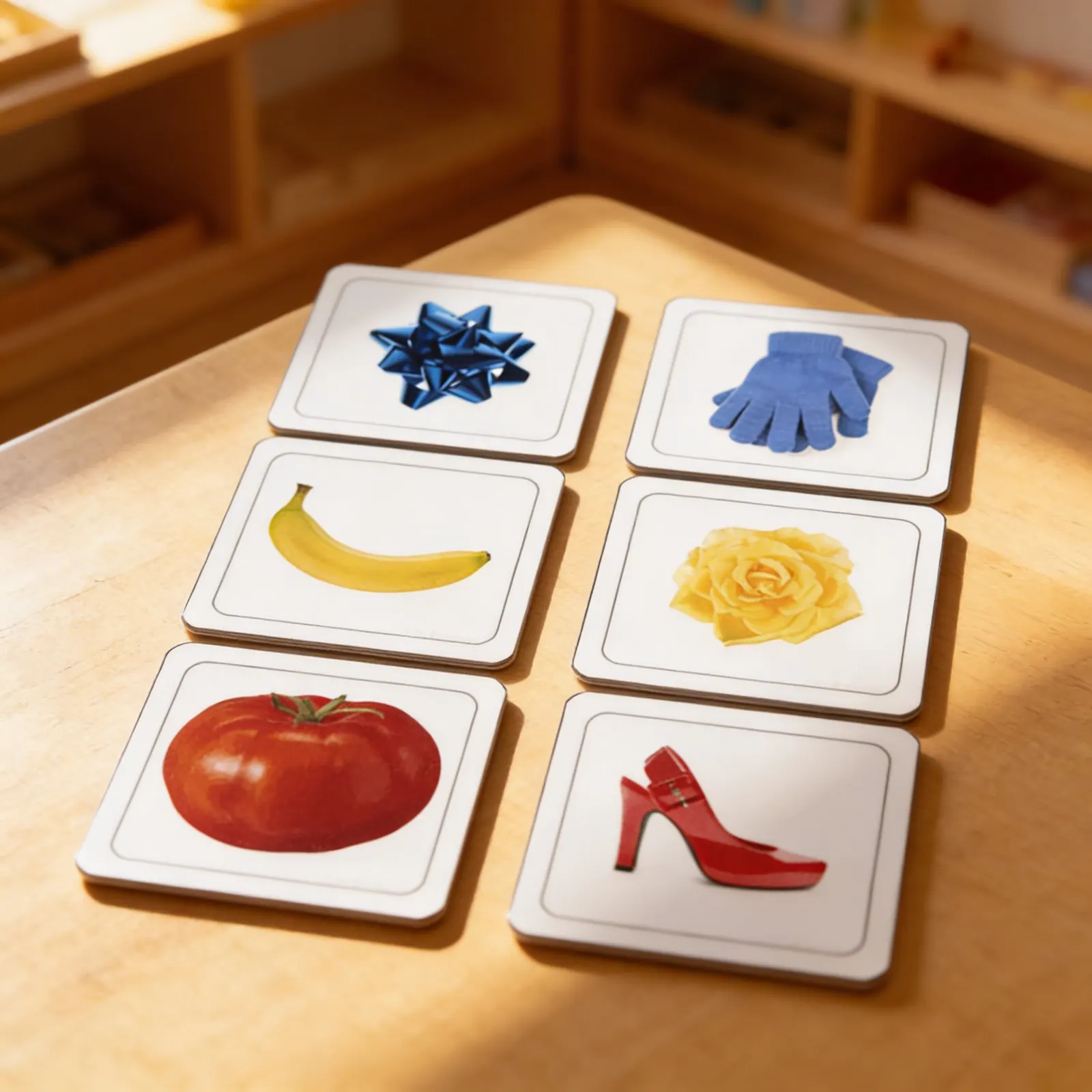
The Visual Discrimination Color Box I introduces young children to color matching through real-world photographic images. This foundational Sensorial material features six double-layered cards with vibrant photographs of familiar objects, each distinctly colored and framed for easy handling. Children develop visual discrimination skills by matching identical color cards, preparing them for more complex color work in the Montessori sequence.
Visual Discrimination
Matching identical images refines the child's ability to perceive subtle differences in color and form
Concentration
The focused matching activity develops sustained attention and careful observation skills
Order and Classification
Pairing activities satisfy the child's need for order while introducing fundamental classification concepts
How to present it
Place the material on a neutral-colored mat. Arrange the six pairs of color cards face up in two columns, mixing the order of one column
- 1Invite the child, naming the material. Select one card from the left column and examine it carefully
- 2Slowly scan the right column from top to bottom, comparing each card to find the match
- 3When finding the match, place the cards side by side to verify they are identical
- 4Continue matching all pairs, then invite the child to try
3 tips for parents
- Support at home by playing 'I Spy' games focusing on colors in your environment
- Avoid correcting color matches immediately - allow your child to self-discover errors
- Create simple color hunts around the house using objects that match the card colors

If you are not sure it suits your child, we answer in person.
Norbert Kovalčín, founder of Faborino · write to him
There is no review here yet. We will ask you for one after you buy. Write the first review
What's in the Box
- Color matching cards: Approx. 6 pairs with photographic images
- Storage box: Compact design for easy shelf storage
Size and material
| Packaging | 15 × 15 × 1 cm |
| Card Construction | Laminated cardboard |
| Image Type | High-quality photographic prints |
| Recommended Age | 3-6 years |
Care
Wipe with slightly damp cloth, dry immediately
Frequently Asked Questions
What's included in the Visual Discrimination Color Box I?
The set contains 6 pairs of double-layered cards (12 cards total) featuring real photographs of familiar objects in distinct colors. Each card is framed for easy handling and durability, making them perfect for young children ages 3-6.
How does this differ from traditional Montessori Color Tablets?
While traditional Color Tablets present abstract color samples, this material uses real-world photographic images of familiar objects. This approach helps children connect color concepts to their everyday experiences, making the learning more meaningful and engaging.
What skills does this material develop?
This material primarily develops visual discrimination and color matching abilities. It also enhances concentration, fine motor skills through card handling, and prepares children for more advanced color work like Color Box II and III in the Montessori Sensorial sequence.
How should children use this material?
Children begin by laying out one set of cards, then match the second set to the first by identifying identical colors. As they progress, they can create patterns, sort by color families, or use the cards for vocabulary development by naming the objects shown.
Why are the cards double-layered with frames?
The double-layer construction with frames serves multiple purposes: it makes the cards more durable for frequent handling, provides a clear border that helps children focus on the image, and makes the cards easier for small hands to pick up and manipulate independently.
Product safety
Manufacturer: Nienhuis Montessori, Anders Celsiusstraat 15, 7442 PB Nijverdal, Netherlands
Colour Box I