
Community Helpers With Figures
The first photo is the maker's own. The other shots are illustrative.
Inv. no. NIE-EC0535
- Maker
- Nienhuis Montessori, since 1929
- Material
- Durable plastic
- Finish
- Pre-cut with rounded corners
- EAN
- 8719924043001
Final price incl. VAT. Delivery €5.90, €80.10 to go for free delivery.
Advice, warranty and returns are handled by us.
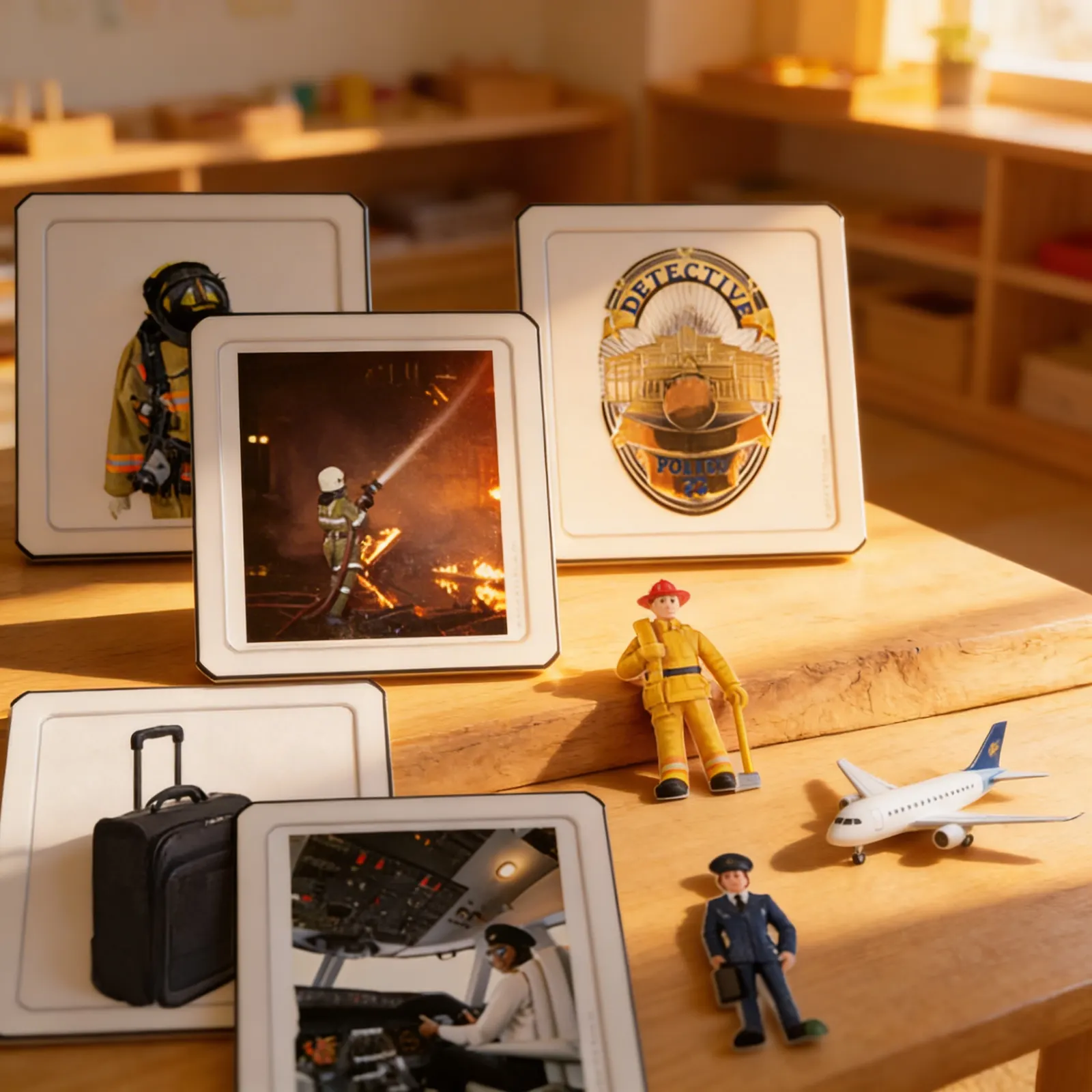
Community Helpers With Figures in a child's hands
Geography comes alive through touch, this Community Helpers matching set combines realistic photo cards with detailed figurines to support vocabulary development and social understanding in the Cultural Studies area. Children match each helper figurine to corresponding occupation cards showing tools, workplaces, and action scenes, building connections between people and their roles in society while developing classification and visual discrimination skills essential for early reading preparation.
Vocabulary Enrichment
Real photographs and concrete figurines support language development and introduce occupation-specific terminology.
Visual Discrimination
Matching activities refine perception skills needed for reading while building logical thinking patterns.
Social Understanding
Learning about community roles develops appreciation for different professions and interdependence in society.
Classification Skills
Sorting helpers with their tools and workplaces builds cognitive organization essential for mathematical thinking.
How to present it
Arrange figurines in a basket on the left side of a work mat. Stack photo cards face-down on the right. Ensure adequate space between for sorting work.
- 1Invite the child to select one figurine and examine its details, uniform, tools, distinctive features
- 2Turn over photo cards one at a time, discussing what you see in each image
- 3When finding a match, place the card below the corresponding figurine
- 4Continue until all figurines are matched with their related photo cards
- 5Invite the child to create groups, all medical helpers together, all education helpers together
3 tips for parents
- Point out community helpers during daily errands, mail carrier, grocery clerk, librarian
- Read books featuring the same occupations to reinforce vocabulary from the material
- Encourage your child to draw pictures of helpers they've met and share at school

If you are not sure it suits your child, we answer in person.
Norbert Kovalčín, founder of Faborino · write to him
There is no review here yet. We will ask you for one after you buy. Write the first review
What's in the Box
- Photo Cards: Approx. 8 cards showing helpers and equipment
- Community Helper Figurines: 3 detailed plastic figures
- Storage Box: Compact container for organized storage
Size and material
| Packaging | 28 × 22 × 3 cm |
| Material | Durable plastic |
| Finish | Pre-cut with rounded corners |
| Recommended Age | 3-6 years |
Care
| Cleaning | Wipe cards and figurines with damp cloth |
| Storage | Keep in original box to prevent loss |
Frequently Asked Questions
What community helpers are included in this set?
While specific helpers vary by set, typical figures include doctor, teacher, firefighter, police officer, mail carrier, chef, farmer, and construction worker. Each figurine is paired with multiple photo cards showing their tools, workplace, and daily activities to provide comprehensive understanding of each role.
How do children use the matching cards with figurines?
Children examine the realistic figurines, then match them to corresponding photo cards showing that helper's tools, workplace, or actions. For example, they might match the firefighter figurine to cards showing a fire truck, fire station, or someone using a fire hose, building multiple connections for each occupation.
What skills does this material develop beyond vocabulary?
This material develops visual discrimination through careful observation of details, classification skills by grouping related items, social awareness by understanding community roles, and pre-reading skills through left-to-right card arrangement. It also supports language development through discussion and storytelling about each helper's importance.
How can I extend learning with this material?
Extend activities by creating three-part cards with labels, sorting helpers by where they work (indoor/outdoor), discussing which helpers children have met, role-playing different occupations, or creating thank you cards for community helpers. Children can also sort by tools used or services provided.
Is this appropriate for children who can't yet read?
Yes, this material is specifically designed for pre-readers aged 3-6. The realistic photos and detailed figurines allow children to make connections through visual recognition alone. The concrete figurines provide tactile exploration while photo cards offer clear visual representations without requiring reading skills.
Product safety
Manufacturer: Nienhuis Montessori, Anders Celsiusstraat 15, 7442 PB Nijverdal, Netherlands
Community Helpers With Figures