
Contents Of The Botany Cabinet
The first photo is the maker's own. The other shots are illustrative.
Inv. no. NIE-00410001
- Maker
- Nienhuis Montessori, since 1929
- Approval
- AMI
- Base Material
- Heavy-duty cardstock
- Finish
- Laminated surface
- EAN
- 8719924002350
Final price incl. VAT. Delivery €5.90, €33.10 to go for free delivery.
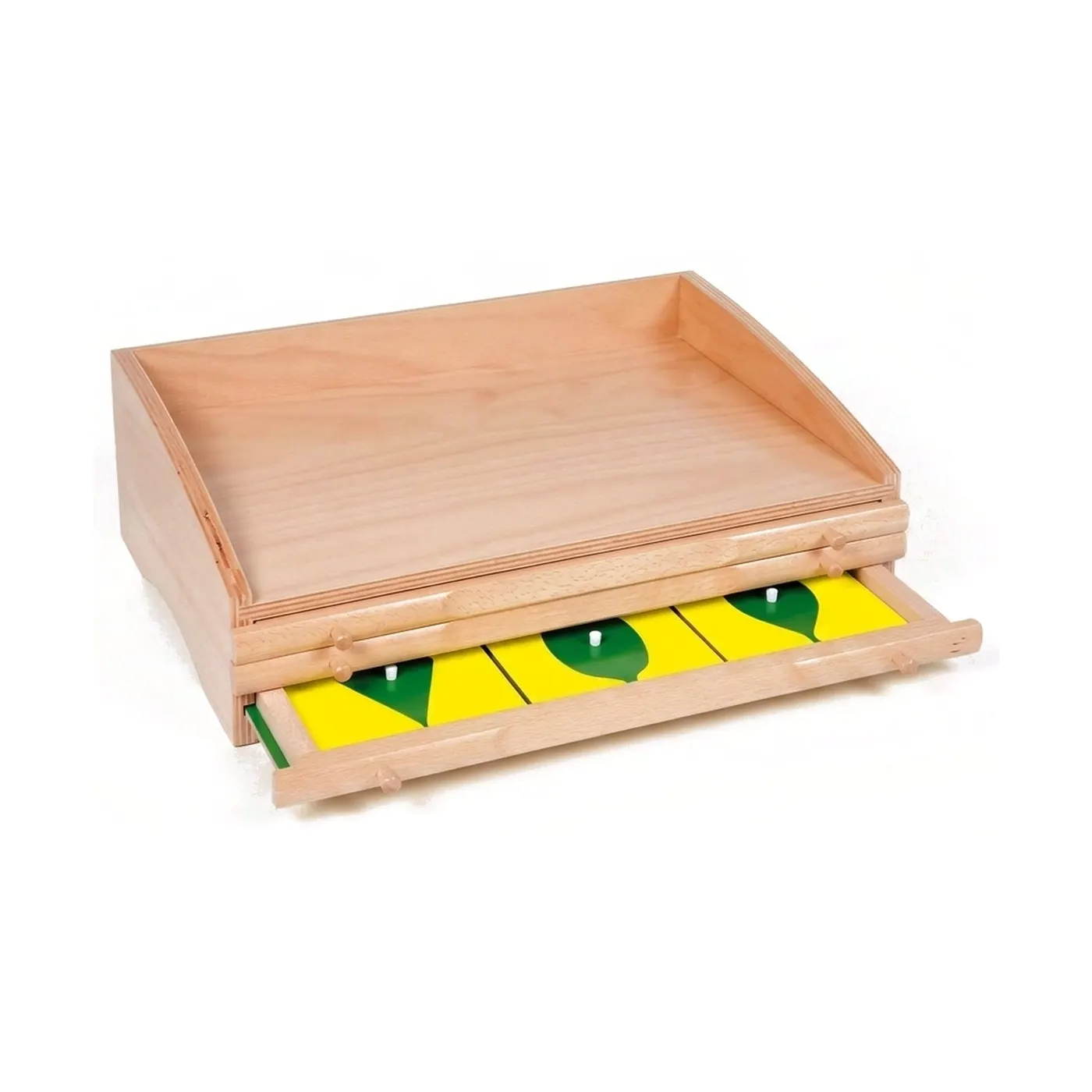 Botany Cabinet €403.90
Advice, warranty and returns are handled by us.
Why it costs €115.90
Behind the price of the original are things you can check yourself.
AMI approval
The material is approved by the Association Montessori Internationale (AMI). Nienhuis has made Montessori materials since 1929.
A verifiable original
The EAN 8719924002350 is on the box. It is the maker's number, not ours.
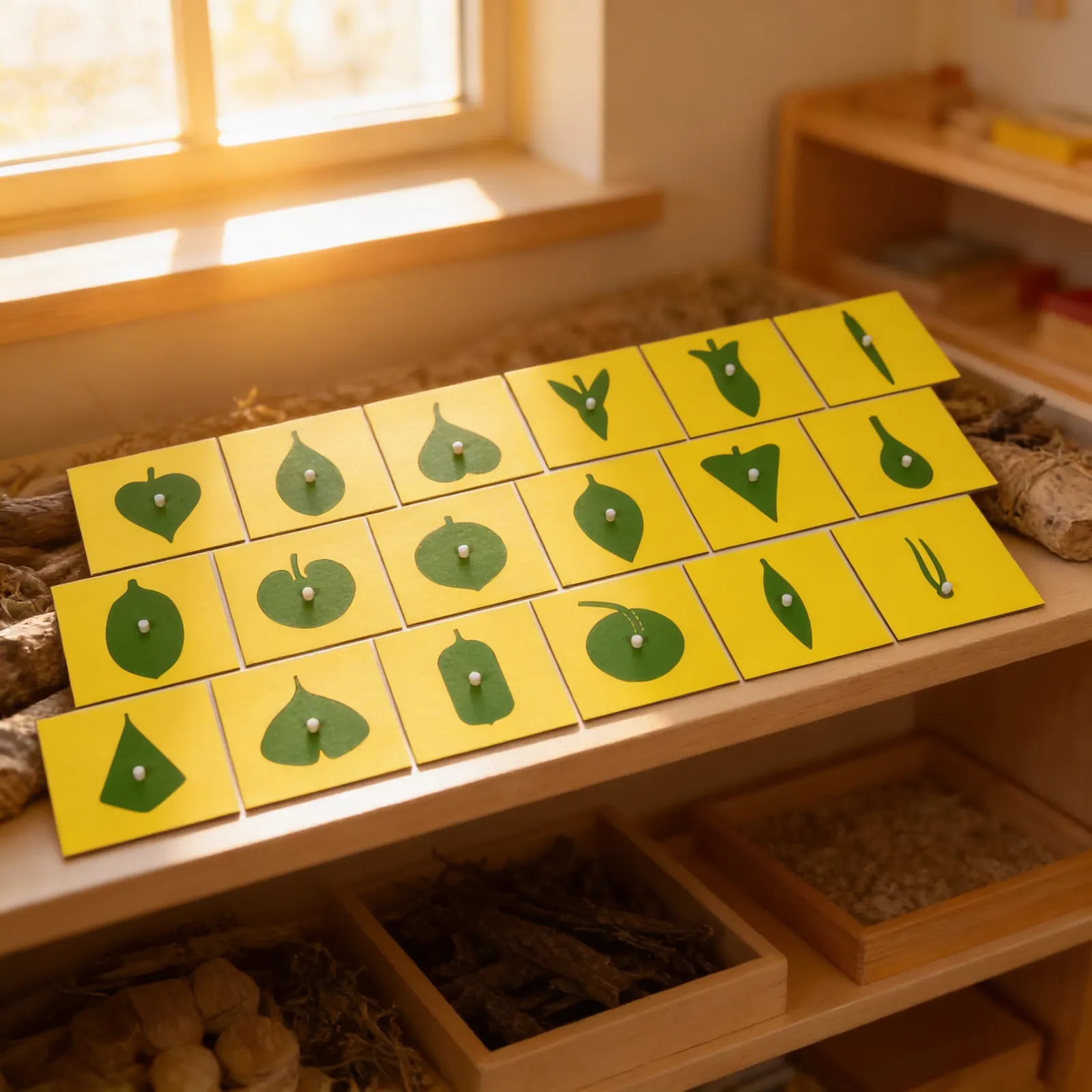
Contents Of The Botany Cabinet in a child's hands
The insets and frames that fill the botany cabinet, sold as the contents rather than the furniture. This is the set to order when a cabinet is already in the room and the leaf shapes need replacing, or when a school is assembling a cabinet from parts across two budgets. The shapes are the material and the cabinet is the storage, and knowing which of the two you are buying is worth checking before ordering either. Cardstock with laminate, for ages 3 to 6.
Visual Discrimination
Refines ability to distinguish subtle differences in leaf shapes and contours through systematic comparison.
Botanical Knowledge
Introduces accurate botanical terminology and classification of leaf forms found in nature.
Fine Motor Control
Tracing activities with guide dots strengthen pencil grip and hand control for writing preparation.
Scientific Classification
Develops early understanding of how scientists organize and categorize natural specimens.
How to present it
Arrange cards in a basket on the shelf near the Botany Cabinet. Place a small tray with collected real leaves nearby. Ensure good lighting for detailed observation.
- 1Invite the child to bring 3-4 contrasting leaf cards to a mat
- 2Demonstrate tracing the white dots slowly with your index finger
- 3Give a three-period lesson for the leaf names
- 4Invite matching cards to Botany Cabinet insets or real leaves
- 5Show how to sort cards by characteristics
3 tips for parents
- Collect leaves during walks to match with your child's card knowledge
- Create a home leaf collection using clear contact paper
- Use precise vocabulary when discussing plants in daily life

If you are not sure it suits your child, we answer in person.
Norbert Kovalčín, founder of Faborino · write to him
There is no review here yet. We will ask you for one after you buy. Write the first review
What's in the Box
- Leaf Shape Cards: Approx. 18 laminated cards
- Card Varieties: Multiple botanical leaf forms
Size and material
| Packaging | 42 × 29 × 5 cm |
| Base Material | Heavy-duty cardstock |
| Finish | Laminated surface |
| Recommended Age | 3-6 years |
Care
Wipe with slightly damp cloth, dry immediately
Frequently Asked Questions
What exactly is included in the Contents of the Botany Cabinet set?
This set includes laminated cards featuring precise green leaf silhouettes on yellow backgrounds. Each card corresponds to the leaf shapes found in the Botany Cabinet and includes strategic white dots that guide children in tracing activities. The cards are designed to complement and extend work with the physical Botany Cabinet.
How do these cards support children's learning without the actual Botany Cabinet?
While these cards are designed to complement the Botany Cabinet, they can be used independently for visual discrimination exercises, matching activities, and vocabulary development. Children can sort, classify, and trace the leaf shapes, though the full sensorial experience requires the three-dimensional cabinet pieces.
What makes the white dots important for tracing activities?
The strategic white dots serve as starting points and guides for proper tracing technique. They help children develop correct directional movements and proper pencil grip while reinforcing the shape of each leaf. This prepares the hand for writing while simultaneously teaching botanical forms.
How durable are these laminated cards for classroom use?
The cards are professionally laminated for durability in busy classroom environments. They can withstand regular handling by young children, are easy to clean, and resist bending or tearing. The lamination also allows for use with dry-erase markers for additional tracing practice.
What botanical vocabulary do children learn with these cards?
Children learn precise botanical terminology including leaf shapes such as ovate, lanceolate, elliptical, orbicular, spatulate, and many more. The cards support the three-period lesson format, helping children recognize, associate, and name various leaf forms found in nature.
Product safety
Manufacturer: Nienhuis Montessori, Anders Celsiusstraat 15, 7442 PB Nijverdal, Netherlands
Contents Of The Botany Cabinet