
Counters Red (100)
The first photo is the maker's own. The other shots are illustrative.
Inv. no. NIE-003401
- Maker
- Nienhuis Montessori, since 1929
- Approval
- AMI
- Primary Material
- Durable plastic
- Finish
- Smooth, rounded edges
- EAN
- 8719924001858
Final price incl. VAT. Delivery €5.90, €139.00 to go for free delivery.
Advice, warranty and returns are handled by us.
Why it costs €10.00
Behind the price of the original are things you can check yourself.
AMI approval
The material is approved by the Association Montessori Internationale (AMI). Nienhuis has made Montessori materials since 1929.
A verifiable original
The EAN 8719924001858 is on the box. It is the maker's number, not ours.
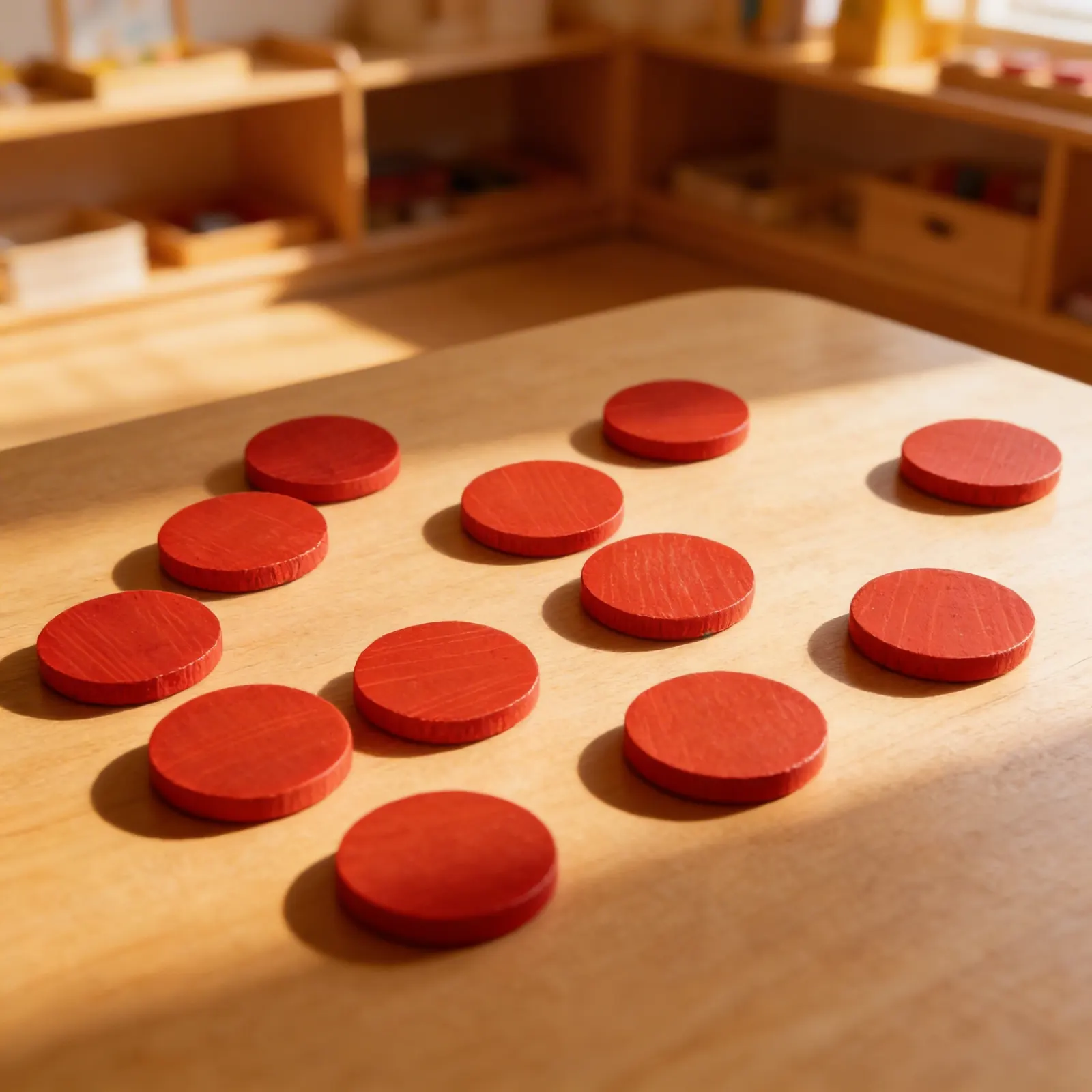
Counters Red (100) in a child's hands
One hundred red counters, the loose quantity behind the cards and counters work. The counters are laid in pairs under each numeral, and it is the pairing that does the teaching: numbers that come out even leave two neat columns, odd ones leave a single counter with nothing beside it, and the child sees odd and even as a shape before either word is used. A hundred is enough for the full row of numerals with spares. The cards are a separate item.
Mathematical Concepts
Builds understanding of quantity, one-to-one correspondence, and number relationships through concrete manipulation.
Fine Motor Skills
Develops pincer grasp and hand-eye coordination through precise placement and arrangement of counters.
Pattern Recognition
Supports visual discrimination and pattern creation through organized arrangements and groupings.
Concentration
Encourages focused attention through repetitive counting and systematic organization of materials.
How to present it
Place a work mat on the table. Present the container of red counters to the child. Prepare number cards 1-10 if introducing counting correspondence.
- 1Invite the child to count out 10 red counters, placing each one deliberately on the mat
- 2Arrange the counters in a horizontal line, then demonstrate regrouping into pairs
- 3Introduce skip counting by grouping counters into sets of 2, then counting the groups
- 4Present simple addition by combining two small groups of counters and counting the total
- 5Explore patterns by creating triangles, squares, or other shapes with specific quantities
3 tips for parents
- Practice counting everyday objects at home - buttons, coins, or snacks - to reinforce skills learned with counters
- Play simple games like 'give me 5 red counters' during meal preparation to make math part of daily life
- Allow your child to use counters to solve real problems like dividing snacks equally among family members

If you are not sure it suits your child, we answer in person.
Norbert Kovalčín, founder of Faborino · write to him
There is no review here yet. We will ask you for one after you buy. Write the first review
What's in the Box
- Red Counting Discs: 100 pieces
Size and material
| Packaging | 11 × 7 × 1 cm |
| Primary Material | Durable plastic |
| Finish | Smooth, rounded edges |
| Recommended Age | 3-6 years |
Care
Wipe clean with damp cloth and mild soap
Frequently Asked Questions
What size are these red counters and what are they made of?
These counters are made of durable plastic with a smooth finish. Each counter is uniformly sized at approximately 1 inch (2.5cm) in diameter, making them easy for small hands to manipulate while being large enough to prevent choking hazards.
What Montessori activities can I do with these 100 red counters?
These counters are perfect for cards and counters exercises, skip counting, odd and even number work, simple addition and subtraction, creating arrays for multiplication concepts, and one-to-one correspondence activities. They're essential for concrete mathematical learning in the 3-6 age range.
How do these red counters differ from other Montessori counting materials?
Unlike beads or cubes, these flat counters are specifically designed for precise placement and alignment work. Their uniform red color helps children focus on quantity rather than sorting by attributes, making them ideal for pure counting exercises and number formation activities.
Can these counters be used with other Montessori math materials?
Yes, these counters complement many Montessori materials including number rods, sandpaper numbers, spindle boxes, and hundred boards. They're particularly effective when used with number cards for the classic cards and counters exercise.
How should these counters be stored and maintained?
Store the counters in a small basket or divided container on your math shelf at child height. Clean them with mild soap and water as needed. Having exactly 100 pieces helps children work with base-ten concepts and check their work by counting the full set.
Product safety
Manufacturer: Nienhuis Montessori, Anders Celsiusstraat 15, 7442 PB Nijverdal, Netherlands
Counters Red (100)