
Cubing Material
The first photos are the maker's own. The other shots are illustrative.
Inv. no. NIE-018900
- Maker
- Nienhuis Montessori, since 1929
- Approval
- AMI
- Primary Material
- Solid wood
- Finish
- Painted surfaces
- EAN
- 8719924010102
Final price incl. VAT. Free delivery.
Advice, warranty and returns are handled by us.
Why it costs €1,381.90
Behind the price of the original are things you can check yourself.
AMI approval
The material is approved by the Association Montessori Internationale (AMI). Nienhuis has made Montessori materials since 1929.
A verifiable original
The EAN 8719924010102 is on the box. It is the maker's number, not ours.
Cubing Material in a child's hands
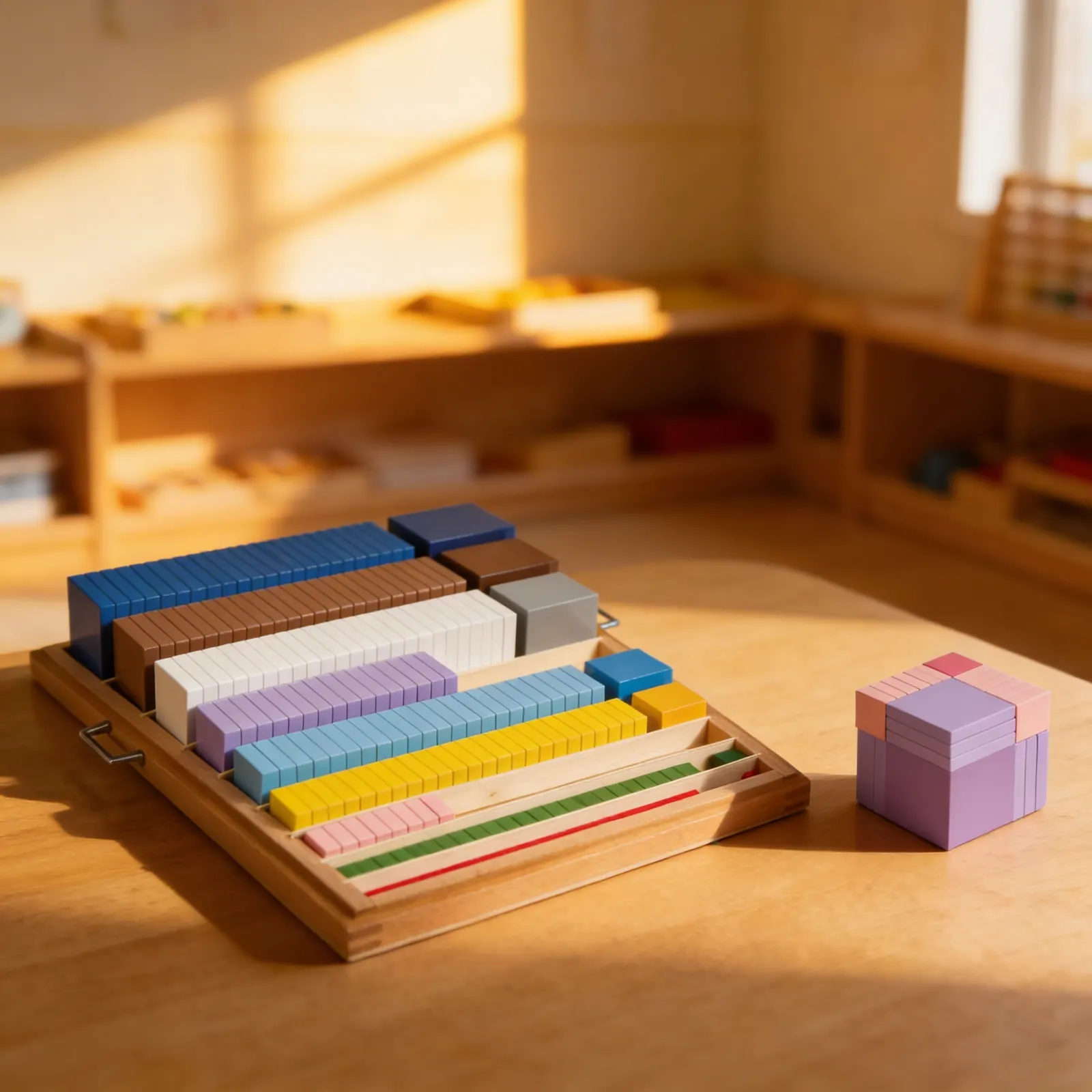
The Cubing Material is an advanced mathematical manipulative that makes tangible the concepts behind algebraic concepts through concrete, color-coded wooden components. This comprehensive set features precisely crafted rods and cubes organized in a tiered wooden tray, and children can then physically explore the relationships between numbers, squares, and cubes while building a sensorial first step toward abstract mathematical thinking.
Abstract Mathematical Thinking
Bridges concrete manipulation to abstract algebraic concepts through visual and tactile exploration of numerical relationships.
Pattern Recognition
Color-coding and systematic organization develop the ability to recognize mathematical patterns and sequences.
Spatial Reasoning
Three-dimensional manipulation of cubing materials enhances understanding of volume and spatial relationships.
Mathematical Precision
Precisely measured components cultivate accuracy and attention to detail in mathematical work.
How to present it
Place the Cubing Material tray on a large work mat. Ensure all color-coded rods and cubes are organized in their designated compartments. Have paper and colored pencils available for recording discoveries.
- 1Begin with the smallest unit cube, exploring how it represents 1³
- 2Introduce the concept of (a+b)² using two different colored rods and their corresponding squares
- 3Progress to (a+b)³ by constructing the cube layer by layer
- 4Create the trinomial cube (a+b+c)³ using three colors
- 5Record the algebraic expressions that correspond to each physical construction
3 tips for parents
- Avoid rushing to algebraic notation - the concrete exploration phase is crucial for deep understanding
- When your child shares discoveries, ask them to show you with the materials rather than explain verbally
- Support pattern recognition by asking 'What do you notice?' rather than pointing out relationships

If you are not sure it suits your child, we answer in person.
Norbert Kovalčín, founder of Faborino · write to him
There is no review here yet. We will ask you for one after you buy. Write the first review
What's in the Box
- Wooden storage tray: Multi-tiered design
- Color-coded rods: Varying lengths representing values 1-10
- Mathematical blocks: Approx. 10 components total
Size and material
| Packaging | 57 × 47 × 12 cm |
| Primary Material | Solid wood |
| Finish | Painted surfaces |
| Recommended Age | 6-12 years |
Care
Wipe with damp cloth, avoid soaking
Frequently Asked Questions
What mathematical concepts does the Cubing Material teach?
The Cubing Material introduces children to algebraic concepts including squaring, cubing, binomial and trinomial theorems. It provides a concrete foundation for understanding powers of numbers, algebraic formulas like (a+b)², (a+b)³, and the relationship between linear, square, and cubic measurements through hands-on manipulation.
What components are included in the Cubing Material set?
The set includes color-coded wooden rods representing units and tens, along with corresponding squares and cubes. All components are precisely crafted and organized in a multi-tiered wooden tray system. The materials allow children to build and explore mathematical relationships from simple squares to complex algebraic expressions.
At what age should children begin using the Cubing Material?
While suitable for ages 6-12, children typically begin using the Cubing Material around age 7-8, after mastering the bead chains and squares. The material grows with the child, starting with simple squaring exercises and progressing to complex algebraic work through upper elementary years.
How does this material prepare children for advanced mathematics?
The Cubing Material provides sensorial experience with abstract algebraic concepts before children encounter them symbolically. By physically building squares and cubes, children develop deep understanding of exponential relationships, making the transition to written algebra natural and meaningful rather than memorized.
Why is the Cubing Material so expensive compared to other math materials?
The high cost reflects the precision manufacturing required for each component to maintain exact mathematical relationships, the use of high-quality hardwood, and the complexity of the multi-tiered storage system. This is a comprehensive material that supports years of mathematical exploration from elementary through early adolescence.
Product safety
Manufacturer: Nienhuis Montessori, Anders Celsiusstraat 15, 7442 PB Nijverdal, Netherlands
Cubing Material