
Cut-Out Numerals And CountersInternational Version
The first photo is the maker's own. The other shots are illustrative.
Inv. no. NIE-003620
- Maker
- Nienhuis Montessori, since 1929
- Approval
- AMI
- Primary Material
- Solid wood construction
- Finish
- Painted surfaces
- EAN
- 8719924001926
Final price incl. VAT. Delivery €5.90, €108.10 to go for free delivery.
Advice, warranty and returns are handled by us.
Why it costs €40.90
Behind the price of the original are things you can check yourself.
AMI approval
The material is approved by the Association Montessori Internationale (AMI). Nienhuis has made Montessori materials since 1929.
A verifiable original
The EAN 8719924001926 is on the box. It is the maker's number, not ours.
Cut-Out Numerals And Counters in a child's hands
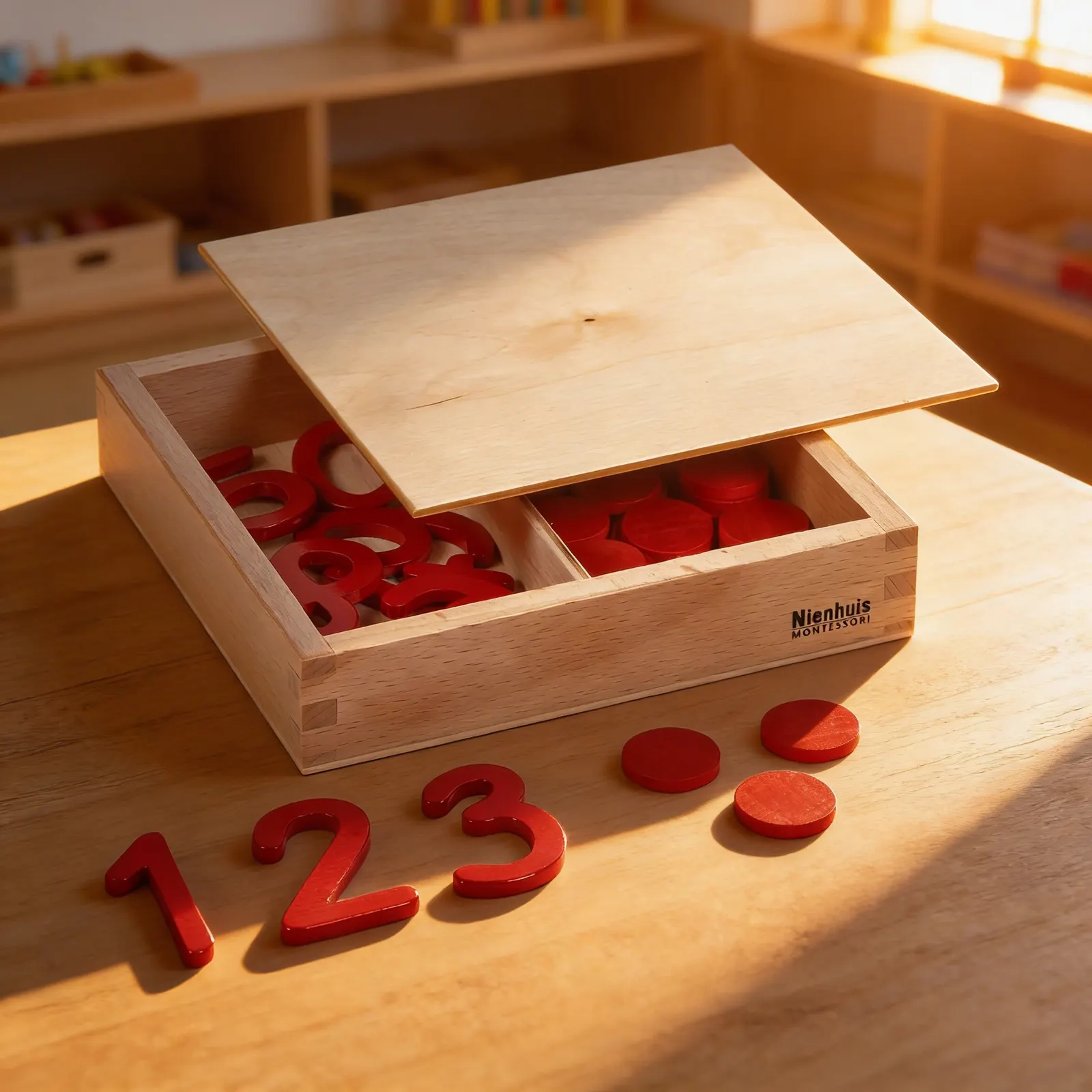
Cut out numerals one to ten with counters, the final stage of the first number work. A child places the numerals in sequence and then sets the matching quantity of counters beneath each, in pairs. Doing it that way is what makes odd and even fall out on their own: every second numeral ends with a single counter left standing alone at the bottom, and no one has to say the word before the child has seen the pattern. Wood and painted wood, for ages 3 to 6.
Number Symbol Recognition
Children learn to identify and name numerals 0-9 through visual and tactile exploration of the cut-out forms.
One-to-One Correspondence
Placing counters beneath numerals develops understanding that each number symbol represents a specific quantity.
Mathematical Order
Sequential arrangement of numerals introduces the concept of numerical progression and the decimal system foundation.
Fine Motor Refinement
Precise placement of small counters strengthens pincer grip and hand-eye coordination needed for writing.
How to present it
Place the wooden box on a mat. Remove numerals and arrange them in mixed order at the top. Place the container of red discs to the right.
- 1Arrange numerals 0-9 in sequence from left to right
- 2Starting with 1, place corresponding red discs below each numeral
- 3Count each group aloud while pointing to discs, then the numeral
- 4For zero, demonstrate the empty space below, explaining 'zero means nothing'
- 5Invite child to identify which numbers have an 'extra' disc (odd numbers)
3 tips for parents
- Practice counting objects at home in pairs to reinforce the odd/even visual pattern
- When child shows interest, count items during daily activities using the same deliberate pace
- Avoid rushing to larger numbers - mastery of 0-9 is more valuable than counting to 100

If you are not sure it suits your child, we answer in person.
Norbert Kovalčín, founder of Faborino · write to him
There is no review here yet. We will ask you for one after you buy. Write the first review
What's in the Box
- Wooden storage box: with sliding lid and compartments
- Cut-out numerals 0-9: smooth sanded edges
- 55 red counting discs: uniform size and weight
Size and material
| Packaging | 17 × 12 × 7 cm |
| Primary Material | Solid wood construction |
| Finish | Painted surfaces |
| Counter Material | Painted wood discs |
| Recommended Age | 3-6 years |
Care
Wipe with slightly damp cloth, dry immediately
Frequently Asked Questions
What is the difference between the International Version and other versions?
The International Version features numerals in a standard font style that is universally recognized across different educational systems. The numbers are precisely cut from smooth wood without serifs or decorative elements, making them ideal for international classrooms and homes where clear, simple number recognition is prioritized.
How do children use the Cut-Out Numerals and Counters?
Children first learn to identify each wooden numeral by tracing its shape with their fingers. They then place the corresponding number of red counters beneath each numeral, arranging them in pairs to visually understand odd and even numbers. This hands-on activity builds number recognition, one-to-one correspondence, and introduces mathematical concepts through concrete manipulation.
What skills does this material develop?
This material develops number recognition (0-9), counting skills, one-to-one correspondence, understanding of quantity, introduction to odd and even numbers, fine motor skills through handling small counters, visual discrimination, and sequential ordering. It provides a concrete foundation for abstract mathematical thinking.
What is included in the complete set?
The set includes 10 precisely cut wooden numerals (0-9), 55 smooth red counting discs (enough to represent quantities 1-10), and a handcrafted wooden storage box with a sliding lid. All components are made from high-quality, child-safe materials designed for repeated classroom or home use.
At what age should children begin using this material?
Children typically begin using Cut-Out Numerals and Counters around age 3.5-4 years, after they have worked with number rods and sandpaper numerals. The material remains useful through age 6 as children develop more complex understanding of number relationships, skip counting, and basic addition concepts.
Product safety
Manufacturer: Nienhuis Montessori, Anders Celsiusstraat 15, 7442 PB Nijverdal, Netherlands
Cut-Out Numerals And Counters